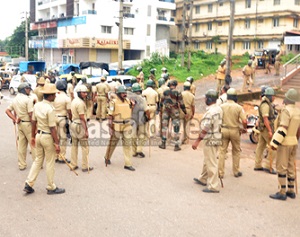
Prohibitory orders in 4 taluks of Dakshina Kannada extended till July 21

July 11, 2017

Bantwal, Jul 11: Even though the trouble hit areas of Dakshina Kannada are slowly returning to normalcy, the district administration has decided to extend the prohibitory orders for 10 more days in four taluks.bc road 1

As per the previous order of the district administration, the Section 144 of the Criminal Procedure Code will be ended at midnight on July 11 in Bantwal, Sullia, Puttur and Belthangady taluks that fall under the limits of Dakshina Kannada district police.

However, as part of precautionary measures, on Tuesday, the deputy commissioner issued a fresh order extending the ban orders till July 21.

The orders were initially enforced in Bantwal taluk on May 27 following skirmishes between two groups. Later it was extended to the four taluks as violence spread.

The murder of a Social Democratic Party of India worker at Benjanapadavu in Bantwal on June 21 escalated the tension forcing authorities to extend prohibitory orders.

The attack on RSS activist Sharath in BC Road on July 4 by unidentified miscreants and his death in a hospital on July 7 led to further exacerbation of the communal tension.

With the fresh extension, Bantwal taluk will complete 56 continuous days of being covered under the ban order. The Mangaluru city police commissionerate area has been exempted from the order, police said.

Comments

Cow and the politics
 - 
Friday, 14 Jul 2017

India is a sarzameen given by God to live temporarily. These nonsense gandu rashtra people just live a illogical life.

Cow and the politics
 - 
Friday, 14 Jul 2017

All the best, tell your people how great is Islam. It is not the same these gandu rashtra people teach you to get some votes

Add new comment

  • Coastaldigest.com reserves the right to delete or block any comments.
  • Coastaldigset.com is not responsible for its readers’ comments.
  • Comments that are abusive, incendiary or irrelevant are strictly prohibited.
  • Please use a genuine email ID and provide your name to avoid reject.
News Network
February 19,2020

Mangaluru, Feb 19: The Plenary Assembly of the Conference of Catholic Bishops of India (CCBI) of the Latin Church elected Bishop Peter Paul Saldanha, Bishop of Mangalore, Karnataka, as the new Chairman of the CCBI Commission for Liturgy.

The Conference also elected 26 Bishops of the CCBI to participate in the three-week Golden Jubilee Conference of the Federation of Asian Bishops’ Conferences (FABC) to be held in November 2020 at Bangkok in Thailand. The one day meeting of the CCBI discussed various matters affecting the Latin Catholic Church in India, which consists of 132 dioceses and 190 Bishops.

The CCBI animates the Church in India through its 16 Commissions and 4 Departments. Its main Secretariat is in Bangalore with extensions in Goa, Delhi and Pachmarhi (MP).

The Conference of Catholic Bishops of India (CCBI) which is the Canonical National Episcopal Conference is the largest in Asia and the fourth largest in the world.

Comments

Add new comment

  • Coastaldigest.com reserves the right to delete or block any comments.
  • Coastaldigset.com is not responsible for its readers’ comments.
  • Comments that are abusive, incendiary or irrelevant are strictly prohibited.
  • Please use a genuine email ID and provide your name to avoid reject.
Ram Puniyani
February 4,2020

As democracy is seeping in slowly all over the world, there is an organization which is monitoring the degree of democracy in the individual countries, The Economist Intelligence Unit. As such in each country there are diverse factors which on one hand work to deepen it, while others weaken it. Overall there is a march from theoretical democracy to substantive one. The substantive democracy will herald not just the formal equality, freedom and community feeling in the country but will be founded on the substantive quality of these values. In India while the introduction of modern education, transport, communication laid the backdrop of beginning of the process, the direction towards deepening of the process begins with Mahatma Gandhi when he led the non-cooperation movement in 1920, in which average people participated. The movement of freedom for India went on to become the ‘greatest ever mass movement’ in the World.

The approval and standards for democracy were enshrined in Indian Constitution, which begins ‘We the people of India’, and was adopted on 26th January 1950. With this Constitution and the policies adopted by Nehru the process of democratization started seeping further, the dreaded Emergency in 1975, which was lifted later restored democratic freedoms in some degree. This process of democratisation is facing an opposition since the decade of 1990s after the launch of Ram Temple agitation, and has seen the further erosion with BJP led Government coming to power in 2014. The state has been proactively attacking civil liberties, pluralism and participative political culture with democracy becoming flawed in a serious way. And this is what got reflected in the slipping of India by ten places, to 51st, in 2019. On the index of democracy India slipped down from the score of 7.23 to 6.90. The impact of sectarian BJP politics is writ on the state of the nation, country.

Ironically this lowering of score has come at a time when the popular protests, the deepening of democracy has been given a boost and is picking up with the Shaheen Bagh protests. The protest which began in Shaheen Bagh, Delhi in the backdrop of this Government getting the Citizenship amendment Bill getting converted into an act and mercilessly attacking the students of Jamia Milia Islamia, Aligarh Muslim University along with high handed approach in Jamia Nagar and neighbouring areas.  From 15th December 2019, the laudable protest is on.

It is interesting to note that the lead in this protest has been taken by the Muslim women, from the Burqa-Hijab clad to ‘not looking Muslim’ women and was joined by students and youth from all the communities, and later by the people from all the communities. Interestingly this time around this Muslim women initiated protest has contrast from all the protests which earlier had begun by Muslims. The protests opposing Shah Bano Judgment, the protests opposing entry of women in Haji Ali, the protests opposing the Government move to abolish triple Talaq. So far the maulanas from top were initiating the protests, with beard and skull cap dominating the marches and protests. The protests were by and large for protecting Sharia, Islam and were restricted to Muslim community participating.

This time around while Narendra Modi pronounced that ‘protesters can be identified by their clothes’, those who can be identified by their external appearance are greatly outnumbered by all those identified or not identified by their appearance.

The protests are not to save Islam or any other religion but to protect Indian Constitution. The slogans are structured around ‘Defence of democracy and Indian Constitution’. The theme slogans are not Allahu Akbar’ or Nara-E-Tadbeer’ but around preamble of Indian Constitution. The lead songs have come to be Faiz Ahmad Faiz’s ‘Hum Dekhenge’, a protest against Zia Ul Haq’s attempts to crush democracy in the name of religion. Another leading protest song is from Varun Grover, ‘Tanashah Aayenge…Hum Kagaz nahin Dikhayenge’, a call to civil disobedience against the CAA-NRC exercise and characterising the dictatorial nature of the current ruling regime.

While BJP was telling us that primary problem of Muslim women is Triple talaq, the Muslim women led movements has articulated that primary problem is the very threat to Muslim community. All other communities, cutting across religious lines, those below poverty line, those landless and shelter less people also see that if the citizenship of Muslims can be threatened because of lack of some papers, they will be not far behind in the victimization process being unleashed by this Government.

While CAA-NRC has acted as the precipitating factor, the policies of Modi regime, starting from failure to fulfil the tall promises of bringing back black money, the cruel impact of demonetisation, the rising process of commodities, the rising unemployment, the divisive policies of the ruling dispensation are the base on which these protest movements are standing. The spread of the protest movement, spontaneous but having similar message is remarkable. Shaheen Bagh is no more just a physical space; it’s a symbol of resistance against the divisive policies, against the policies which are increasing the sufferings of poor workers, the farmers and the average sections of society.

What is clear is that as identity issues, emotive issues like Ram Temple, Cow Beef, Love Jihad and Ghar Wapasi aimed to divide the society, Shaheen Bagh is uniting the society like never before. The democratisation process which faced erosion is getting a boost through people coming together around the Preamble of Indian Constitution, singing of Jan Gan Man, waving of tricolour and upholding the national icons like Gandhi, Bhagat Singh, Ambedkar and Maulana Azad. One can feel the sentiments which built India; one can see the courage of people to protect what India’s freedom movement and Indian Constitution gave them.

Surely the communal forces are spreading canards and falsehood against the protests. As such these protests which is a solid foundation of our democracy. The spontaneity of the movement is a strength which needs to be channelized to uphold Indian Constitution and democratic ethos of our beloved country.


Comments

Add new comment

  • Coastaldigest.com reserves the right to delete or block any comments.
  • Coastaldigset.com is not responsible for its readers’ comments.
  • Comments that are abusive, incendiary or irrelevant are strictly prohibited.
  • Please use a genuine email ID and provide your name to avoid reject.
News Network
April 21,2020

Global oil markets remained under intense pressure on Tuesday, with Brent crude dropping below $20 per barrel for the first time in 18 years while other major benchmarks across the world tumbled. 

Brent, the international crude marker, slipped to $18.10, indicating that markets see no immediate let-up to the collapse in oil demand that sent some US oil benchmarks plunging under $0 for the first time on Monday, leaving producers paying for buyers to take their oil away while available storage is scarce.

Coronavirus has sent the oil sector into a state of crisis, with lockdowns implemented by authorities to smother the outbreak slashing demand for crude by as much as a third.

Contracts for the US benchmark West Texas Intermediate for delivery next month tumbled as low as minus $40 a barrel on Monday. Analysts at Citi warned that “if global storage worsens more quickly, Brent could chase WTI down to the bottom”.

The collapse in the May WTI contract was partly a technical product of the fact that it expires on Tuesday, meaning trading volumes were low and making the contract for June delivery more noteworthy, analysts said. That contract held above $20 a barrel on Monday but slid as much as 42 per cent on Tuesday to trade at lows of $11.79, suggesting the blowout in the May contract was more than a blip and that the entire global oil market faced challenges.

Goldman Sachs analysts said the June contact was likely to face downward pressure in the coming weeks, pointing to the “still unresolved market surplus”.

“As storage becomes saturated, price volatility will remain exceptionally high in coming weeks,” they said. “But with ultimately a finite amount of storage left to fill, production will soon need to fall sizeably to bring the market into balance, finally setting the stage for higher prices once demand gradually recovers.”

Warren Patterson, head of commodities strategy at ING, said it was likely that “storage this time next month will be even more of an issue, given the surplus environment”.

“And so in the absence of a meaningful demand recovery, negative prices could return for June,” he added.

European equities traded lower, partly dragged down by weaker energy stocks. The continent-wide Stoxx 600 was down 1.9 per cent, with its oil and gas sub-index dropping 3.3 per cent. In London the FTSE shed 1.7 per cent, while Frankfurt’s Dax slid 2.3 per cent. 

Equities were also broadly lower in Asia, with futures tipping US stocks to fall 1 per cent when trading in New York begins later.

On Wall Street overnight, the S&P 500 closed down 1.8 per cent, partly because of weakness in energy shares, but also due to increased pessimism over the time it will take for countries to emerge from lockdowns.

In fixed income, the yield on the 10-year US Treasury fell 0.03 percentage points to 0.585 per cent as investors retreated to the safety of the debt.

Comments

Add new comment

  • Coastaldigest.com reserves the right to delete or block any comments.
  • Coastaldigset.com is not responsible for its readers’ comments.
  • Comments that are abusive, incendiary or irrelevant are strictly prohibited.
  • Please use a genuine email ID and provide your name to avoid reject.