


Prohibitory orders in 4 taluks of Dakshina Kannada extended till July 21

July 11, 2017

Bantwal, Jul 11: Even though the trouble hit areas of Dakshina Kannada are slowly returning to normalcy, the district administration has decided to extend the prohibitory orders for 10 more days in four taluks.bc road 1
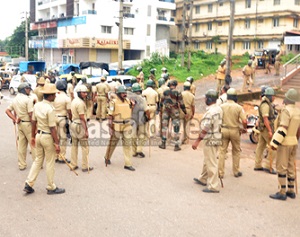
As per the previous order of the district administration, the Section 144 of the Criminal Procedure Code will be ended at midnight on July 11 in Bantwal, Sullia, Puttur and Belthangady taluks that fall under the limits of Dakshina Kannada district police.

However, as part of precautionary measures, on Tuesday, the deputy commissioner issued a fresh order extending the ban orders till July 21.

The orders were initially enforced in Bantwal taluk on May 27 following skirmishes between two groups. Later it was extended to the four taluks as violence spread.

The murder of a Social Democratic Party of India worker at Benjanapadavu in Bantwal on June 21 escalated the tension forcing authorities to extend prohibitory orders.

The attack on RSS activist Sharath in BC Road on July 4 by unidentified miscreants and his death in a hospital on July 7 led to further exacerbation of the communal tension.

With the fresh extension, Bantwal taluk will complete 56 continuous days of being covered under the ban order. The Mangaluru city police commissionerate area has been exempted from the order, police said.

Comments

Cow and the politics
 - 
Friday, 14 Jul 2017

India is a sarzameen given by God to live temporarily. These nonsense gandu rashtra people just live a illogical life.

Cow and the politics
 - 
Friday, 14 Jul 2017

All the best, tell your people how great is Islam. It is not the same these gandu rashtra people teach you to get some votes

Add new comment

  • Coastaldigest.com reserves the right to delete or block any comments.
  • Coastaldigset.com is not responsible for its readers’ comments.
  • Comments that are abusive, incendiary or irrelevant are strictly prohibited.
  • Please use a genuine email ID and provide your name to avoid reject.
News Network
April 3,2020

Mangaluru, Apr 3: The Dakshina Kannada district administration’s decision to ban use of private vehicles, excluding permitted categories, from Friday for effective implementation of lockdown, began showing results since morning itself.

Mangaluru City Traffic Police and Dakshina Kannada district police erected several pickets at vantage places on arterial roads to check those moving without a valid reason. Several two-wheelers were seized during the checking while a few car drivers were let off with a strict warning.

Assistant Commissioner of Police (Traffic), M Manjunatha Shetty, who was supervising a picket at Hampankatta, said that movement of private vehicles has drastically reduced in the city.

Comments

Add new comment

  • Coastaldigest.com reserves the right to delete or block any comments.
  • Coastaldigset.com is not responsible for its readers’ comments.
  • Comments that are abusive, incendiary or irrelevant are strictly prohibited.
  • Please use a genuine email ID and provide your name to avoid reject.
News Network
July 26,2020

Bellary,  Jul 26: A 100-year-old woman resident of Huvina Hadagali town in Bellary district, Karnataka, recovered from COVID-19 after testing positive for the virus earlier this month.

"Doctors treated me well. Along with regular food, I was eating an apple a day. The doctors are giving me tablets and injection, and I am healthy now. COVID-19 is like a common cold," said Hallamma while speaking to news agency.

The woman's son, daughter-in-law, and grandson had also tested positive for the virus, and the family was treated at their home.

According to health department officials, her son works at a bank and had tested positive on July 3, after which Hallamma tested positive on July 16; the 100-year-old reported negative for the virus on July 22.

Meanwhile, the covid-19 death toll in the country rose to 32,063 with 705 fatalities being recorded in a day on Sunday. The number of tests for detection of covid-19 has crossed the 16-million mark in the country.

Comments

Add new comment

  • Coastaldigest.com reserves the right to delete or block any comments.
  • Coastaldigset.com is not responsible for its readers’ comments.
  • Comments that are abusive, incendiary or irrelevant are strictly prohibited.
  • Please use a genuine email ID and provide your name to avoid reject.
News Network
April 2,2020

The current physical distancing guidelines provided by the World Health Organisation (WHO) and by the US Centers for Disease Control and Prevention (CDC) may not be adequate to curb the coronavirus spread, according to a research which says the gas cloud from a cough or sneeze may help virus particles travel up to 8 metres. The research, published in the Journal of the American Medical Association, noted that the the current guidelines issued by the WHO and CDC are based on outdated models from the 1930s of how gas clouds from a cough, sneeze, or exhalation spread.

Study author, MIT associate professor Lydia Bourouiba, warned that droplets of all sizes can travel 23 to 27 feet, or 7-8 metres, carrying the pathogen.

According to Bourouiba, the current guidelines are based on "arbitrary" assumptions of droplet size, "overly simplified", and "may limit the effectiveness of the proposed interventions" against the deadly pandemic.

 She explained that the old guidelines assume droplets to be one of two categories, small or large, taking short-range semi-ballistic trajectories when a person exhales, coughs, or sneezes.

However based on more recent discoveries, the MIT scientist said, sneezes and coughs are made of a puff cloud that carries ambient air, transporting within it clusters of droplets of a wide range of sizes.

Bourouiba warned that this puff cloud, with ambient air entrapped in it, can offer the droplets moisture and warmth that can prevent it from evaporation in the outer environment.

"The locally moist and warm atmosphere within the turbulent gas cloud allows the contained droplets to evade evaporation for much longer than occurs with isolated droplets," she said.

"Under these conditions, the lifetime of a droplet could be considerably extended by a factor of up to 1000, from a fraction of a second to minutes," the researcher explained in the study.

The MIT scientist, who has researched the dynamics of coughs and sneezes for years, added that these droplets settle along the trajectory of a cough or sneeze contaminating surfaces, with their residues staying suspended in the air for hours.

"Even when maximum containment policies were enforced, the rapid international spread of COVID-19 suggests that using arbitrary droplet size cutoffs may not accurately reflect what actually occurs with respiratory emissions, possibly contributing to the ineffectiveness of some procedures used to limit the spread of respiratory disease," Bourouiba wrote in the study

Comments

Add new comment

  • Coastaldigest.com reserves the right to delete or block any comments.
  • Coastaldigset.com is not responsible for its readers’ comments.
  • Comments that are abusive, incendiary or irrelevant are strictly prohibited.
  • Please use a genuine email ID and provide your name to avoid reject.