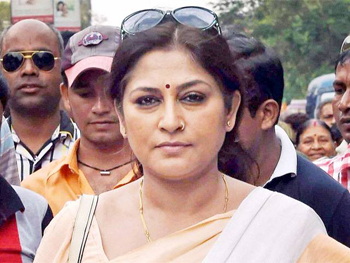
FIRs lodged against BJP leaders for making controversial remarks on women safety

Agencies
July 16, 2017

Kolkata, Jul 16: Police cases were lodged on Saturday against BJP Rajya Sabha member Roopa Ganguly and party's West Bengal unit chief Dilip Ghosh for making controversial remarks about women safety in the state and targeting Chief Minister Mamata Banerjee respectively.Roopa Ganguly

On Friday, actor-turned-politician Ganguly had said if people from outside send their wives and daughters to the state, they won't "survive" even 15 days without getting raped.

"I will tell people of India and politicians, everyone who supports Trinamool Congress including some Congress leaders... send their wives and daughters to Bengal without taking hospitality of Mamata Banerjee, if they are able to survive there for 15 days without getting raped, then tell me," she had said at a programme.

Reacting angrily, state Power Minister and senior Trinamool Congress leader Sovandeb Chatterjee said: "She calls herself a cultural personality, and makes such comments. Whatever she has said has damaged Bengal's image."

On Saturday, a police complaint was filed at Nimta police station in North 24 Parganas district against Ganguly for public mischief and criminal intimidation.

But she remained unperturbed.

"There is no question of withdrawing my comments. In fact, I displayed lenience when I talked of '15 days'," she said.

Meanwhile, addressing a public meeting in his constituency Kharagpur, Ghosh virtually challenged the Chief Minister to take action against him.

"If you have the guts, then try and touch Dilip Ghosh. I will bring Bengal to standstill... What have you seen in Darjeeling? Your house will be torched," he said.

On Saturday, a local Trinamool leader handed out a letter to the Kolkata police complaining against Ghosh.

Comments

Iqbal
 - 
Monday, 17 Jul 2017

Why this COASTAL DIGEST team is working as an agent of BJP/RSS ? They know what RSS ppl know for JIHADI word. Even though these CD team is very happy to qupte Shobhas words, Very sad and shame

Add new comment

  • Coastaldigest.com reserves the right to delete or block any comments.
  • Coastaldigset.com is not responsible for its readers’ comments.
  • Comments that are abusive, incendiary or irrelevant are strictly prohibited.
  • Please use a genuine email ID and provide your name to avoid reject.
News Network
June 25,2020

India has jumped past 4.5 lakh coronavirus cases and 14,476 people have succumbed to the viral infection so far. In this backdrop, speaking to IANS in an exclusive interview, AIIMS Director Randeep Guleria said India is also vulnerable to second wave of coronavirus and people should continue to follow social distancing, wearing mask and other precautions, after cases begin to decline.

He added that in order to contain the outbreak of Covid-19, a limited lockdown in hotspots, where volume of cases is very high, may be considered along with a micro-plan to prevent leakage of cases from these areas to other non-containment areas. Excerpts of the interview are below:

Q: Reports say China and South Korea are witnessing a second wave of coronavirus infection, what is this second wave, is India also vulnerable to this?

A: When cases come down significantly, people tend to drop their guard against the viral infection, and this leads to the second wave (which means a sudden increase in the number of cases). After cases begin to decline, people should continue to follow the precautions -- continue to maintain social distancing and wear masks regularly. See what happened in Singapore, it was struck by a second wave of coronavirus. Look, what happened in the 1918 pandemic, people dropped their guard and the second wave of viral infection struck back. If people do not follow social distancing then the spike in cases is apparent. We need to take these precautions at least for one year. India is also vulnerable to this second wave.

Q: If Covid-19 cases continue to rise rapidly, do you think we need another lockdown in areas where volume of cases are very high?

A: A large volume of cases is concentrated in specific areas like hotspots, and in order to maintain things in order, we may need a limited lockdown in these areas. This should be followed by a micro-plan which entails extensive testing of people and also extensive contact tracing of people who have got in touch with positive people. Need to ensure there is no leakage of cases from these areas. People from these areas should not mix with others in non-containment areas. This will aid in containing the outbreak of the virus. People who have developed symptoms should get themselves tested, especially in the containment areas.

Q: With more than 4.5 lakh cases and close to 14,500 deaths, do you think India has reached its peak and a decline in cases is prominent?

A: The cases will continue to increase for some time. The doubling time of cases has also increased. But, the cases will also begin to flatten. Though, it is difficult to give an exact time period in this viral infection, it seems, the growth in cases will flatten in the end of July or beginning of August. A decline will come to this viral infection, but it does not mean that people should drop their guard. As a measure, we need to decrease community participation and citizens should continue to follow social distancing. People should get themselves tested. All these efforts will help in preventing people from contracting this virus. These precautions will also prevent us from the second wave, and we must continue to take precautions. The virus has not gone away, it is still lurking.

Q: India has crossed the 4.5 lakh coronavirus cases so far, although our recovery rate is good, but still 10,000 to 15,000 cases are reported daily. Why do cases continue to spiral, what is the reason?

A: We have to remember a few things -- the bulk of cases are in 10 cities, nearly 70 per cent, and if we take into account cases per million population, the number is not very high, as compared with countries including countries in Europe. Many European countries put together still do not add up to the Indian population. Do not compare India to countries like Italy, Spain etc. We need to focus on hotspots, which contribute to between 70 -80 per cent of cases, and we have to identify cases in these areas at an early stage. The population density is very high in these cities. People in lower socio-economic status are highly vulnerable to the viral infection, as many live together in small spaces and there is a lot of mixing of people happening there. Look at the market places, people are not following social distancing and not wearing masks. In fact, many are in close vicinity of each other.


Comments

Add new comment

  • Coastaldigest.com reserves the right to delete or block any comments.
  • Coastaldigset.com is not responsible for its readers’ comments.
  • Comments that are abusive, incendiary or irrelevant are strictly prohibited.
  • Please use a genuine email ID and provide your name to avoid reject.
Agencies
January 26,2020

Guwahati, Jan 26: Four powerful grenade explosions--three in Dibrugarh and one in Charaideo districts--rocked Assam Sunday morning as the country celebrated Republic Day, police said.

In Dibrugarh district, an explosion took place at Graham Bazar and another beside a gurudwara on A T Road, both under Dibrugarh police station.

Another explosion rocked the oil town of Duliajan whose details are still awaited, police said.

Another explosion rocked Teok Ghat under Sonari police station of Charaideo district, they said.

Senior officials have rushed to the explosion sites and details of casualty are awaited, police added.

Comments

Add new comment

  • Coastaldigest.com reserves the right to delete or block any comments.
  • Coastaldigset.com is not responsible for its readers’ comments.
  • Comments that are abusive, incendiary or irrelevant are strictly prohibited.
  • Please use a genuine email ID and provide your name to avoid reject.
Agencies
June 29,2020

New Delhi, Jun 29: The Supreme Court on Monday asked the Central government to find out the facts related to blacklisting and canceling of visas of foreign nationals who attended the congregation of Tablighi Jamaat in Nizamuddin area here.

A three-judge bench headed by Justice AM Khanwilkar and also comprising Justices Dinesh Maheshwari and Sanjiv Khanna asked the Centre to find out the facts related to the matter and fixed it for further hearing on July 2.

The apex court asked Solicitor General Tushar Mehta "if visas of these foreigners are canceled, then why are they still in India?"

"You (Centre) can deport them. If visas are not canceled, then, it is a different situation," the court said. The top court was hearing a number of petitions challenging blacklisting and cancellation of visas filed by few foreigners.

Mehta sought more time to file a reply on the matter, after which the court posted the matter for further hearing on July 2.

The petitions, filed by the foreign nationals from 35 countries, have sought directions to the Ministry of Home Affairs (MHA) to remove their names from the blacklist, reinstate their visas and facilitate their return to their respective countries.

The petitions sought to declare the decision of the MHA of blacklisting the foreign nationals who attended the Tablighi Jamaat congregation as "arbitrary".

"Unilateral blacklisting of 960 foreigners by the Home Ministry vide press release dated April 2, 2020, and the subsequent blacklisting of around 2500 foreigners as reported on June 4, 2020, is in violation of Article 21. Therefore, it is void and unconstitutional as the petitioners have neither been provided any hearing nor notice or intimation in this regard," the plea said.

One of the petitioners named Fareedah Cheema, a Thai national in the seventh month of her pregnancy, said she was quarantined in March, like other foreign nationals but was released from quarantine only in late May and is still at a facility under restricted movements, without the avenue to go back to her home nation and experience the birth of her child with security and dignity, with her loved ones.

These foreign nationals presently in India were blacklisted for a period of 10 years from traveling to India for their alleged involvement in Tablighi Jamaat activities.

The Home Ministry had said that foreign Tablighi Jamaat members, who were staying in India in violation of visa rules during the nationwide lockdown implemented to combat the COVID-19 spread, have been blacklisted.
A large congregation organised by Tablighi Jamaat in the national capital in March had emerged as a major COVID-19 hotspot in the country.

The government had said the decision of banning the foreign Tablighi Jamaat members was taken after details of foreigners found illegally living in mosques and religious places emerged from various states across the country.

Comments

Add new comment

  • Coastaldigest.com reserves the right to delete or block any comments.
  • Coastaldigset.com is not responsible for its readers’ comments.
  • Comments that are abusive, incendiary or irrelevant are strictly prohibited.
  • Please use a genuine email ID and provide your name to avoid reject.