



Global credit card fraud worth Rs 100 cr busted in Bengaluru

DHNS
July 16, 2017

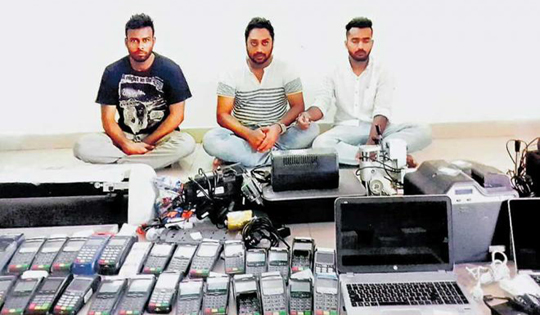
Bengaluru: Jul 16: A Sri Lankan national and two Bengalureans have been arrested for defrauding bank customers in different countries of a staggering Rs 100 crore by faking their credit cards in what is believed to be a massive online racket.
fraudstars

Divyan, a 30-year-old man from Jaffna, Sri Lanka, teamed up with Nawaz Shariff (22), a resident of Kanakanagar, and Nadeem Shariff (30), from HRBR Layout, to cheat credit card holders from Australia, Japan, Germany, Britain and other European countries. The gang targeted customers from these countries presuming that police would not come to India in search of them.

The suspects used an ingenious method to commit the fraud. First, they bought credit card data from shady websites. They then purchased magnetic swipe cards from e-commerce firms and used the secret data to clone credit cards. The next step was to contact businessmen from Haryana, Delhi, Mumbai and Puducherry who operate in Bengaluru and use point of sale (PoS) machines. They convinced these businessmen to allow them to swipe the credit cards at their PoS machines and promised them attractive commission on each transaction.

At this stage, the suspects acted cautiously. They always carried out transactions of low amounts so as to avoid scrutiny. Once the transactions were done, money would get transferred from the original card holders’ accounts in foreign banks to the businessmen’s bank accounts in India.

Foreign currency gets automatically converted into Indian rupees in case of credit card transactions. In these cases, credit cards were used and money was transferred without any sale taking place. Around 36 shopkeepers, some of the relatives of the suspects and bank officials were also part of the racket which had been going on for several years now and proved a money-spinner for all those involved.

The trio’s luck, however, ran out when they bought three LED television sets for Rs 1.1 lakh at Vishnupriya International, a home appliances store at Doddakallasandra, on June 21 and used a fake credit card to make the payment. The credit card turned out to be of a person from Bengaluru. The customer immediately blocked the card after receiving a message from the bank. The transaction was cancelled.

A team of the Central Crime Branch (CCB) happened to visit Canara Bank to investigate the increasing cases of online fraud. The bank staff informed the police about the illegal transaction at Vishnupriya International. The suspects had left a trail: they had given their phone number at the time of placing the order for the LED sets.

CCB sleuths started tracking them on the basis of the phone’s location and traced them to a three-bedroom flat at Prestige Collingwood in Jalahalli. During the raid, police found 144 fake credit cards, 16 fake driving licences, 36 card swipe machines, a card reader, a lamination machine, a card-printing machine and 270 plain cards.

Comments

ayes p
 - 
Tuesday, 18 Jul 2017

what about other right wing organisations!!

Add new comment

  • Coastaldigest.com reserves the right to delete or block any comments.
  • Coastaldigset.com is not responsible for its readers’ comments.
  • Comments that are abusive, incendiary or irrelevant are strictly prohibited.
  • Please use a genuine email ID and provide your name to avoid reject.
coastaldigest.com news network
June 10,2020

Udupli, Jun 10: A promising Kabaddi player and young businessman allegedly committed suicide inside his father’s boat today at Malpe fishing port as he had suffered heavy loss in business due to covid lockdown. 

The deceased has been identified as Bhagyaraj (27), a resident of Pavanjigudde in Badanidiyoor, Bailakere. He was working as writer for two boats owned by his father. He was a well-known Kabaddi player in Udupi district. 

It is said that he had raised a huge loan to build a house and also acquired a fishing boat. However, he suffered heavy losses in business due to lockdown. Fish famine added to his woes. 

Upset by these developments, Bhagyaraj hanged himself inside his boat that was anchored at the port. A case was registered at Malpe police station. Investigations are on.

Comments

Add new comment

  • Coastaldigest.com reserves the right to delete or block any comments.
  • Coastaldigset.com is not responsible for its readers’ comments.
  • Comments that are abusive, incendiary or irrelevant are strictly prohibited.
  • Please use a genuine email ID and provide your name to avoid reject.
Agencies
February 20,2020

India ranked 77th on a sustainability index that takes into account per capita carbon emissions and ability of children in a nation to live healthy lives and secures 131st spot on a flourishing ranking that measures the best chance at survival and well-being for children, according to a UN-backed report.

The report was released on Wednesday by a commission of over 40 child and adolescent health experts from around the world. It was commissioned by the World Health Organization (WHO), UN Children's Fund (UNICEF) and The Lancet medical journal.

In the report assessing the capacity of 180 countries to ensure that their youngsters can survive and thrive, India ranks 77th on the Sustainability Index and 131 on the Flourishing Index, it said.

Flourishing is the geometric mean of Surviving and Thriving. For Surviving, the authors selected maternal survival, survival in children younger than 5 years old, suicide, access to maternal and child health services, basic hygiene and sanitation, and lack of extreme poverty.

For Thriving, the domains were educational achievement, growth and nutrition, reproductive freedom, and protection from violence.

Under the Sustainability Index, the authors noted that promoting today's national conditions for children to survive and thrive must not come at the cost of eroding future global conditions for children's ability to flourish.

The Sustainability Index ranks countries on excess carbon emissions compared with the 2030 target. This provides a convenient and available proxy for a country's contribution to sustainability in future.

The report noted that under realistic assumptions about possible trajectories towards sustainable greenhouse gas emissions, models predict that global carbon emissions need to be reduced from 39·7 giga­ tonnes to 22·8 gigatonnes per year by 2030 to maintain even a 66 per cent chance of keeping global warming below 1·5°C.

It said that the world's survival depended on children being able to flourish, but no country is doing enough to give them a sustainable future.

"No country in the world is currently providing the conditions we need to support every child to grow up and have a healthy future," said Anthony Costello, Professor of Global Health and Sustainability at University College London, one of the lead authors of the report.

"Especially, they're under immediate threat from climate change and from commercial marketing, which has grown hugely in the last decade," said Costello – former WHO Director of Mother, Child and Adolescent health.

Norway leads the table for survival, health, education and nutrition rates - followed by South Korea and the Netherlands. Central African Republic, Chad and Somalia come at the bottom.

However, when taking into account per capita CO2 emissions, these top countries trail behind, with Norway 156th, the Republic of Korea 166th and the Netherlands 160th.

Each of the three emits 210 per cent more CO2 per capita than their 2030 target, the data shows, while the US, Australia, and Saudi Arabia are among the 10 worst emitters. The lowest emitters are Burundi, Chad and Somalia.

According to the report, the only countries on track to beat CO2 emission per capita targets by 2030, while also performing fairly – within the top 70 – on child flourishing measures are: Albania, Armenia, Grenada, Jordan, Moldova, Sri Lanka, Tunisia, Uruguay and Vietnam.

"More than 2 billion people live in countries where development is hampered by humanitarian crises, conflicts, and natural disasters, problems increasingly linked with climate change," said Minister Awa Coll-Seck from Senegal, Co-Chair of the commission.

The report also highlights the distinct threat posed to children from harmful marketing.

Evidence suggests that children in some countries see as many as 30,000 advertisements on television alone in a single year, while youth exposure to vaping (e-cigarettes) advertisements increased by more than 250 per cent in the US over two years, reaching more than 24 million young people.

Studies in Australia, Canada, Mexico, New Zealand and the US – among many others – have shown that self-regulation has not hampered commercial ability to advertise to children.

Children's exposure to commercial marketing of junk food and sugary beverages is associated with purchase of unhealthy foods and overweight and obesity, linking predatory marketing to the alarming rise in childhood obesity, it said.

The number of obese children and adolescents increased from 11 million in 1975 to 124 million in 2016 – an 11-fold increase, with dire individual and societal costs, the report said.

To protect children, the authors call for a new global movement driven by and for children.

Specific recommendations include stopping CO2 emissions with the utmost urgency, to ensure children have a future on this planet; placing children and adolescents at the centre of global efforts to achieve sustainable development, the report said.

New policies and investment in all sectors to work towards child health and rights; incorporating children's voices into policy decisions and tightening national regulation of harmful commercial marketing, supported by a new Optional Protocol to the UN Convention on the Rights of the Child, it said.

Comments

Add new comment

  • Coastaldigest.com reserves the right to delete or block any comments.
  • Coastaldigset.com is not responsible for its readers’ comments.
  • Comments that are abusive, incendiary or irrelevant are strictly prohibited.
  • Please use a genuine email ID and provide your name to avoid reject.
News Network
May 29,2020

New Delhi, May 29: Opining that there is no harm in importing ideas from abroad Swadeshi Jagran Manch, an affiliate of Rashtriya Swayamsevak Sangh, has suggested that India should take a cue from Pakistan and turn the “locust threat” into “chicken feed.

In an interview, Ashwani Mahajan, national co-convener of Swadeshi Jagran Manch (SJM) said: “I saw an article which shows that Pakistan has turned the locust threat into an opportunity by converting it into chicken feed”

“If there is a good idea originating from anywhere, we should be open to exploring such ideas. We should adopt good ideas. There is no harm in that,” he added.

He also shared the article on Twitter and wrote: “Pakistan turns locust threat into chicken feed. Need to understand the idea and replicate it in India.”

The article stated “an innovative pilot project in Pakistan’s Okara district offers a sustainable solution in which farmers earn money by trapping locusts that are turned into high-protein chicken feed by animal feed mills”.

“It was the brainchild of Muhammad Khurshid, a civil servant in the Ministry of National Food Security and Research, and Johar Ali, a bio-technologist from the Pakistan Agricultural Research Council,” according to the article.

Both Pakistan and India have been hit by locust attacks. These are desert locusts, which is one of the 12 species of short-horned grasshoppers. Swarms can comprise billions and travel up to 130 km in a day.

India has been battling the locust attacks with moderate success since December. However, the onset of monsoon could bring more trouble.

Comments

Add new comment

  • Coastaldigest.com reserves the right to delete or block any comments.
  • Coastaldigset.com is not responsible for its readers’ comments.
  • Comments that are abusive, incendiary or irrelevant are strictly prohibited.
  • Please use a genuine email ID and provide your name to avoid reject.