


Karnataka BJP MPs mum on farmers’ woes; protest Roopa's transfer

News Network
July 18, 2017

New Delhi, Jul 18: The Lok Sabha was adjorned without transacting any business on Tuesday due to opposition parties' noisy protests over woes of farmers and lynching of people in the name of protection of cows.
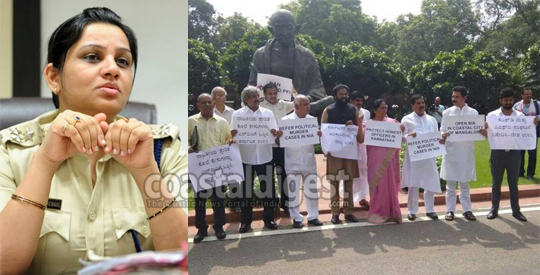
roopa

The MPs of the ruling Bharatiya Janata Party from Karnataka too displayed placards and drew the attention on the need to protect honest officers in the State.

They were apparently referring to transfer of Indian Police Service officer Roopa D Moudgil by the State Government after she exposed that the imprisoned All India Anna Dravida Munnethra Kazhagam (AIADMK) Amma leader V Sasikala was being provided special facilities and services in a jail in Bengaluru. Shobha Karandlaje and other BJP MPs from Karnataka also staged a protest in the premises of Parliament against transfer of Roopa by the Congress Government in the State.

The Lok Sabha witnessed uproar as several MPs of the opposition parties like Congress, Trinamool Congress, Rashtriya Janata Dal, Communist Party of India (Marxist) trooped into the well of the House. They raised slogans slamming the BJP-led Government for failing to help the farmers and to stop the lynching of people by the cow vigillantes.

The noisy protests started shortly after the House assembled for the day and Speaker moved to start the proceedings of the Question Hour.

The opposition MPs, who came to the well, held up placards that read “Gau mata toh bahana hai, Karz maafi se dhyan hatana hai (clamour for protection of cow just a tactic for diverting people's attention from farmers' demand for loan waiver), and “Who allowed Vijay Mallya (business tycoon accused of loan default) to leave the country?” Speaker Sumitra Mahajan repeatedly asked the MPs to go back to their seats. Her efforts to continue the proceedings of the Question Hour however failed as the ruckus went on. She then adjourned the House till 12 noon.

When the House reassembled, the uproar continued as the opposition MPs returned to the well and started raising slogans against the Government. Speaker then adjourned the House for the day.

Comments

Aslam Sheikh
 - 
Wednesday, 19 Jul 2017

Why he has not be suspended!!! Punish him in the same way, so he could feel the pain.

Muhammaf
 - 
Wednesday, 19 Jul 2017

Masha Allah,
People want peace
Great scholar, great leader, great mission
Barakkallah

Add new comment

  • Coastaldigest.com reserves the right to delete or block any comments.
  • Coastaldigset.com is not responsible for its readers’ comments.
  • Comments that are abusive, incendiary or irrelevant are strictly prohibited.
  • Please use a genuine email ID and provide your name to avoid reject.
News Network
March 5,2020

Bengaluru, Mar 5: The Karnataka government has constituted a competent authority for I Monetary Advisory (IMA) cases under the KPIDFE (Karnataka Protection of Interest of Depositors in Financial Establishments) Act, 2004, which is required to call claims from erstwhile depositors of the IMA group of entities under the provisions of the Act, said Harsh Gupta, Special Officer and Competent Authority for IMA cases.

In order to ensure transparency and to avoid harassment to the claimants, an online application software has been developed for accepting claims from the depositors, Gupta stated.

"The claim application can be filed from any of Banglore-1, Karnataka-1 and Seva-Sindhu Kendras of the state government in person or through online. The required documents can be submitted using e-attestation along with claims or at a later date, but prior to the claim settlement. The details of authorities for e-attestation will be informed later," the official stated.

The claimants will have to provide Aadhaar authentication based identification or identification by the designated officer based on alternate documents; current mobile number and address among others.

The details of the draft claim filing process has been put for public feedback on website 'imaclaims.karnataka.gov.in'. The depositors can give their feedback on the website, WhatsApp number or email, Gupta stated.

Based on feedback received from the depositors, the claim process and the claim application software will be finalised, the official said and further informed that the start date for acceptance of claims will be informed through wide publicity at a later date.

"There will be a total time period of 30 days for submission of the claims from the start date of acceptance of claims," Gupta said.

An SIT was investigating the multi-crore IMA Jewels case, where the firm had allegedly cheated a large number of investors after promising them impressive returns on their deposits. The SIT has already arrested several government officials and questioned others including politicians in the matter.

The prime accused and Managing Director of IMA Mohammed Mansoor Khan, who had fled the country after several complaints were registered against him in connection with the scam, has also been arrested.

The state government had constituted an SIT to probe the scam when it first came to light in June earlier this year when more than 4,000 investors trooped outside the showroom after an audio clip purportedly recorded by Khan went viral.

Comments

Add new comment

  • Coastaldigest.com reserves the right to delete or block any comments.
  • Coastaldigset.com is not responsible for its readers’ comments.
  • Comments that are abusive, incendiary or irrelevant are strictly prohibited.
  • Please use a genuine email ID and provide your name to avoid reject.
Agencies
May 8,2020

Washington D.C., May 8: The prime time for brain development in a child's life is the first year, where the infant spends most of the time asleep. It is the time when neural connections form and sensory memories are encoded.

However, when sleep is disrupted, as occurs more often among children with autism, brain development may be affected, too.

New research led by the University of Washington finds that sleep problems in a baby's first 12 months may not only precede an autism diagnosis but also may be associated with altered growth trajectory in a key part of the brain, the hippocampus.

The study, which was published in the American Journal of Psychiatry, researchers report that in a sample of more than 400 taken of 6- to 12-month-old infants, those who were later diagnosed with autism were more likely to have had difficulty falling asleep.

It also states that this sleep difficulty was associated with altered growth trajectories in the hippocampus.

"The hippocampus is critical for learning and memory, and changes in the size of the hippocampus have been associated with poor sleep in adults and older children.

As many as 80 per cent of the children with autism spectrum disorder have sleep problems," said Annette Estes, director of the UW Autism Center and senior author of the study.

"In our clinical experience, parents have a lot of concerns about their children's sleep, and in our work on early autism intervention, we observed that sleep problems were holding children and families back," added Estes, who is also a UW professor of speech and hearing sciences.

"It could be that altered sleep is part-and-parcel of autism for some children. One clue is that behavioural interventions to improve sleep don't work for all children with autism, even when their parents are doing everything just right. This suggests that there may be a biological component to sleep problems for some children with autism," said Estes.

To consider links among sleep, brain development, and autism, researchers at the IBIS Network looked at MRI scans of 432 infants, surveyed parents about sleep patterns, and measured cognitive functioning using a standardized assessment.

At the outset of the study, infants were classified according to their risk for developing autism: Those who were at higher risk of developing autism -- about two-thirds of the study sample -- had an older sibling who had already been diagnosed.

Infant siblings of children with autism have a 20 per cent chance of developing autism spectrum disorder -- a much higher risk than children in the general population.

In the current study, 127 of the 432 infants were identified as "low risk" at the time the MRI scans were taken because they had no family history of autism.

They later evaluated all the participants at 24 months of age to determine whether they had developed autism. Of the roughly 300 children originally considered "high familial risk," 71 were diagnosed with autism spectrum disorder at that age.

Problems with sleep were more common among the infants later diagnosed with an autism spectrum disorder, as were larger hippocampi. No other subcortical brain structures were affected, including the amygdala, which is responsible for certain emotions and aspects of memory, or the thalamus, a signal transmitter from the spinal cord to the cerebral cortex.

The authors note that while parents reported more sleep difficulties among infants who developed autism compared to those who did not, the differences were very subtle and only observed when looking at group averages across hundreds of infants.

Sleep patterns in the first years of life change rapidly as infants transition from sleeping around the clock to a more adult-like sleep/wake cycle. Until further research is completed, Estes said, it is not possible to interpret challenges with sleep as an early sign of increased risk for autism.

Comments

Add new comment

  • Coastaldigest.com reserves the right to delete or block any comments.
  • Coastaldigset.com is not responsible for its readers’ comments.
  • Comments that are abusive, incendiary or irrelevant are strictly prohibited.
  • Please use a genuine email ID and provide your name to avoid reject.
coastaldigest.com news network
May 4,2020

Mangaluru, May 4: No major crowds were seen in the coastal city of Mangaluru today except in front of the liquor shops after the district administration relaxed the lockdown norms for 12 hours a day (between 7am and 7pm).

There was no mad rush of vehicles either on city roads when the relaxed lockdown began. There were fewer people to buy essentials in front of grocery and vegetable shops as they had time till late evening.

There was no let down in the number of police pickets as well as curbs on vehicular movement across the city either. 

The government has allowed sale of liquor in CL2 (standalone wine shops) and CL 11 (MSIL outlets) to mop up revenues when Lockdown-3 commenced from Monday. Compared the other parts of Karnataka, the size of queues in front of liquor shops in Mangaluru were smaller. 

Like other parts of the country, the lockdown was imposed in the coastal district on March 24 to prevent the spread of Covid-19. Prior to that, a curfew was imposed in the district from March 22 midnight. The lockdown did not apply to essential services such as sale of food, groceries, milk, vegetables, fruits, and meat and fish. Gradually the district administration had to intensify the lockdown and allow those shops to remain open only between 7 a.m. and 12 noon. 

With the lockdown relaxation extending till 7 p.m., Mangaluru today witnessed people and private vehicles moving freely in the afternoon for the first time in more than a month. However, only those who had to go for work and do other essential activities were seen on roads. After 7 p.m. movements of all kinds of vehicles will be prohibited. 

The relaxation was to facilitate economic activities that had come to a standstill during the first two phases of lockdown. Mangaluru City Police Commissioner Dr P S Harsha, meanwhile, warned the people against misusing lockdown relaxation and venturing out without any genuine reason.

Comments

Add new comment

  • Coastaldigest.com reserves the right to delete or block any comments.
  • Coastaldigset.com is not responsible for its readers’ comments.
  • Comments that are abusive, incendiary or irrelevant are strictly prohibited.
  • Please use a genuine email ID and provide your name to avoid reject.