


Karnataka BJP MPs mum on farmers’ woes; protest Roopa's transfer

News Network
July 18, 2017

New Delhi, Jul 18: The Lok Sabha was adjorned without transacting any business on Tuesday due to opposition parties' noisy protests over woes of farmers and lynching of people in the name of protection of cows.
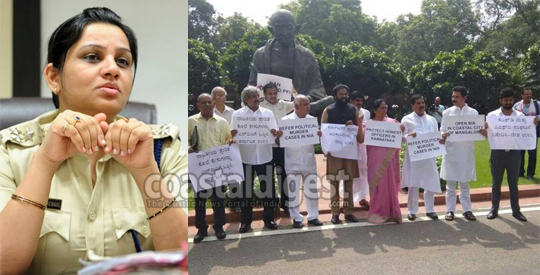
roopa

The MPs of the ruling Bharatiya Janata Party from Karnataka too displayed placards and drew the attention on the need to protect honest officers in the State.

They were apparently referring to transfer of Indian Police Service officer Roopa D Moudgil by the State Government after she exposed that the imprisoned All India Anna Dravida Munnethra Kazhagam (AIADMK) Amma leader V Sasikala was being provided special facilities and services in a jail in Bengaluru. Shobha Karandlaje and other BJP MPs from Karnataka also staged a protest in the premises of Parliament against transfer of Roopa by the Congress Government in the State.

The Lok Sabha witnessed uproar as several MPs of the opposition parties like Congress, Trinamool Congress, Rashtriya Janata Dal, Communist Party of India (Marxist) trooped into the well of the House. They raised slogans slamming the BJP-led Government for failing to help the farmers and to stop the lynching of people by the cow vigillantes.

The noisy protests started shortly after the House assembled for the day and Speaker moved to start the proceedings of the Question Hour.

The opposition MPs, who came to the well, held up placards that read “Gau mata toh bahana hai, Karz maafi se dhyan hatana hai (clamour for protection of cow just a tactic for diverting people's attention from farmers' demand for loan waiver), and “Who allowed Vijay Mallya (business tycoon accused of loan default) to leave the country?” Speaker Sumitra Mahajan repeatedly asked the MPs to go back to their seats. Her efforts to continue the proceedings of the Question Hour however failed as the ruckus went on. She then adjourned the House till 12 noon.

When the House reassembled, the uproar continued as the opposition MPs returned to the well and started raising slogans against the Government. Speaker then adjourned the House for the day.

Comments

Aslam Sheikh
 - 
Wednesday, 19 Jul 2017

Why he has not be suspended!!! Punish him in the same way, so he could feel the pain.

Muhammaf
 - 
Wednesday, 19 Jul 2017

Masha Allah,
People want peace
Great scholar, great leader, great mission
Barakkallah

Add new comment

  • Coastaldigest.com reserves the right to delete or block any comments.
  • Coastaldigset.com is not responsible for its readers’ comments.
  • Comments that are abusive, incendiary or irrelevant are strictly prohibited.
  • Please use a genuine email ID and provide your name to avoid reject.
News Network
July 3,2020

Bengaluru, Jul 3: Karnataka on Friday reported its biggest single day spike of 1,694 new COVID-19 cases, taking the taking the total number of infections in the state to 19,710, the Health department said.
The state also recorded 21 fatalities pushing the number of deaths to 293.

The day also saw 471 patients getting discharged after recovery; even as 201 patients in the state were undergoing treatment in ICU. Of the 1,694 fresh cases reported on Friday, a whopping 994 cases were from Bengaluru Urban alone.

As of July 3 evening, cumulatively 1,9710 COVID-19 positive cases have been confirmed in the state, which includes 293 deaths and 8,805 discharges, the Health department said in its bulletin.

It said, out of 10,608 active cases, 10,407 patients are in isolation at designated hospitals and are stable, while 201 are in ICU.

The 21 dead include five from Bengaluru Urban, three each from Chikkaballapura and Kalaburagi, two each from Vijayapura and Shivamogga and one each from Ballari, Hassan, Davangere, Bidar, Raichur and Bengaluru Rural.

Out of 21, fourteen are men between the age 48-87 years, and seven women between 25-75 years.

Those dead include those with the history of Severe Acute Respiratory Infection (SARI), Influenza-like illness (ILI), inter-state and inter-district travel and cardiac patients.

The contact history of at least four dead people is under tracing.

Out of 1,694 positive cases on Friday, contacts of the majority of the cases are still under tracing.

Among the districts where the new cases were reported, Bengaluru Urban accounted for 994, followed by 97 from Ballari

and Dakshina Kannada, Kalaburagi 72, Tumakuru 57, Bengaluru Rural 44, Dharwad 38, Mysuru 35, Mandya 33, Bidar 28, Chamarajanagara 24, Shivamogga 23, Gadag 19, sixteen each from Udupi and Kodagu, Yadgir 14, thirteen each from Hassan and Belagavi, Kolar 11.

Bengaluru Urban district tops the list of positive cases, with a total of 7,173 infections, followed by Kalaburagi (1,560) and Udupi (1,258). Among discharges, Kalaburagi tops the list with 1,143 followed by Udupi (1,093) and Yadgir (855).

A total of 6,71,934 samples have been tested so far, out of which 18,307 were tested on Friday alone.

So far 6,35,582 samples have been reported as negative, and out of them 16,290 were reported negative on Friday.

Comments

Add new comment

  • Coastaldigest.com reserves the right to delete or block any comments.
  • Coastaldigset.com is not responsible for its readers’ comments.
  • Comments that are abusive, incendiary or irrelevant are strictly prohibited.
  • Please use a genuine email ID and provide your name to avoid reject.
Wafa Sultana
April 4,2020

Over the last couple of days when the world was occupied with unifying efforts to fight the deadly Covid19 pandemic, sections of Indian media provided viewers a familiar scapegoat – the Indian Muslims – who are often stereotyped as a community being constantly at loggerheads with the citizenry and the State. Biased media channels were quick to resort to blaming the entire Muslim community for the spread of the disease in the country, thanks to an ill-timed Tablighi Jamaat gathering at its international headquarters in Delhi’s Nizamuddin. Unsurprisingly, the opprobrium was also marked by a sudden spike in WhatsApp forwards of videos with people wearing skullcaps licking spoons and performing Sufi breathing rituals, suggesting some sort of wild conspiracy on the part of the community to spread the virus.  Some media channels were quick to formulate, hypothesize and provide loose definitions of a newly discovered form of Jihad i.e. ‘Corona Jihad ’ thereby vilifying the Islamic faith and its followers.

While the investigation on the culpability of the organizers of the Nizamuddin event is still ongoing, there is enough information to suggest that the meeting was held before any lockdown was in force, and the problem began when there was no way of getting people out once the curfew was announced. Be that as it may, there is little doubt that organizing a meet of such a scale when there is a global pandemic smacks of gross misjudgment, and definitely the organizers should be held accountable if laws or public orders were defied. Attendees who attempt to defy quarantine measures must be dealt with strictly. However, what is alarming is that the focus and narrative have now shifted from the unfortunate event at Nizamuddin to the Tablighi Jamaat itself.

For those not familiar with the Tablighi Jamaat, the organization was founded in 1926 in Mewat by scholar Maulana Mohammad Ilyas. The Jamaat’s main objective was to get Muslim youth to learn and practice pristine Islam shorn of external influences. This is achieved through individuals dedicating time for moral and spiritual upliftment secluded from the rest of the world for a brief period of time. There is no formal membership process. More senior and experienced participants typically travel from one mosque to other delivering talks on religious topics, inviting local youth to attend and then volunteer for a spiritual retreat for a fixed number of days to a mosque in a nearby town or village to present the message to their co-religionists. Contrary to ongoing Islamophobic rhetoric, the movement does not actively proselytize. The focus is rather on getting Muslims to learn the teachings and practices of Islam.  This grassroots India-based movement has now grown to almost all countries with substantial Muslim populations. Its annual meets, or ‘ijtemas’ are among the largest Islamic congregations in the world after the annual Haj. One of the reasons for its popularity and wide network in the subcontinent and wordwide is the fact that it has eschewed the need for scholarly intervention, focusing on peer learning of fundamental beliefs and practice rather than high-falutin ideological debates. The Tablighi Jamaat also distinguishes itself from other Islamic movements through its strictly apolitical nature, with a focus on individual self-improvement rather than political mobilization. Hardships and difficulty in the world are expected to be face through ‘sabr’ (patience) and ‘dua’ (supplication),  than through quest for political power or influence. In terms of ideology, it is very much based on mainstream Sunni Islamic principles derived from the Deobandi school.

So, why is all this background important in the current context? While biased media entities have expectedly brought out their Islamophobic paraphernalia out for full display, more neutral commentators have tried to paint the Tablighi Jamaat as a fringe group and have tried to distance it from 'mainstream Muslims'. While the intent is no doubt innocent, this is a trap we must not fall into. This narrative, unfortunately, is also gaining ground due to apathy some Muslims have for the group, accusing it of being “disconnected from the realities of the world”. Unlike other Muslim organizations and movements, the Tablighi Jamat, by virtue of its political indifference, does not boast of high-profile advocates and savvy spokespersons who can defend it in mainstream or social media.  The use of adjectives such as 'outdated' and 'orthodox' by liberal columnists to describe the Jamaat feeds into the malignant attempt to change the narrative from the control of the spread of the pandemic due to the Nizamuddin gathering to 'raison d'etre' of the organization itself.

A large mainstream religious group like the Tablighi Jamaat with nearly a hundred-year history, normally considered to be peaceful, apolitical and minding its own business is now suddenly being villainized owing to unfortunate circumstances. Biased media reactions filled with disgust and hate seem to feed the Indian public conscience with a danngerous misconception - to be a nominal Muslim is okay but being a practicing one is not.  For those committed to the truth and fighting the spread of Islamophobia, the temptation to throw the entire Tablighi Jamaat under the bus must be resisted.

The writer is a lawyer and research scholar at Qatar University. Her research interests include Islamic law and politics.

Comments

zahoorahmed
 - 
Saturday, 4 Apr 2020

great article! provides a great perspective on tableeg jamat

Add new comment

  • Coastaldigest.com reserves the right to delete or block any comments.
  • Coastaldigset.com is not responsible for its readers’ comments.
  • Comments that are abusive, incendiary or irrelevant are strictly prohibited.
  • Please use a genuine email ID and provide your name to avoid reject.
News Network
July 14,2020

Bengaluru, July 14: Ahead of the week-long lockdown in Bengaluru starting from Tuesday night, around 35,000 people have left the city and grocery stores and liquor shops are witnessing a rush with customers thronging to stock up on for the shutdown.

According to transport department officials, labourers from other parts of the state migrated in good numbers from Bengaluru ahead of the lockdown fearing that they would have to face similar challenges as they had to confront during the previous shuttering. 

"Yesterday 35,000 passengers left Bengaluru. The number is big given the fact that we are allowing a limited number of passengers in the buses to maintain social distancing," a KSRTC official said.

Tipplers made a beeline for liquor shops and a senior State Excise official said liquor worth Rs 230 crore was sold on Monday alone.

"There was apparently a mad rush yesterday.India Made Foreign Liquor worth Rs 215.55 crore and 14.83 crore worth beer was sold...," the officer said.

In view of the rising coronavirus cases in the city at an alarming proportion, the government decided to impose lockdown from Tuesday 8 pm till 5 am on July 22.

Later, Dharwad and Dakshina Kannada districts too decided to impose a lockdown for nine days and seven days respectively from Wednesday.

"For the past two days there is an unusual rush of customers in our store," an executive of the Metro Cash and Carry said.

According to him, people are buying grocery items and vegetables with long shelf life such as onion, potato, radish, carrot and beetroot.

A salesperson at the Star Bazaar too said people were thronging the store for the past two to three days.

During the Sunday curfew, Home Minister Basavaraj Bommai said the week-long lockdown will be stringent one and government has made all arrangements to address all concerns ahead of the shutdown.

As many as 19,702 people in Bengaluru have tested positive, of which there are 15,052 active cases, while 4,328 have been discharged.

The number of fatalities as of Monday is 321.

Across Karnataka, 41,581 people have tested positive for coronavirus including 24,572 active cases, 16,248 discharges and 757 deaths since the outbreak of the pandemic in the state.
 

Comments

Add new comment

  • Coastaldigest.com reserves the right to delete or block any comments.
  • Coastaldigset.com is not responsible for its readers’ comments.
  • Comments that are abusive, incendiary or irrelevant are strictly prohibited.
  • Please use a genuine email ID and provide your name to avoid reject.