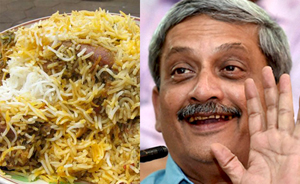
Is BJP ‘Beef Joy Party’ now? VHP asks after Parrikar’s assurances to beef eaters

News Network
July 19, 2017

Panaji, Jul 19: BJP leader and Goa Chief Minister Manohar Parrikar’s claim that the state would never be short of beef, has landed him the soup. A senior leader of Vishwa Hindu Parishad (VHP) has asked him whether BJP has become the Beef Joy Party. On the other hand the Opposition have slammed the brazen double standard of the saffron party.parikarbeef

NCP’s Nawab Malik, CPI (M)’s Sitaram Yechuri and Congress’ Rajeev Shukla said that the if the BJP approved Parriakar’s statements, then the party was indulging in a dangerous double game, as gau rakshaks, claiming to be members of the party, have been assaulting those they suspect of carrying beef..

“Manohar Parkiar's comments show the BJP has a special set of rules for its party members. The fact that Goa's CM said that there will be no shortage of beef in the state, and that beef will be imported from Karnataka shows how the party’s true colours,” he said.

Sitaram Yechuri of the CPI (M) echoed Malik’s statement, saying that it was a case of double-standards shown by the party. “While gau rakshaks create havoc in the rest of the country, the Goa CM proudly proclaims that there will be no shortage of beef in the state. I wonder how the BJP feels about his statement,” he added.

Parrikar on Tuesday said the state-run abattoir here produces around 2,000 kgs of beef per day and the additional demand for it is met by supplies from neighbouring Karnataka.

Addressing the state assembly on the first day of the monsoon session, Parrikar, in reply to a BJP member's concern over the quality of beef supplied from the neighbouring state, said the beef purchased from Karnataka would be subjected to proper inspection. "Approximately 2,000 kgs beef is produced per day at the state abattoir of the Goa Meat Complex Limited, while rest of beef is brought in from Karnataka. "The estimated sale of beef, based on the meat inspection charges paid by beef dealers/traders is approximately 2,300 - 2,400 kgs/day," said Parrikar, who also holds the animal husbandry portfolio.

“On one hand, the BJP assaults Dalits and Muslims, and on the other, the Goa CM says that there won't be a shortage of beef in the state for its citizens. It's quite the double speak on part of the party,” Rajeev Shukla of the Congress said.

While the party high command has not reacted to Parrikar’s statement, the VHP has called for the Goa Chief Minister’s resignation. “Has the BJP become the Beef Joy Party? Parrikar should resign for his comments,” VHP leader Dr Surendra Jain said in a series of tweets.

Comments

MBS
 - 
Saturday, 22 Jul 2017

Good decision go ahead,we are with you

Ahmed K. C.
 - 
Saturday, 22 Jul 2017

There are similarities between US and India like:-
Intolerance towards certain community
Favoring Super rich.
Hate speeches.
Self boasting.
Both love Israel cause common enemy.

But, lot of differences like:-
For us beef is god, for US beef is food.
We have Gou Rakshaks, US has Gou bakshaks.
For us only one national flag, for US each state have it's own flag besides national flag.
We buy weapons, US sells weapons.
We are just trying to get into wars, whereas US is always in war since 200 years.

Add new comment

  • Coastaldigest.com reserves the right to delete or block any comments.
  • Coastaldigset.com is not responsible for its readers’ comments.
  • Comments that are abusive, incendiary or irrelevant are strictly prohibited.
  • Please use a genuine email ID and provide your name to avoid reject.
coastaldigest.com web desk
July 2,2020

When the black and white photos of the ‘London to Calcutta (Kolkata) bus service’ went viral on social media recently, the response of some of the netizens was “stop spreading fake news!” But, it isn’t a fake news. The late 1950s indeed offered people a lavish bus trip from London to Kolkata. 

While one of the viral images shows passengers at the Victoria Coach Station, London, boarding 'Albert', the other image show the same bus travelling through a valley. In another image the bus is stationed at a tourist spot. All these photos were captured during the bus’ maiden international journey in 1957.  

An image of the bus ticket is also making rounds on social media, that shows the route of the bus — London, Belgium, West Germany, Austria,Yugoslavia, Bulgaria, Turkey, Iran, Afghanistan, West Pakistan, India. The route in India followed Delhi, Agra, Allahabad, Banaras and finally Calcutta.

The ticket shows that a one side travel cost 145 pounds (13,644 Rupees at the present day) back then, and it was inclusive of all the luxury provided during the run.

The luxurious bus provided the facilities of reading, individual sleeping bunks, radio/taped music for parties and pleasure and fan heaters, among other things. The brochure reads, "Your complete home while you travel."

Some of the tour highlights included Banaras on the Ganges, The Taj Mahal, The Raj Path, The Rhine Valley and The Peacock Throne. Passengers reportedly got free shopping days in New Delhi, Tehran, Salzburg, Kabul, Istanbul and Vienna.

Comments

Add new comment

  • Coastaldigest.com reserves the right to delete or block any comments.
  • Coastaldigset.com is not responsible for its readers’ comments.
  • Comments that are abusive, incendiary or irrelevant are strictly prohibited.
  • Please use a genuine email ID and provide your name to avoid reject.
Ram Puniyani
June 29,2020

In Minneapolis, US an African American, George Floyd lost his life as the white policeman, Derek Chauvin, caught hold of him and put his knee on his neck. This is a technique developed by Israel police. For nine long minutes the knee of the while policeman was on the neck of George, who kept shouting, I can’t breathe.

Following this gruesome murder America erupted with protests, ‘Black lives matter’. The protestors were not just African Americans but also a large section of whites. Within US one police Chief apologized for the act of this. In a touching gesture of apology the police force came on its knees. This had reverberations in different parts of the World.

The act was the outcome of the remnants of the racial hatred against blacks by the whites. It is the hatred and the perceptions which are the roots of such acts of violence. What was also touching that the state of democracy in US is so deep that even the police apologized, the nation, whites and blacks, stood up as a sensitive collective against this violence.

US is not the only country where the brutal acts of violence torment the marginalized sections of society. In India there is a list of dalits, minorities and adivasis who are regularly subjected to such acts. But the reaction is very different. We have witnessed the case of Tabrez Ansari, who was tied to the pole by the mob and beaten ruthlessly. When he was taken to police station, police took enough time to take him to hospital and Tabrez died.

Mohsin Sheikh, a Pune techie was murdered by Hindu Rashtra Sena mob, the day Modi came to power in 2014. Afrazul was killed by Shambhulal Regar, videotaped the act released on social media. Regar believed that Muslims are indulging in love Jihad, so deserve such a fate. Mohammad Akhlaq is one among many names who were mob lynched on the issue of beef cow. The list can fill pages after pages.

Recently a young dalit boy was shot dead for the crime of entering a temple. In Una four dalits were stripped above waste and beaten mercilessly. Commenting on this act the Union Minister Ramvilas Paswan commented that it is a minor incident. Again the list of atrocities against dalits is long enough. The question is what Paswan is saying is the typical response to such gruesome murders and tortures. In US loss of one black life, created the democratic and humane response. In India there is a general silence in response to these atrocities. Some times after a good lapse of time, the Prime Minister will utter, ‘Mother Bharati has lost a son’. Most of the time victim is blamed. Some social groups raise their voice in some fora but by and large the deafening silence from the country is the norm.

India is regarded as the largest democracy. Democracy is the rule of law, and the ground on which the injustices are opposed. In America though the present President is insensitive person, but its institutions and processes of democratic articulations are strong. The institutions have deepened their roots and though prejudices may be guiding the actions of some of the officers like the killer of George, there are also police officers who can tell their President to shut up if he has nothing meaningful to say on the issue. The prejudices against Blacks may be prevalent and deep in character, still there are large average sections of society, who on the principles of ‘Black lives matter’. There are large sections of vocal population who can protest the violation of basic norms of democracy and humanism.

In India by contrast there are multiple reasons as to why the lives of Tabrez Ansari, Mohammad Akhlaq, Una dalit victims and their likes don’t matter. Though we claim that we are a democracy, insensitivity to injustices is on the rise. The strong propaganda against the people from margins has become so vicious during last few decades that any violence against them has become sort of a new normal. The large populace, though disturbed by such brutalities, is also fed the strong dose of biases against the victims. The communal forces have a great command over effective section of media and large section of social media, which generates Hate against these disadvantaged groups, thereby the response is muted, if at all.

As such also the process of deepening of our democracy has been weak. Democracy is a dynamic process; it’s not a fixed entity. Decades ago workers and dalits could protest for their rights. Now even if peasants make strong protests, dominant media presents it as blocking of traffic! How the roots of democracy are eroded and are visible in the form where the criticism of the ruling dispensation is labelled as anti National..

Our institutions have been eroded over a period of time, and these institutions coming to the rescue of the marginalized sections have been now become unthinkable. The outreach of communal, divisive ideology, the ideology which looks down on minorities, dalits and Adivasis has risen by leaps and bounds.

The democracy in India is gradually being turned in to a hollow shell, the rule of law being converted in to rule of an ideology, which does not have faith in Indian Constitution, which looks down upon pluralism and diversity of this country, which is more concerned for the privileges of the upper caste, rich and affluent. The crux of the matter is the weak nature of democracy, which was on way to become strong, but from decades of 1980s, as emotive issues took over, the strength of democracy started dwindling, and that’s when the murders of the types of George Floyd, become passé. One does complement the deeper roots of American democracy and its ability to protect the democratic institutions, which is not the case in India, where protests of the type, which were witnessed after George Floyd’s murder may be unthinkable, at least in the present times. 

Comments

Add new comment

  • Coastaldigest.com reserves the right to delete or block any comments.
  • Coastaldigset.com is not responsible for its readers’ comments.
  • Comments that are abusive, incendiary or irrelevant are strictly prohibited.
  • Please use a genuine email ID and provide your name to avoid reject.
News Network
May 24,2020

Bengaluru, May 24:The first 'Sunday curfew' imposed by the Karnataka government to try and contain the spread of COVID-19 got underway in the state today, with people by and large adhering to norms, roads wearing a deserted look and almost no vehicular traffic, barring essential services.

With barricades being up across most roads in the state, people ventured out only to purchase groceries, vegetabes and medicines.

Instances of violation of Sunday curfew lockdown norms were reported in COVID-19 hotspots of Shivajinagar and Rayapura in Bengaluru and Nelamangala and Devanahalli.

Temples, malls, bars, eateries and small food joints remained shut throughout state.

In most parts of the state buses, autorickshaws and cabs did not ply.

In Bengaluru, the ever bustling Majestic area, which houses the central city bus stand, inter-city bus stand, Metro Railway Station and the City Railway Station, did not see any activity as buses did not ply and all shops were shut, police said.

Reports from Mysuru, Tumakuru, Kolar, Mangaluru, Udupi and other towns across the state said there were no lockdown violations.

Amid the rigid curfew marriages were conducted in a simple manner in various parts of the state like Gollarahatti and Yashwanthapura in Bengaluru and also in Davangere.

Families of the brides and grooms invited only a few people for the event, adhered to social distancing norms and wore masks.

In Gollarahatti, the event organisers cleaned the road, after which the invitees, who were hardly 25 to 30 in number, sat down to have a feast.

The Karnataka government had eased restrictions during Lockdown 4 for start of economic activities like city buses, inter-district bus service, intrastate train services, opening of shops and markets.

However, the government had made it clear that there will be 'Janata Curfew' every Sunday during which only essential services would be permitted.

Comments

Add new comment

  • Coastaldigest.com reserves the right to delete or block any comments.
  • Coastaldigset.com is not responsible for its readers’ comments.
  • Comments that are abusive, incendiary or irrelevant are strictly prohibited.
  • Please use a genuine email ID and provide your name to avoid reject.