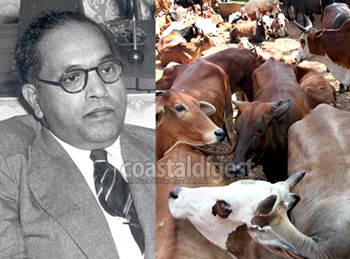
Cow protection mooted by Ambedkar, not BJP, claims Jaitley

News Network
July 21, 2017

New Delhi, Jul 21: Finance Minister Arun Jaitley on Thursday asked the Opposition parties in the Rajya Sabha to stop giving a political colour to cow-related violence, saying it could never be a partisan issue.ambacow

Replying to a debate on the issue of beef-related violence and lynching, Jaitley said, “Violence can never be a partisan issue and oppression in the name of cow will not be tolerated.”

He held that the protection of cows was not introduced by the BJP. He quoted Article 48 of the Constitution, which calls upon the state to protect cows from slaughter, saying it was written by Dr B R Ambedkar.

“Then, there was not a state where the BJP was in power. It was during (Jawaharlal) Nehru’s rule,” he said. Senior Congress leader Ghulam Nabi Azad said his party was not seeking to support the slaughter of cows.

Jaitley said, “Wherever acts of violence and lynching have erupted, legal proceedings and charge sheets have been filed in a systematic way. Sensitivity to the cow could not justify violence.”

Comments

shamon
 - 
Sunday, 23 Jul 2017

What can we expect from this unhuman shoba. I think she forgot to include names of various BJP leaders in the list of people kiilled in karnataka. Did she inlude her name also (may be yes). what a shame?

Add new comment

  • Coastaldigest.com reserves the right to delete or block any comments.
  • Coastaldigset.com is not responsible for its readers’ comments.
  • Comments that are abusive, incendiary or irrelevant are strictly prohibited.
  • Please use a genuine email ID and provide your name to avoid reject.
coastaldigest.com news network
July 18,2020

Udupi, Jul 18: Noted multi-lingual scholar Dr Uliyar Padmanabha Upadhyaya passed away last night at a private hospital in Manipal. The 88-year-old was survived by a son and a daughter.

His wife Susheela Uadhyaya, who was also a multi-lingual scholar, had passed away in January 2014 at the age of 77. The duo had compiled the six-volume Tulu Lexicon. Its first volume was published in 1988 and the last volume in 1997.

Son of Sitaram Upadhyaya, who was a scholar in the court of the Raja of Travancore, Dr Padmanabha was born on April 10, 1932 at Uliyar in Majur Village near Kaup in Udupi district. 

The Upadhyaya couple had conducted serious research work in linguistics and folk culture and produced a number of books-some of them jointly, some individually and some in collaboration with others. 

Dr Padmanabha had acquired three Master of Arts degrees in Sanskrit, Kannada and Linguistics from Madras, Kerala and Pune Universities, Vidwan in Hindi and PhD in Linguistics from the Pune University for his thesis titled “A Comparative Study of Kannada Dialects”.

He was a visiting Professor at the Universities of London and Paris. He knew Hindi, Kannada, Tulu, Malayalam, Tamil, English, French and Olof, the language of Senegal in Africa.

His works include Nanjanagudu Kannada (Vokkaliga Dialect), Coorg Kannada, Kuruba - A Dravidian Language, Kannada - A Phonetic Language, Malayalam Language and Literature (with Ms. Susheela), Effect of Bilingualism on Bidar Kannada, Coimbatore Tamil, Kannada as Spoken by Different Population Groups in Mysore City, Dravidian and Negro African: Ethno Linguistic Study (with Ms. Susheela), Conversational Kannada, Coastal Karnataka and Bhuta Worship: Aspects of a Ritualistic Theatre (with Ms. Susheela).

Also Read: Eminent linguist Dr Susheela P Upadhyaya no more

Comments

Add new comment

  • Coastaldigest.com reserves the right to delete or block any comments.
  • Coastaldigset.com is not responsible for its readers’ comments.
  • Comments that are abusive, incendiary or irrelevant are strictly prohibited.
  • Please use a genuine email ID and provide your name to avoid reject.
News Network
January 28,2020

Jan 28: Hindu temple processions with an elephant adorned in ornaments carrying the idol, with percussionists and devotees walking side by side, are no new sight in Kerala. However, a similar procession in Kerala's cultural capital, Thrissur, turned heads. Hundreds of Muslims were seen holding hands and clearing traffic to help the procession move smoothly.

Muslims made way for the passage of a Hindu temple procession during their protest against Citizenship Amendment Act(ACT) in Thrissur on Saturday, January 25.

Various Muslim organisations had organised a mass protest in the Swaraj ground in the town. On the same day, the local Bhaktapriyam temple's procession was also taking place. Stuck in a dilemma, the temple authorities approached the police and the Muslim organisations to find a solution. The Muslim organisations then promised to help proceed the temple procession without any obstacles.

Nearly a thousand people who had turned up for the protest volunteered to clear traffic and control the crowd so that the temple procession could smoothly pass through the town.

A video of the procession was shared on Facebook by the Thrissur City Police on Saturday, which showed Muslims holding hands on either side of the procession to make way.

"Humanity is bigger than religion. That's the lesson the residents of Thrissur are giving to the country. Thrissur is truly the cultural capital of Kerala," read the caption of the post in Malayalam. The video soon went viral and was viewed by over 36k views.

Comments

Abdullah
 - 
Tuesday, 28 Jan 2020

I am sure that sanghis especially Amit Shah got lose motion on getting this motion.  But what we can do, even Doctor cant stop it.   Enjoy it dears. 

Add new comment

  • Coastaldigest.com reserves the right to delete or block any comments.
  • Coastaldigset.com is not responsible for its readers’ comments.
  • Comments that are abusive, incendiary or irrelevant are strictly prohibited.
  • Please use a genuine email ID and provide your name to avoid reject.
Agencies
May 8,2020

Washington D.C., May 8: The prime time for brain development in a child's life is the first year, where the infant spends most of the time asleep. It is the time when neural connections form and sensory memories are encoded.

However, when sleep is disrupted, as occurs more often among children with autism, brain development may be affected, too.

New research led by the University of Washington finds that sleep problems in a baby's first 12 months may not only precede an autism diagnosis but also may be associated with altered growth trajectory in a key part of the brain, the hippocampus.

The study, which was published in the American Journal of Psychiatry, researchers report that in a sample of more than 400 taken of 6- to 12-month-old infants, those who were later diagnosed with autism were more likely to have had difficulty falling asleep.

It also states that this sleep difficulty was associated with altered growth trajectories in the hippocampus.

"The hippocampus is critical for learning and memory, and changes in the size of the hippocampus have been associated with poor sleep in adults and older children.

As many as 80 per cent of the children with autism spectrum disorder have sleep problems," said Annette Estes, director of the UW Autism Center and senior author of the study.

"In our clinical experience, parents have a lot of concerns about their children's sleep, and in our work on early autism intervention, we observed that sleep problems were holding children and families back," added Estes, who is also a UW professor of speech and hearing sciences.

"It could be that altered sleep is part-and-parcel of autism for some children. One clue is that behavioural interventions to improve sleep don't work for all children with autism, even when their parents are doing everything just right. This suggests that there may be a biological component to sleep problems for some children with autism," said Estes.

To consider links among sleep, brain development, and autism, researchers at the IBIS Network looked at MRI scans of 432 infants, surveyed parents about sleep patterns, and measured cognitive functioning using a standardized assessment.

At the outset of the study, infants were classified according to their risk for developing autism: Those who were at higher risk of developing autism -- about two-thirds of the study sample -- had an older sibling who had already been diagnosed.

Infant siblings of children with autism have a 20 per cent chance of developing autism spectrum disorder -- a much higher risk than children in the general population.

In the current study, 127 of the 432 infants were identified as "low risk" at the time the MRI scans were taken because they had no family history of autism.

They later evaluated all the participants at 24 months of age to determine whether they had developed autism. Of the roughly 300 children originally considered "high familial risk," 71 were diagnosed with autism spectrum disorder at that age.

Problems with sleep were more common among the infants later diagnosed with an autism spectrum disorder, as were larger hippocampi. No other subcortical brain structures were affected, including the amygdala, which is responsible for certain emotions and aspects of memory, or the thalamus, a signal transmitter from the spinal cord to the cerebral cortex.

The authors note that while parents reported more sleep difficulties among infants who developed autism compared to those who did not, the differences were very subtle and only observed when looking at group averages across hundreds of infants.

Sleep patterns in the first years of life change rapidly as infants transition from sleeping around the clock to a more adult-like sleep/wake cycle. Until further research is completed, Estes said, it is not possible to interpret challenges with sleep as an early sign of increased risk for autism.


Comments

Add new comment

  • Coastaldigest.com reserves the right to delete or block any comments.
  • Coastaldigset.com is not responsible for its readers’ comments.
  • Comments that are abusive, incendiary or irrelevant are strictly prohibited.
  • Please use a genuine email ID and provide your name to avoid reject.