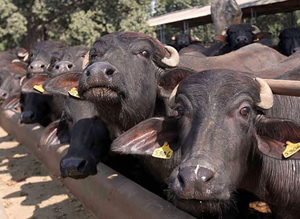
Udupi: Bajrang Dal men thrash 2 for transporting buffaloes; arrested

coastaldigest.com news network
July 21, 2017

Udupi, Jul 21: Miscreants belonging to Bajrang Dal on Thursday waylaid a vehicle and thrashed two persons for allegedly illegally transporting two buffaloes at Jarigekatte Junction in Mundkur village coming under Karkala Rural Police Station limits in Udupi district.buffaloes

It is learnt that the miscreants stopped a van which was carrying two buffaloes at Jarigekatte Junction at around 8 a.m.. They beat the two persons, Rajesh Mendonca and Sadhu Poojary, who were transporting the two buffaloes in the van.

Meanwhile, Sub-Inspector of Police Karkala Rural Police Station who also got information about this, rushed to the spot and raided the van. Since Rajesh Mendonca had been assaulted, he was taken to hospital for treatment. Meanwhile, Sadhu Poojary had managed to escape.

The police seized the two buffaloes which had been kept tied in the van along with the vehicle. A case had been registered against the victims in the van under sections 8, 9 and 11 of Karnataka Cow Slaughter Prevention Act and Section 379 (theft) of the Indian Penal Code (IPC).

Rajesh Mendonca in his complaint stated that he was transporting the two buffaloes in the van from the house of Sadhu Poojary at Renjal village in Karkala taluk, which were to be given to a person, Chandrahasa Shetty, at Punaroor village near Mulki in Dakshina Kannada district, for rearing them.

But when the van reached Jarigekatte Junction, the two activists, Sandeep and Ramesh, stopped the vehicle.

They beat him and Sadhu Poojary, who was with him, with their hands. He suffered an injury in his head. But in the melee, Sadhu Poojary managed to escape.

A case has been registered under Sections 341 (punishment for wrongful restraint), 324 (voluntarily causing hurt by dangerous weapons or means), 323 (punishment for voluntarily causing hurt) read with Section 34 of Indian Penal Code.

K.T. Balakrishna, Superintendent of Police, said that the police had arrested both Sandeep and Ramesh and produced them before court which granted them bail.

Meanwhile, Rajesh Mendonca, who was later arrested, was produced before court which remanded in judicial custody, he said.

Comments

Wonder Kotian
 - 
Sunday, 23 Jul 2017

Wonderful Ashokappa Better you become Law and Order man to obey the law!!!!!!! but in Dakshina Karnataka, Not only RSS Criminal but also some other poor Humans killed by RSS criminals, Ashoka and Shobakka both side of a Coin, but every Dog has its own day, our greatest, Honourable Minister doing fantastic work around Dakshina Karnataka, Hats of to him.
Jai Hoo Siddanna.

Add new comment

  • Coastaldigest.com reserves the right to delete or block any comments.
  • Coastaldigset.com is not responsible for its readers’ comments.
  • Comments that are abusive, incendiary or irrelevant are strictly prohibited.
  • Please use a genuine email ID and provide your name to avoid reject.
News Network
February 17,2020

Bengaluru, Feb 17: Leader of Opposition in Karnataka Assembly Siddaramaiah on Monday demanded that forest minister Anand Singh should either be expelled from the Cabinet or assigned a different portfolio.

This comes amid a number of cases, pending against Singh, including those under the Karnataka Forest Act.

"How can we expect justice from Anand Singh who has been made forest minister and is accused of (illegal mining)? We demand that he should either be dropped out of the state Cabinet or at least his portfolio be changed," Siddaramaiah told media.

Earlier in the day, Chief Minister BS Yediyurappa allocated portfolios to the 10 newly inducted ministers in his Cabinet.

As part of state Cabinet's expansion, 10 MLAs including Ramesh Jarkiholi, Anand Singh, K Sudhakar, and BA Basavaraja took oath as ministers at Raj Bhawan in Bengaluru on February 6.

Comments

Add new comment

  • Coastaldigest.com reserves the right to delete or block any comments.
  • Coastaldigset.com is not responsible for its readers’ comments.
  • Comments that are abusive, incendiary or irrelevant are strictly prohibited.
  • Please use a genuine email ID and provide your name to avoid reject.
News Network
August 2,2020

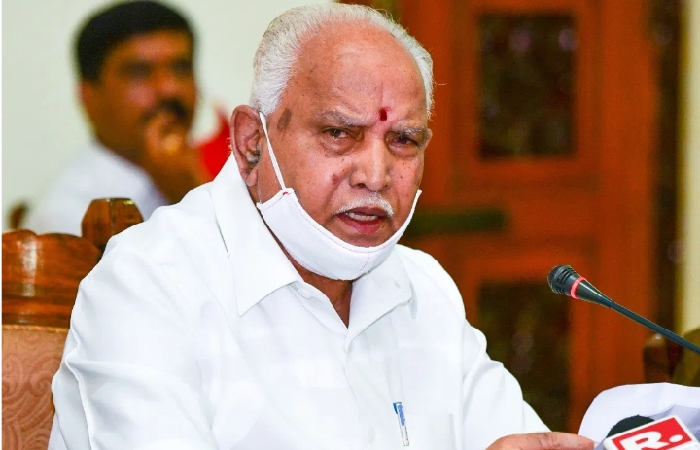
Bengaluru, Aug 2: Within a year of returning to power for the fourth time as Chief Minister in Karnataka, septuagenarian B.S. Yediyurappa has consolidated his position in the ruling BJP to stay the course till the next Assembly elections in mid-2023.

"A combination of factors helped Yediyurappa to consolidate and stay the course for the remaining term of his office to ensure the saffron party retains power in the state though he is unlikely to stake claim for the chief minister's post again as he would be 80 years old by 2023," a party source told news agency here.

Since the 77-year-old seasoned politician assumed office on July 26, 2019, the first year has been tumultuous for him, as he had go through a "trial by fire" what with the party's mighty high command and detractors testing his patience in the face of natural calamities like drought, floods and the Covid pandemic.

The first 7-8 months of the term were spent in tackling drought and floods, winning 12 of the 15 by-elections in December to secure a majority for the ruling party in the lower house and expanding the cabinet in February.

Even as Yediyurappa was settling down to seriously govern after presenting the state budget for fiscal 2020-21 in early March, the coronavirus outbreak overwhelmed him, as the pandemic spread and wreaked havoc, disrupting life, livelihood, economic growth and development.

"While the emphatic victory in the by-elections ensured the government's stability till the assembly term up to mid-2023, the second cabinet expansion on February 6 posed a challenge to Yediyurappa, as he could induct only 10 of the 12 MLAs who defected from the Congress and the Janata Dal-Secular (JD-S) and won the by-elections, triggering a revolt in the party by the loyalists left out of the ministry," the source recalled.

Though Yeddiyurappa has been leading the battle against the virus from day 1 and initially succeeded in controlling it from spreading during the extended lockdown till May 31, reopening the state under Unlock since June has undone the gains, as positive cases shot up to 1,29,287 so far, including 73,219 in Bengaluru after 53,648 recovered from across the state till date, while 2,412 succumbed to the deadly disease since March 9.

"For a state of 7 crore population, the data reveals that the pandemic has been fought on war-footing to contain it from spreading in all the 30 districts, although there are no signs of it going away till a vaccine is found. The chief minister has been trying to balance unlocking the state and containing the infection," a member of the health task force told IANS.

With six cabinet posts in the 34-member ministry being vacant, filling them will be a daunting task for Yediyurappa, as at least 20 legislators, including 5-6 newly elected turncoats and party's veterans are lobbying to become ministers at any cost.

By appointing 20 party legislators as heads of state-run board and corporations, nominating 5 as members of the state legislative council, including JD-S defector A.H. Vishwanath in July and getting 2 Congress defectors R. Shankar and M.T.B. Nagaraj elected as MLCs in June with 2 others, Yediyurappa ensured that these lawmakers would not be in the reckoning for the 6 cabinet posts, as dozen MLAs are already pitching for them.

Nagaraj and Vishwanath lost in the December 5 by-elections, while Shankar was not given a ticket to contest in the by-poll but was assured of making him an MLC with another disgruntled member C.P. Yogeshwar, who lost in the 2018 May assembly polls to JD-S leader and former chief minister H.D. Kumaraswamy of the 14-month-old JD-S and Congress coalition government from May 23, 2018 to July 23, 2019.

Resignations of 17 rebels, including 14 from the Congress and 3 from the JD-S led to the fall of the coalition government, as Kumaraswamy lost the majority in the 225-member assembly on July 23, 2019 in their absence.

Though Yediyurappa led the party to win 105 seats in the 2018 assembly elections and formed a government on May 17, 2018, he resigned 3 days later on May 19, 2018, as he fell 8-9 seats short of the halfway mark (113) for a simple majority in the lower house.

In a post-poll alliance, the JD-S and the Congress formed the coalition government to keep the BJP out of power in May 2018, after the assembly elections gave split verdict and the Congress lost power then.

"The record victory of the ruling party in the May 2019 general elections, when 25 of its 27 contestants won out of 28 Lok Sabha seats from the state, reinforced the popular belief that Yediyurappa is the party's mascot in winning elections and an unquestionable leader of the politically dominant Lingayats in the state," the source pointed out.

When Yediyurappa left the BJP and floated a regional outfit (Karnataka Janata Party) in January 2013, he delivered a body blow to the BJP in the May 2013 state assembly polls, as the votes got split and was defeated by then Congress.

"Besides the party's high command, everyone in the party's state unit, including leaders and cadres are aware of Yediyurappa's popularity across the state, as has the wherewithal to connect with masses and win elections," the source added.


Comments

Add new comment

  • Coastaldigest.com reserves the right to delete or block any comments.
  • Coastaldigset.com is not responsible for its readers’ comments.
  • Comments that are abusive, incendiary or irrelevant are strictly prohibited.
  • Please use a genuine email ID and provide your name to avoid reject.
Agencies
May 8,2020

Washington D.C., May 8: The prime time for brain development in a child's life is the first year, where the infant spends most of the time asleep. It is the time when neural connections form and sensory memories are encoded.

However, when sleep is disrupted, as occurs more often among children with autism, brain development may be affected, too.

New research led by the University of Washington finds that sleep problems in a baby's first 12 months may not only precede an autism diagnosis but also may be associated with altered growth trajectory in a key part of the brain, the hippocampus.

The study, which was published in the American Journal of Psychiatry, researchers report that in a sample of more than 400 taken of 6- to 12-month-old infants, those who were later diagnosed with autism were more likely to have had difficulty falling asleep.

It also states that this sleep difficulty was associated with altered growth trajectories in the hippocampus.

"The hippocampus is critical for learning and memory, and changes in the size of the hippocampus have been associated with poor sleep in adults and older children.

As many as 80 per cent of the children with autism spectrum disorder have sleep problems," said Annette Estes, director of the UW Autism Center and senior author of the study.

"In our clinical experience, parents have a lot of concerns about their children's sleep, and in our work on early autism intervention, we observed that sleep problems were holding children and families back," added Estes, who is also a UW professor of speech and hearing sciences.

"It could be that altered sleep is part-and-parcel of autism for some children. One clue is that behavioural interventions to improve sleep don't work for all children with autism, even when their parents are doing everything just right. This suggests that there may be a biological component to sleep problems for some children with autism," said Estes.

To consider links among sleep, brain development, and autism, researchers at the IBIS Network looked at MRI scans of 432 infants, surveyed parents about sleep patterns, and measured cognitive functioning using a standardized assessment.

At the outset of the study, infants were classified according to their risk for developing autism: Those who were at higher risk of developing autism -- about two-thirds of the study sample -- had an older sibling who had already been diagnosed.

Infant siblings of children with autism have a 20 per cent chance of developing autism spectrum disorder -- a much higher risk than children in the general population.

In the current study, 127 of the 432 infants were identified as "low risk" at the time the MRI scans were taken because they had no family history of autism.

They later evaluated all the participants at 24 months of age to determine whether they had developed autism. Of the roughly 300 children originally considered "high familial risk," 71 were diagnosed with autism spectrum disorder at that age.

Problems with sleep were more common among the infants later diagnosed with an autism spectrum disorder, as were larger hippocampi. No other subcortical brain structures were affected, including the amygdala, which is responsible for certain emotions and aspects of memory, or the thalamus, a signal transmitter from the spinal cord to the cerebral cortex.

The authors note that while parents reported more sleep difficulties among infants who developed autism compared to those who did not, the differences were very subtle and only observed when looking at group averages across hundreds of infants.

Sleep patterns in the first years of life change rapidly as infants transition from sleeping around the clock to a more adult-like sleep/wake cycle. Until further research is completed, Estes said, it is not possible to interpret challenges with sleep as an early sign of increased risk for autism.

Comments

Add new comment

  • Coastaldigest.com reserves the right to delete or block any comments.
  • Coastaldigset.com is not responsible for its readers’ comments.
  • Comments that are abusive, incendiary or irrelevant are strictly prohibited.
  • Please use a genuine email ID and provide your name to avoid reject.