


President Pranab Mukherjee not in favour of two executives: Hamid Ansari

Agencies
July 24, 2017

New Delhi, Jul 24: Vice President Hamid Ansari on Sunday said outgoing President Pranab Mukherjee had told Governors and Lt. Governors that their role was “mainly confined to giving advice to the Chief Minister as there cannot be two functional executive authorities in a state”. He said Mukherjee had also noted that the Governor had no discretion but to accept the verdict of floor test in certain situations.

“In a farewell dinner for Governors and Lt. Governors last week, President Mukherjee spoke about the constitutional design by which ‘there cannot be two functional executive authorities in a state’ and the Governor’s role, therefore, is ‘mainly confined to giving advice to the Chief Minister’,” Ansari said in his speech at the farewell ceremony for Mukherjee in the Central Hall of Parliament.

“He (Mukherjee) added that in certain situations, the Governor has no discretion but to accept the verdict of the floor test. He advised the Governors to perform diligently their constitutional responsibility with regard to the Scheduled Tribes areas in the states,” he added.

Mukherjee’s remarks assume significance in the wake of the present spat between Puducherry Chief Minister V. Narayanasamy and Lt. Governor Kiran Bedi. There was a tussle earlier between Delhi Chief Minister Arvind Kejriwal and then Lt. Governor Najeeb Jung. There have also been instances in the past of differences between Chief Ministers and Governors.

Ansari also lauded Mukherjee for adorning the highest elected office with great distinction and dignity. “His contribution in enriching our national life, parliamentary institutions, and political discourse are highly regarded along with his unshakable belief in the idea of India,” he added.

Ansari said that President Pranab Mukherjee — or Pranab Da, as he is affectionately known — had had a long and distinguish career in public life. “In his parliamentary ‘avatar’, Mukherjee strove to raise the level of debates and discussions in Parliament by erudite articulation on the issues of public importance. His parliamentary performance earned him the Outstanding Parliamentarian Award for 1997.

“He once famously remarked — ‘democracy should comprise of three ‘D’s of debate, dissent and decision, not the fourth ‘D’ of ‘disruption’. This assumes much significance in our present troubled times,” Ansari said.

The Vice President said that no tribute to Mukherjee can be complete without a reference to his role in the governance of the country. Mukherjee held important ministerial charges in government and played a significant role in shaping the policies for progress and inclusive development over the years, Ansari said, adding that in representing India in international fora, he was the consummate diplomat.

“His expertise in economic and financial matters similarly have been much sought after. He was rated one of the best Finance Ministers of the world for 1984 and declared ‘Finance Minister of the Year for Asia’ in 2010,” Ansari said.

The Vice President said the outgoing President combines the qualities of an erudite scholar with those of a seasoned politician. His views and pronouncements on issues of national and international importance have enhanced the stature of the high office held by him,” Ansari said.

From the highest pedestal, Mukherjee has, on several occasions, urged citizens to rededicate themselves to the cause of upholding the democratic values, the Vice President said. Quoting the President, Ansari said: “Our traditions has always celebrated the ‘argumentative’ Indian; not the ‘intolerant’ Indian. Multiple views, thoughts and philosophies have competed with each other peacefully for centuries in our country.”

Wishing Mukherjee good health and long life, Ansari said his rich political legacy holds valuable lessons for us and guide the future generations in public life.

Comments

Vikram
 - 
Tuesday, 25 Jul 2017

Pray for protection from violent gau rakshak... Isn't funny????
Let's do this way. Pray for win in election and sit home enjoy the biriyani instead of working in the field.

Is there any govt. in Karnataka??? or just prayer??. or goonda raajya? What is goin on ?.

If everything can be solved just by praying then why is the law on order , police, constitution ?

Add new comment

  • Coastaldigest.com reserves the right to delete or block any comments.
  • Coastaldigset.com is not responsible for its readers’ comments.
  • Comments that are abusive, incendiary or irrelevant are strictly prohibited.
  • Please use a genuine email ID and provide your name to avoid reject.
News Network
August 8,2020

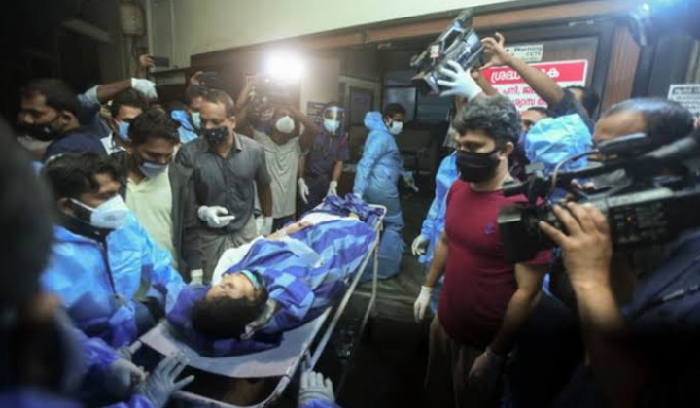
Kozhikode, Aug 8: A family of five, returning to their hometown at Koducalli in Kozhikode from Dubai, were aboard the fateful Air India Express flight that crash-landed at the Kozhikode airport claiming at least 18 lives on Friday.

Saifudheen, 40, is a businessman in Dubai. During the vacation when schools were closed here, his wife Fasalunnisa travelled, along with their children Muhammad Shahil, Fathima Sana and Aysha Shanza, to meet her husband.

On Friday, they were all travelling in the Air India aircraft to Kozhikode.

All five have received injuries and have been admitted to Baby Memorial Hospital Kozhikode except Sana, who is admitted to Al Shifa Hospital at Perinthalmanna in Malappuram.

"Saifudheen is my uncle. He and his family members were returning from Dubai when this unfortunate incident occurred. We were informed about the mishap at 8 pm. Now the family members have been shifted to Baby Memorial Hospital and everyone is fine now," Muhammad Salih, nephew of Saifudheen said.

The death toll in the flight crash landing incident at Kozhikode International Airport in Kerala rose to 18, including two pilots, Civil Aviation Minister Hardeep Singh Puri said on Saturday.

The minister said that he will visit the Kozhikode airport to take stock of the situation.

Two special relief flights have been arranged from Delhi and one from Mumbai for rendering humanitarian assistance to all the passengers and the family members.

Aircraft Accident Investigation Bureau (AAIB), Directorate General of Civil Aviation (DGCA) and Flight Safety Departments have reached to investigate the incident, the Air India Express stated.

Comments

Add new comment

  • Coastaldigest.com reserves the right to delete or block any comments.
  • Coastaldigset.com is not responsible for its readers’ comments.
  • Comments that are abusive, incendiary or irrelevant are strictly prohibited.
  • Please use a genuine email ID and provide your name to avoid reject.
News Network
January 13,2020

Jan 13: For the first time in years, the government of India’s Prime Minister Narendra Modi is playing defense. Protests have sprung up across the country against an amendment to India’s laws — which came into effect on Friday — that makes it easier for members of some religions to become citizens of India. The government claims this is simply an attempt to protect religious minorities in the Muslim-majority countries that border India; but protesters see it as the first step toward a formal repudiation of India’s constitutionally guaranteed secularism — and one that must be resisted.

Modi was re-elected prime minister last year with an enhanced majority; his hold over the country’s politics is absolute. The formal opposition is weak, discredited and disorganized. Yet, somehow, the anti-Citizenship Act protests have taken hold. No political party is behind them; they are generally arranged by student unions, neighborhood associations and the like.

Yet this aspect of their character is precisely what will worry Modi and his right-hand man, Home Minister Amit Shah. They know how to mock and delegitimize opposition parties with ruthless efficiency. Yet creating a narrative that paints large, flag-waving crowds as traitors is not quite that easy.

For that is how these protests look: large groups of young people, many carrying witty signs and the national flag. They meet and read the preamble to India’s Constitution, into which the promise of secularism was written in the 1970’s.

They carry photographs of the Constitution’s drafter, the Columbia University-trained economist and lawyer B. R. Ambedkar. These are not the mobs the government wanted. They hoped for angry Muslims rampaging through the streets of India’s cities, whom they could point to and say: “See? We must protect you from them.” But, in spite of sometimes brutal repression, the protests have largely been nonviolent.

One, in Shaheen Bagh in a Muslim-dominated sector of New Delhi, began simply as a set of local women in a square, armed with hot tea and blankets against the chill Delhi winter. It has now become the focal point of a very different sort of resistance than what the government expected. Nothing could cure the delusions of India’s Hindu middle class, trained to see India’s Muslims as dangerous threats, as effectively as a group of otherwise clearly apolitical women sipping sweet tea and sharing their fears and food with anyone who will listen.

Modi was re-elected less than a year ago; what could have changed in India since then? Not much, I suspect, in most places that voted for him and his party — particularly the vast rural hinterland of northern India. But urban India was also possibly never quite as content as electoral results suggested. India’s growth dipped below 5% in recent quarters; demand has crashed, and uncertainty about the future is widespread. Worse, the government’s response to the protests was clearly ill-judged. University campuses were attacked, in one case by the police and later by masked men almost certainly connected to the ruling party.

Protesters were harassed and detained with little cause. The courts seemed uninterested. And, slowly, anger began to grow on social media — not just on Twitter, but also on Instagram, previously the preserve of pretty bowls of salad. Instagram is the one social medium over which Modi’s party does not have a stranglehold; and it is where these protests, with their photogenic signs and flags, have found a natural home. As a result, people across urban India who would never previously have gone to a demonstration or a political rally have been slowly politicized.

India is, in fact, becoming more like a normal democracy. “Normal,” that is, for the 2020’s. Liberal democracies across the world are politically divided, often between more liberal urban centers and coasts, and angrier, “left-behind” hinterlands. Modi’s political secret was that he was that rare populist who could unite both the hopeful cities and the resentful countryside. Yet this once magic formula seems to have become ineffective. Five of India’s six largest cities are not ruled by Modi’s Bharatiya Janata Party in any case — the financial hub of Mumbai changed hands recently. The BJP has set its sights on winning state elections in Delhi in a few weeks. Which way the capital’s voters will go is uncertain. But that itself is revealing — last year, Modi swept all seven parliamentary seats in Delhi.

In the end, the Citizenship Amendment Act is now law, the BJP might manage to win Delhi, and the protests might die down as the days get unmanageably hot and state repression increases. But urban India has put Modi on notice. His days of being India’s unifier are over: From now on, like all the other populists, he will have to keep one eye on the streets of his country’s cities.

Comments

Add new comment

  • Coastaldigest.com reserves the right to delete or block any comments.
  • Coastaldigset.com is not responsible for its readers’ comments.
  • Comments that are abusive, incendiary or irrelevant are strictly prohibited.
  • Please use a genuine email ID and provide your name to avoid reject.
News Network
March 23,2020

New Delhi, Mar 23: The total number of COVID-19 cases in the country rose to 390 on Monday after 30 fresh cases were reported.

The figure includes 41 foreign nationals and the seven deaths reported so far.

Gujarat, Bihar and Maharahstra reported a death each on Sunday, while four fatalities were reported earlier from Karnataka, Delhi, Maharashtra and Punjab, the Union Health Ministry said.

The total number of active COVID-19 cases across the country now stands at 359, while 24 people have been cured/discharged/migrated.

Comments

Add new comment

  • Coastaldigest.com reserves the right to delete or block any comments.
  • Coastaldigset.com is not responsible for its readers’ comments.
  • Comments that are abusive, incendiary or irrelevant are strictly prohibited.
  • Please use a genuine email ID and provide your name to avoid reject.