Basavanna taught us to worship one god; opposed Hindu practices: Lingayat seer

coastaldigest.com news network
July 27, 2017

Belagavi, Jul 27: Endorsing the idea of independent religious status for Veerashaiva-Lingayat community, Jaya Mrutyunjaya Swami of Panchamasali Peetha, Kudalasangama, has said that the 12th century reformer Basavanna had strongly opposed Vedic (Hindu) religion and its practices.

basavannaSpeaking to reporters on Wednesday, the seer said Basavanna fought against caste system in the Vedic religion and for gender equality. He gave a philosophy of one god worship, inventing the ‘Ishta Linga’ concept, and founded Lingayatism religion. People who had opposed separate religious status to Jains and Sikhs were creating confusion. They were now opposing independent religion status to Lingayat religion, which flourished in Kannada land, the Swami said.

After a long delay, the community has become aware and the time is ripe for them to get their due. The term Veerashaiva is a new one and is not equivalent to Lingayat. All those who followed Basavanna were Lingayats, he said.

The leaders of BJP and Congress should pay tributes to Basavanna by ensuring separate religious status. With the government sending its recommendations in support of the demand to the Centre, BJP leaders under the leadership of former chief minister B S Yeddyurappa should prevail upon the Narendra Modi government to accord the status. Lingayats had all the potential to become a separate religion, encompassing all sects, he said.

The seer said, Yeddyurappa, who had opposed the separate religious status, had changed his view and clarified he would be bound by the decision of the Veerashaiva/Lingayat Mahasabha. He said a convention of the Lingayat community to demand separate religion status would be held at Kudalasangama on August 20.

Comments

Sharief S
 - 
Sunday, 30 Jul 2017

The move is much impressive and a great step towards Logic, but still lacking towards perfection.

We should know well the God has a already decreed us the religion which is for all to obey. That religion is perfectly preaching 1ness and much perfect.

We dont want to worry to invent it, as the God has already introduced it for all of us.

We need to just identify it amontst the so called religions. You be whoever with your name.

You have Islam religion is there which God has created for all. Read and understand it, nothing can be found parallel to it.

Because it is the devine set of God's command in its entirety forms one and only true religion.

Please know it well, it is the latest revised version of its predecessing religions Judaism and Christianity.

In otherwords it is the latest version by the God for all of us. Follow it well it is Lingaitism in its purest form.


This is like is you are searching true gold among the imitated fake  products.


It is everybody's duty and right to seach for your rights.


shamon
 - 
Thursday, 27 Jul 2017

Its shame that courts are respecting terrorists and releasing them on bail whereas innocents are denied of bail and rotting in jails. This is ache din for trouble makers and hate mongers.

shamon
 - 
Thursday, 27 Jul 2017

Death Israel terrorists and their supporters. May Allah destroy Israeli army and let them go to hell. Its shame that Muslim countries and UNO is doing nothing for the force being used by Jews terrorists on unarmed palestinians.

M. K.
 - 
Thursday, 27 Jul 2017

Basavanna was a thinker beyond his times. He questioned the prevalent religious systems of his time and promoted social and gender equality. We have a lot to learn from him- to not stick to old religious dogmas and democratically rethink about religious teachings.
Unfortunately, we have forgotten him.

Add new comment

  • Coastaldigest.com reserves the right to delete or block any comments.
  • Coastaldigset.com is not responsible for its readers’ comments.
  • Comments that are abusive, incendiary or irrelevant are strictly prohibited.
  • Please use a genuine email ID and provide your name to avoid reject.
Agencies
April 25,2020

From loudspeakers on the roof of a Minnesota mosque, the Islamic call to prayer echoed for the first time ever throughout a Minneapolis neighbourhood late on Thursday as the Muslim community there prepared to begin the holy month of Ramadan.

It echoed again on Friday morning and will continue five times a day during the holy month. 

The simple, short call - known as the adhan - marked an historical moment for Minneapolis and major cities across the United States, community members said. While the adhan is commonly broadcast throughout the Middle East, North Africa and other places, for many Muslims in the US, it is only heard inside mosques or community centres.

"There's definitely a lot of excitement," said Imam Abdisalam Adam, who is on the board of the Dar al-Hijrah mosque, from where the adhan will be broadcast.
"Some people see it as historic," Adam told Al Jazeera. "To the point ... that they're not doing it, able to see it in their lifetime." 

Recited by different representatives from mosques around the city, the call to prayer is expected to reach thousands in the Cedar-Riverside neighbourhood in Minneapolis, according to Jaylani Hussein, the executive director of Minnesota's Council on American-Islamic Relations (CAIR).

While Hussein says the community had discussed broadcasting the call for years, it became even more pressing this year when the coronavirus pandemic forced mosques to shut their doors and residents to stay inside. The coronavirus has infected more than 870,000 people nationwide and killed at least 50,000.
"We wanted to touch those individuals who frequent this mosque and this community," Hussein said. "If we cannot be physically together, at least this echo, this voice, this call to prayer can be an extension of us being together at this difficult time. To give some people some solace."
Ramadan - Minnesota.

The Dar al-Hijrah mosque in the Cedar-Riverside neighbourhood of Minneapolis, Minnesota [Courtesy of Abdisalem Adam] 
Ramadan is traditionally a time when Muslims worldwide regularly attend mosques for daily prayers and break their fasts together. But this year, most have been told to pray at home and forgo community iftars in favour of staying safe from the COVID-19 crisis.

Adam, the imam, said while the Muslim community is experience loss this Ramadan, they hope the call to prayer broadcast will create a "semblance of normalcy".

"With the loss of Friday prayers and the regular congregational prayers, we are hoping that this will give a sense of solace and connection to the spiritual needs of community members," he added. 

An avenue to greater investment?

The Cedar-Riverside neighbourhood is a densely populated area of Minneapolis that has historically been an entry point for many immigrants and today is home to large Somali and Oromo communities.

Ramla Bile, a Somali American who lives in a neighbourhood adjacent to Cedar-Riverside, has been active in the community for years. She welcomed the broadcast of the call to prayer, saying it will help people "feel the spirit of Ramadan in a way that is meaningful".

But she also hopes the city of Minneapolis, which provided the noise permit for the broadcast, will make bigger strides to invest in the community in even more tangible ways.

"There's been a lot of need and a lot hurt in the community in light of the COVID-19 pandemic. And then there's the ongoing conversation you've been having," she said, pointing to deep-seated Islamophobia, systemic racism and the need for infrastructure projects like sprinkler systems in high-rise buildings. 

"We need to see greater investments to support the most vulnerable members of our community," Bile said referring to the neighbourhood's elders, undocumented individuals, low-income families and others.

"Right now, we're waiting for a bailout for our micro-businesses who comprise our Somali malls, or a rent freeze for neighbourhood residents," she added.

For CAIR's Hussein and Imam Adam, they hope this Ramadan's call to prayer helps encourage other communities around the US to take similar steps.

"This will hopefully inspire others … to think about what could happen in future Ramadans and beyond," Hussein said.

Adam added that while the virus has devastated communities and upended daily life, it has also shown that "we're in this together".

"It just shows the significance of the global village and how interconnected and interdependent we are as a world community," he said. "I think that there will be a lot of change in our way of life for the better. I hope so."


 

Comments

Add new comment

  • Coastaldigest.com reserves the right to delete or block any comments.
  • Coastaldigset.com is not responsible for its readers’ comments.
  • Comments that are abusive, incendiary or irrelevant are strictly prohibited.
  • Please use a genuine email ID and provide your name to avoid reject.
Agencies
July 30,2020

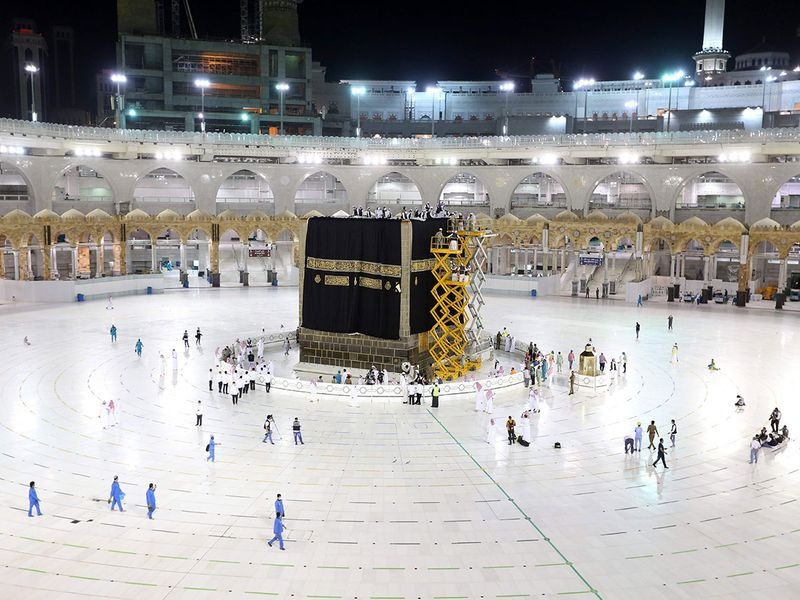
Makkah, July 30: Like every year, the Kiswa (black cloth) of holy Kaaba was replaced on Wednesday night, a process administered by the staff of the General Presidency for the Affairs of the Two Holy Mosques in accordance with the annual tradition, the Saudi Press Agency reported.

Ahmed Bin Mohammed Al-Mansouri, deputy head of the General Presidency for the Affairs of the Two Holy Mosques and director-general of the King Abdul Aziz Complex for the Kaaba, said in a statement that the Holy Kaaba was donned with a new Kiswa, constituted of four sides and a sitar (curtain) for the door.

Each of the four parts of the Kiswa was separately raised, in preparation for stretching it on the old side. The side was consolidated from above by tying it and dropping at the other end after the old side’s ropes were untied by moving the new side up and down.

Then, the old side was removed from the bottom and the new side remained, and the process was repeated four times for each section until the operation was complete and the belt was sewn in a line, straight with the four sides, Al-Mansouri said.

Al-Mansouri added: “The process began from the side of the Hateem (a semi-circular wall opposite the northwest wall of the Kaaba), because Al-Mizab (a rainwater spout made of gold) requires a special opening at the top. After consolidating all the sides, the corners were fixed by sewing them from the top of the cloth to the bottom.

Then, the curtain that required more time and hard work was installed by making a small opening with an approximate width of 3.30 meters. Three other holes were made in the black cloth to put the curtain in place under the cloth, and the sides were sewn in the black cloth of the dress, Al-Mansouri said, adding that the Kaaba cloth is made of 670 kg of high-quality silk, 120 kg of gold threads, and 100 kg of silver threads.

As many as 200 Saudi craftsmen are engaged in producing the black curtain at the King Abdul Aziz Complex for Holy Kaaba Kiswa, Al-Mansouri said.

Comments

Add new comment

  • Coastaldigest.com reserves the right to delete or block any comments.
  • Coastaldigset.com is not responsible for its readers’ comments.
  • Comments that are abusive, incendiary or irrelevant are strictly prohibited.
  • Please use a genuine email ID and provide your name to avoid reject.
Agencies
July 29,2020

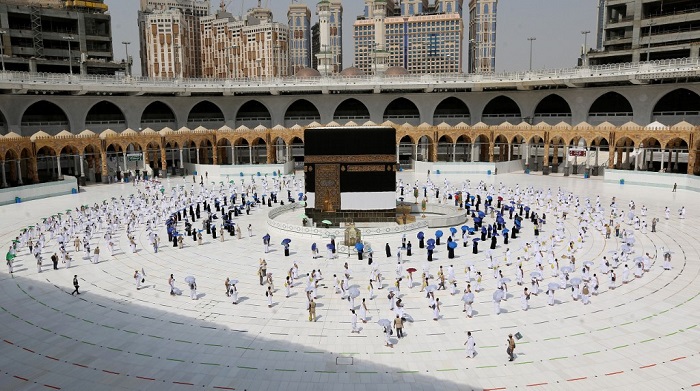
Dubai, Jul 29: Muslim pilgrims on Wednesday begin the annual Haj, downsized this year as the Saudi hosts strive to prevent a coronavirus outbreak during the five-day pilgrimage.

The Haj, one of the five pillars of Islam and a must for able-bodied Muslims at least once in their lifetime, is usually one of the world's largest religious gatherings.

But this year only up to 10,000 people already residing in the Kingdom will participate in the ritual, a tiny fraction of the 2.5 million pilgrims from around the world that attended last year.

"There are no security-related concerns in this pilgrimage, but (downsizing) is to protect pilgrims from the danger of the pandemic," said Khalid bin Qarar Al Harbi, Saudi Arabia's director of public security.

Pilgrims will be required to wear masks and observe social distancing during a series of religious rites that are completed over five days in the holy city of Makkah and its surroundings in western Saudi Arabia.

Those selected to take part in the Haj were subject to temperature checks and placed in quarantine as they began trickling into Makkah at the weekend.

State media showed health workers sanitising their luggage, and some pilgrims reported being given electronic wristbands to allow authorities to monitor their whereabouts.

Workers, clutching brooms and disinfectant, were seen cleaning the area around the Kaaba, the structure at the centre of the Grand Mosque draped in gold-embroidered cloth towards which Muslims around the world pray.

Haj authorities have cordoned off the Holy Kaaba this year, saying pilgrims will not be allowed to touch it, to limit the chances of infection.

They also reported setting up multiple health facilities, mobile clinics and ambulances to cater to the pilgrims.

Saudi authorities said only around 1,000 pilgrims residing in the Kingdom would be permitted for the Haj. Some 70 per cent of the pilgrims are foreigners residing in the Kingdom, while the rest will be Saudi citizens, authorities said.

All worshippers were required to be tested for coronavirus before arriving in the holy city of Makkah and will also have to quarantine after the pilgrimage as the number of cases in the Kingdom nears 270,000.

They were given elaborate amenity kits that include sterilised pebbles for a stoning ritual, disinfectants, masks, a prayer rug and the Ihram, a seamless white garment worn by pilgrims, according to a Haj ministry programme document.

"I did not expect, among millions of Muslims, to be blessed with approval," Emirati pilgrim Abdullah Al Kathiri said in a video released by the Saudi media ministry.

"It is an indescribable feeling... especially since it is my first pilgrimage."

The Haj ministry said non-Saudi residents of the Kingdom from around 160 countries competed in the online selection process but it did not say how many people applied.

Despite the pandemic, many pilgrims consider it safer to participate in this year's ritual without the usual colossal crowds cramming into tiny religious sites, which make it a logistical nightmare and a health hazard.

Comments

Add new comment

  • Coastaldigest.com reserves the right to delete or block any comments.
  • Coastaldigset.com is not responsible for its readers’ comments.
  • Comments that are abusive, incendiary or irrelevant are strictly prohibited.
  • Please use a genuine email ID and provide your name to avoid reject.