Azaan from mosques causes noise pollution: Tripura governor

News Network
October 19, 2017

Agartala, Oct 19: Tripura governorTathagata Roy has created yet another controversy by claiming azaan, or Muslim call to prayer, caused noise pollution.

Roy was in news last week for his comments equating the Supreme Court ban on sale of firecrackers in Delhi to a communal conspiracy.

"Every Diwali fights start over noise pollution from crackers. A few days in a year. But no fight about Azaan over loudspeakers at 4.30 am." he wrote in a series of tweets on Tuesday, comparing noise caused by crackers to the call to prayer by mosques over loudspeakers.

"Actually this silence of the 'secular' crowd over noise pollution by Azaan perplexes me. Loudspeakers are not prescribed in Quran or any Haadis," he added and then claimed: "The Muezzin is supposed to shout Aazan from the minarets, which is why the minarets are there. Use of loudspeakers, thus is contrary to Islam."

Last week, Roy tweeted that those supporting the Supreme Court ban on sale of firecrackers in Delhi would target Hindu cremation rites next, triggering strong reactions both in favour of and against his comments. This time, too, the response was polarised.

Later, Roy defended his tweets on azaan, saying he had not compared firecrackers to the call to prayer but had expressed his reservation about the use of loudspeakers for the same.

Comments

Abdul Vadood
 - 
Friday, 20 Oct 2017

Another RSS agent , if u think Azan is noise pollution then go to any isolated island , there u can never hear your  noisy bajan as well.   Kab Sudhroge, qayamat aane ke badh ??

Hussain
 - 
Friday, 20 Oct 2017

Respected Readers

With Azaan sound,  all devil forces feel uncomforting and they start running. So animal start crying by looking sudden changes in surrounding  like dooms day.

In old days, the Azaan and Namaz was treatment for all type diseases and devil forces.   

Please confirm this fact from your respected elders. Thanks.

a.k. bakhar
 - 
Thursday, 19 Oct 2017

Only Allah should take care of people like Tripura Governor Tathgatta Roya who are hatching communal conspiracy over the issue of noise pollution because of azaan by Muslims.  Azaan is called just for two or three minutes and it should not be a problem for any one.  Moreover even some non-muslims also enjoy this call for prayer by Muslims.  These people fail to recognise the heavy air pollution and noise pollution caused by Hindu festivals like Diwali, Holi, Dasara, their Bhajans and poojas by wasting milk, ghee etc. and cremation of their dead bodies.  No one is worried about these pollutions.  May the Almighty God guide these dirty minded communal conspirators on the right path, Aameen. 

Add new comment

  • Coastaldigest.com reserves the right to delete or block any comments.
  • Coastaldigset.com is not responsible for its readers’ comments.
  • Comments that are abusive, incendiary or irrelevant are strictly prohibited.
  • Please use a genuine email ID and provide your name to avoid reject.
coastaldigest.com news network
July 27,2020

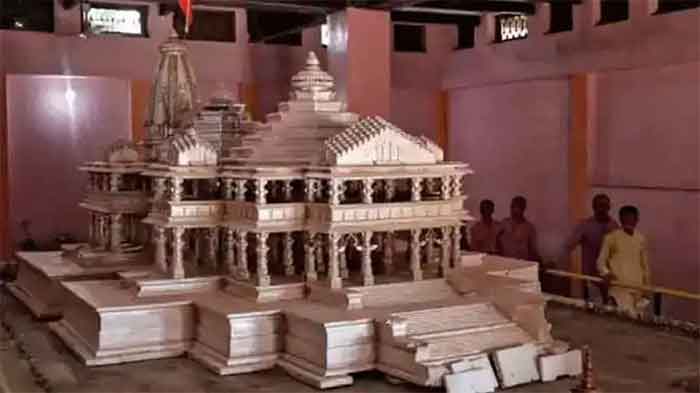
Ayodhya, Jul 27: With days to go for the August 5 "bhoomi pujan" ceremony of the Ram temple in Ayodhya, the mosques adjacent to the demolished Babri Masjid premises are spreading the message of a peaceful coexistence of Hindus and Muslims.

There are eight mosques and two mausoleums located close to the 70-acre Babri Masjid premises mandated by the Supreme Court for a temple of Sri Ram.

Azaan and namaaz are offered in the mosques and the annual "Urs" is held at the mausoleums without any objection from the local Hindus.

The eight mosques located near the upcoming Ram temple premises are Masjid Dorahikuan, Masjid Mali Mandir ke Bagal, Masjid Kaziyana Achchan ke Bagal, Masjid Imambara, Masjid Riyaz ke Bagal, Masjid Badar Paanjitola, Masjid Madaar Shah and Masjid Tehribazar Jogiyon ki.

The two mausoleums are Khanqaahe Muzaffariya and Imambara.

"It is the greatness of Ayodhya that the mosques surrounding the Ram temple are giving a strong message of communal harmony to the rest of the world," Haji Asad Ahmad, the corporator of the Ram Kot ward, said. The Ram temple area is situated in Ahmad's ward.

"Muslims take out the 'juloos' of Barawafaat that goes through the periphery of Ram Janmabhoomi. All religious functions and rituals of Muslims are respected by their fellow citizens," the corporator said.

Asked for a comment on the presence of mosques near the upcoming Ram temple premises, the chief priest of the temple, Acharya Satyendra Das, said, "We had a dispute only with the structure that was connected to the name of (Mughal emperor) Babur. We have never had any issue with the other mosques and mausoleums in Ayodhya. This is a town where Hindus and Muslims live in peace."

"Muslims offer namaaz, we perform our puja. The mosques around us will strengthen Ayodhya's communal harmony and peace will prevail," he added.

Both Hindus and Muslims have accepted the Supreme Court verdict over Ram Janmabhoomi, Das said, adding, "We have no dispute with each other."

Sayyad Akhlaq Ahmad Latifi, the "sajjada nasheen" and "pir" of the 500-year-old Khanqaahe Muzaffariya mausoleum, said Muslims in Ayodhya are performing all religious practices freely.

"We offer prayers five times a day in the mosque at Khanqaah and hold the yearly 'Urs'," he added.

"What a scene would it be -- a grand Ram temple surrounded by small mosques and mausoleums and everyone offering prayers according to their beliefs. That will be representative of the true culture of India," Mahant Yugal Kishore Sharan Shastri, the chief priest of the Sarayu Kunj temple adjacent to the Ram Janmabhoomi premises, said.

Reacting to the presence of mosques and mausoleums near the Ram Janmabhoomi premises, Triloki Nath Pandey, the decree holder of the land as the "first friend of Ram Lalla" as mandated by the Supreme Court, said, "We do not have any objection to either those mosques or any other mosques. We will not trigger a dispute regarding any structure, Ayodhya must live in peace and communal harmony."

Mahant Raju Das, the priest of the Hanumangarhi temple, said, "The presence of the mosques tells the story of Ayodhya's communal harmony. A Ram mandir will be built and there will be no objection to the mosques or religious practices of Muslims."

Comments

Add new comment

  • Coastaldigest.com reserves the right to delete or block any comments.
  • Coastaldigset.com is not responsible for its readers’ comments.
  • Comments that are abusive, incendiary or irrelevant are strictly prohibited.
  • Please use a genuine email ID and provide your name to avoid reject.
Agencies
January 20,2020

New Delhi, Jan 20: The BJP has got a brand new President in the form of JP Nadda. At around 2.30 pm, the announcement was made, bringing an end to the Amit Shah era in BJP. The party's Working President Jagat Prakash Nadda won unopposed, sparking celebrations outside the BJP headquarters here on Monday. 

Amit Shah himself was among the people who proposed Nadda's name along with Nitin Gadkari and Rajnath Singh. Soon after his annointment, BJP election returning officer Radha Mohan Singh told the media, "I announce JP Nadda as the new BJP President." Shah was also seen hugging Nadda.

The nomination process for the post of the BJP President began at 10 am and went on till 12.30 pm. For the next hour, the filed nomination paper, which was just one, was examined. Party members waitied till 2.30 pm for the candidate to withdraw if he wished to. It was after this that Nadda was declared as the man who would step into the shoes of Amit Shah.

Many in the BJP believe that although Nadda is the BJP chief now, Shah would still make all macro-level decisions like pre poll alliances or top organisational appointments. Nadda would be in charge of monitoring the day-to-day needs of the organisation. BJP sources say that Amit Shah himself wanted an arrangement like this one and personally wanted Nadda to take over. as he helped Shah formulate legislations like Triple Talaq and Citizenship Amendment Act.

The party constitution mandates completion of election of at least 50 per cent of state Presidents for the election of national President to happen. In the last few days, the BJP has completed the election of a slew of state Presidents like in West Bengal, Nagaland among others.

The process of election of the national BJP President is quite elaborate and has been described in detail in the party constitution, which says that the national president shall be elected by an electoral college, comprising members of the national council and the state councils.

"Any 20 members of the electoral college of a state can jointly propose the name of a person, who has been an active member for four terms and has 15 years of membership, for the post of national president. Such joint proposal should come from not less than five states where elections have been completed for the national council. The consent of the candidate is necessary," it says.

Who is JP Nadda?

Jagat Prakash Nadda, 59, who has his roots in the Rashtriya Swayamsevak Sangh (RSS) and its affiliates, was appointed the Bharatiya Janata Party (BJP) national President on Monday, replacing his 'mentor' and Union Home Minister Amit Shah.

Former environment, health and law minister from Himachal Pradesh, which has just four of the Lok Sabha's 543 seats, Nadda has tried to carve out his own space in national politics with his low profile and astute organisational skills, believe his party leaders.

He rose through the ranks from the Akhil Bharatiya Vidyarthi Parishad (ABVP), the student wing of the RSS, from where he has managed to build inroads from university to the state politics.

Nadda has been active on the national political scene since 2010 when he was picked by then BJP chief Nitin Gadkari to join his new team. He was made the party's national general secretary.

Born on December 2, 1960, Nadda did his graduation from Patna and holds a post-graduate degree in political science and Bachelor of Legislative Law (LL.B) from Himachal Pradesh University in Shimla.

Starting his political career as a student leader of the ABVP in 1978, Nadda had also worked both with Gadkari and Shah even in the party's youth wing -- the Bharatiya Yuva Morcha -- from 1991 to 1994.

His wife Mallika Nadda, who teaches history at the Himachal Pradesh University and is currently posted in university's campus in Delhi, was an ABVP activist too, and its national general secretary from 1988 to 1999.

In the previous BJP government (2007-12) in the state, Nadda was forced to resign as Forest Minister in 2010 owing to differences between him and then chief minister Prem Kumar Dhumal.

He was elected to the Rajya Sabha in 2012.

Nadda won his first Assembly election from Bilaspur (Sadar) in Himachal in 1993. In 1998, he again won from that seat and became the state Health Minister.

He lost the Assembly elections in 2003, but again won in 2007 and was appointed the Forest Minister in the Himachal Pradesh.

Nadda, as a forest minister, was the brain behind opening forest police stations to check forest crimes, launching community-driven plantation, setting up forest ponds and the massive plantation of deodars to boost the depleting green cover of the 'Queen of Hills', as Shimla was fondly called by the British.

A close confidant of Prime Minister Narendra Modi, Nadda was among those who were mentioned as likely aspirants to the BJP top post after Rajnath Singh was inducted into the Central government as the Home Minister in 2014.

Later, Nadda was inducted into the union cabinet in its first expansion in 2014 as the Health Minister.

Hailing Nadda's appointment, Chief Minister Jai Ram Thakur told IANS it is a proud moment that a leader belonging to a small state in the national politics is today the leader of the country's biggest national party.

His father N.L. Nadda, who was a Vice-Chancellor of the Ranchi University, resides in Bilaspur town.


Comments

Add new comment

  • Coastaldigest.com reserves the right to delete or block any comments.
  • Coastaldigset.com is not responsible for its readers’ comments.
  • Comments that are abusive, incendiary or irrelevant are strictly prohibited.
  • Please use a genuine email ID and provide your name to avoid reject.
News Network
May 19,2020

New Delhi, May 19: In a fresh blow to saffronite journalist Arnab Goswami, the Supreme Court of India today rejected his plea seeking transfer of the investigation of a case, filed against him for defaming Congress interim president Sonia Gandhi, to the CBI. The court also refused to quash the FIRs filed against him.

Goswami, editor-in-chief of Republic TV, has been booked in connection with a TV show on the gathering of migrants outside Bandra railway station on April 14. This apart, multiple FIRs have been filed against him for his show on Palghar lynching. In that show, he had posed certain questions on the incident to Congress President Sonia Gandhi, following which Congress workers lodged complaints against him in various states.

Extending Goswami’s interim protection from arrest by three weeks, the Supreme Court said, “Right of a journalist under 19 1 (a) higher…Free citizens can’t exist if news media can’t speak.”

During the earlier hearing, Senior Advocate Harish Salve, appearing for Goswami, had urged the court to transfer the probe to an agency like CBI. He said the “nature of the” second FIR against Goswami over a show on the migrant gathering outside Bandra station on April 14 “shows that it’s arm-twisting tactic”. 

“They are trying to stifle an unpleasant voice. This is a political party targeting a journalist. All complainants are members of one political party. They have a problem with the government. They want to teach this journalist a lesson,” he added.

Objecting to Salve’s plea to transfer the case to the CBI, Maharashtra government counsel, Senior Advocate Kapil Sibal, had said, “CBI investigation will go into your hands”. 

Sibal denied that Goswami was being harassed and said he was only asked relevant questions. He said Goswami should “stop this communal violence and communal mongering”.

Comments

Add new comment

  • Coastaldigest.com reserves the right to delete or block any comments.
  • Coastaldigset.com is not responsible for its readers’ comments.
  • Comments that are abusive, incendiary or irrelevant are strictly prohibited.
  • Please use a genuine email ID and provide your name to avoid reject.