


Out of court settlement: Shia board proposes temple in Babri land; mosque in Lucknow

Agencies
November 20, 2017

Lucknow, Nov 20: Uttar Pradesh Shia Waqf Board today proposed relinquishing its right over the disputed land in Ayodhya, and building a 'masjid-e-aman" in Lucknow to resolve the Ram janmabhoomi-Babri masjid tangle, a move rejected by the Muslim protagonists involved in the protracted legal feud.

The board, which is the 'mutawalli' (caretaker) of the Babri Mosque, has proposed giving up its right over the land in Ayodhya, and a draft for resolving the issue, prepared by the Shia Waqf Board, has been submitted in the Supreme Court on November 18, its chairman Wasim Rizvi told reporters here.

Claiming that the formula for resolving the matter proposed by the Shia Waqf Board was the best, Rizvi said it is of the view that instead of Ayodhya, a 'masjid-e-aman' (the mosque of peace) be constructed in Lucknow's Hussainabad area.

The Board, he said, has requested the government to provide a one acre plot for it.

The proposal, however, did not go down well with the All India Muslim Personal Law Board (AIMPLB).

"On whose behalf has he brought this draft proposal? He (Rizvi) does not enjoy the confidence or recognition of either the Sunni sect or the Shia sect," AIMPLB counsel in the case and its senior member Zafaryab Jilani said.

Jilani, who is also the convenor of Babri Masjid Action committee, referred to some legal shortcomings in the draft proposal.

"The Shia Board has no authority over the disputed land as the Allahabad High Court, in 2010, had ruled a three-way division of the disputed 2.77-acre area at Ayodhya among Sunni Waqf Board, Nirmohi Akhara and Lord Ram Lalla...the Shia board has no right over any part of the land," he said.

Moreover, Jilani said since the Shia Waqf Board did not appeal against the high court's decision, it meant that the ruling, which was binding on all till the Supreme Court announced its judgement, was acceptable to them.

Rizvi, however, rejected the claim of UP Sunni Central Waqf Board over the disputed site, saying that the Allahabd High court had given the land to Muslims and not to Sunni Waqf Board.

Chairman of the UP Sunni Central Waqf Board Zafar Farooqui said any claim can be accepted or rejected only by the court "...our involvement has been since 1961 and it is being rejected by the Shia Board now...he (Rizvi) does not have the authority to do so..."

Rizvi, he said, has been chairman of the board since 2006-07, and could have spoken on the subject even when the case was being heard by the Lucknow bench, which came up with its verdict in 2010, or in the Supreme Court where the hearing is going on for the last seven years.

"It is absurd. He has been silent on it ever since and has become active only now. The case is going on in the highest court of the country. Whatever he has to say, he should do it in the court. What's the relevance of releasing his formula to the media?" he said.

Jilani alleged that Rizvi was "working overtime to please certain forces in order to serve his personal motives".

Rizvi, who addressed the press conference along with Mahant Narendra Giri, chairman of the All India Akhara Parishad, alleged that the Shia Board's views on the matter were never put forward in a forceful manner because the lawyers deployed for the purpose were "fake".

Referring to the criticism of his recent actions, Rizvi said it was because the board was never given any court copy and that it was not aware that lawyers were pleading on its behalf.

It was only on March 21, 2017, when the apex court said that talks could be initiated for mutual agreement to end the dispute that the Shia Waqf Board looked into the files in detail only to find that though it is a party in the case it never gave 'wakalatnama' to the counsel appearing on its behalf, Rizvi said.

"It is a matter of probe that the case is being pursued by overlooking the actual claimant which is the Shia Board...I have requested the central and state governments to get it enquired as to who had fielded the lawyers on our behalf," he said.

On Rizvi's allegations regarding fake counsel, Jilani said that it should be probed by the Shia board itself.

Jilani, however, said that he had never seen any counsel pleading on behalf of the Shia Board in the court.

On the role of AIMPLB, Rizvi said it (board) should have come forward for a dialogue but since it did not take the initiative, Shia board had to come forward.

Giri said a Ram temple in Ayodhya will be constructed and that an amicable settlement should be reached on the issue by talking to all the parties concerned.

Comments

Fairman
 - 
Tuesday, 21 Nov 2017

Anti Nationals / Terrorist following the devide and rule (same as British done before the Independence) with Sunni Muslims and Shia people for their benefits by giving money one way or other.  But these (Shia) absent minded people is folowing this because of Publicity. 

Mohammed SS
 - 
Tuesday, 21 Nov 2017

First of all Shias are not Muslims they can worship Ram as well, and they can perform their prayer in Ram Mandhir also, they dont have any right to interfere in this issue. This land belongs to Sunni waqf board and it will remain forever to build Mosque or to keep the land vacant it is Sunni Waqf bord choice and Shias nothing to do with this it is  Shia hated world wide and they will became rare to see very soon. 

Add new comment

  • Coastaldigest.com reserves the right to delete or block any comments.
  • Coastaldigset.com is not responsible for its readers’ comments.
  • Comments that are abusive, incendiary or irrelevant are strictly prohibited.
  • Please use a genuine email ID and provide your name to avoid reject.
Agencies
July 1,2020

The ILO has warned that if another Covid-19 wave hits in the second half of 2020, there would be global working-hour loss of 11.9 percent - equivalent to the loss of 340 million full-time jobs.

According to the 5th edition of International Labour Organisation (ILO) Monitor: Covid-19 and the world of work, the recovery in the global labour market for the rest of the year will be uncertain and incomplete.

The report said that there was a 14 percent drop in global working hours during the second quarter of 2020, equivalent to the loss of 400 million full-time jobs.

The number of working hours lost across the world in the first half of 2020 was significantly worse than previously estimated. The highly uncertain recovery in the second half of the year will not be enough to go back to pre-pandemic levels even in the best scenario, the agency warned.

The baseline model – which assumes a rebound in economic activity in line with existing forecasts, the lifting of workplace restrictions and a recovery in consumption and investment – projects a decrease in working hours of 4.9 percent (equivalent to 140 million full-time jobs) compared to last quarter of 2019.

It says that in the pessimistic scenario, the situation in the second half of 2020 would remain almost as challenging as in the second quarter.

“Even if one assumes better-tailored policy responses – thanks to the lessons learned throughout the first half of the year – there would still be a global working-hour loss of 11.9 per cent at the end of 2020, or 340 million full-time jobs, relative to the fourth quarter of 2019,” it said.

The pessimistic scenario assumes a second pandemic wave and the return of restrictions that would significantly slow recovery. The optimistic scenario assumes that workers’ activities resume quickly, significantly boosting aggregate demand and job creation. With this exceptionally fast recovery, the global loss of working hours would fall to 1.2 per cent (34 million full-time jobs).

The agency said that under the three possible scenarios for recovery in the next six months, “none” sees the global job situation in better shape than it was before lockdown measures began.

“This is why we talk of an uncertain but incomplete recovery even in the best of scenarios for the second half of this year. So there is not going to be a simple or quick recovery,” ILO Director-General Guy Ryder said.

The new figures reflect the worsening situation in many regions over the past weeks, especially in developing economies. Regionally, working time losses for the second quarter were: Americas (18.3 percent), Europe and Central Asia (13.9 percent), Asia and the Pacific (13.5 percent), Arab States (13.2 percent), and Africa (12.1 percent).

The vast majority of the world’s workers (93 per cent) continue to live in countries with some sort of workplace closures, with the Americas experiencing the greatest restrictions.

During the first quarter of the year, an estimated 5.4 percent of global working hours (equivalent to 155 million full-time jobs) were lost relative to the fourth quarter of 2019. Working- hour losses for the second quarter of 2020 relative to the last quarter of 2019 are estimated to reach 14 per cent worldwide (equivalent to 400 million full-time jobs), with the largest reduction (18.3 per cent) occurring in the Americas.

The ILO Monitor also found that women workers have been disproportionately affected by the pandemic, creating a risk that some of the modest progress on gender equality made in recent decades will be lost, and that work-related gender inequality will be exacerbated.

The severe impact of Covid-19 on women workers relates to their over-representation in some of the economic sectors worst affected by the crisis, such as accommodation, food, sales and manufacturing.

Globally, almost 510 million or 40 percent of all employed women work in the four most affected sectors, compared to 36.6 percent of men, it said.

The report said that women also dominate in the domestic work and health and social care work sectors, where they are at greater risk of losing their income and of infection and transmission and are also less likely to have social protection.

The pre-pandemic unequal distribution of unpaid care work has also worsened during the crisis, exacerbated by the closure of schools and care services.

Even as countries have adopted policy measures with unprecedented speed and scope, the ILO Monitor highlights some key challenges ahead, including finding the right balance and sequencing of health, economic and social and policy interventions to produce optimal sustainable labour market outcomes; implementing and sustaining policy interventions at the necessary scale when resources are likely to be increasingly constrained and protecting and promoting the conditions of vulnerable, disadvantaged and hard-hit groups to make labour markets fairer and more equitable.

“The decisions we adopt now will echo in the years to come and beyond 2030. Although countries are at different stages of the pandemic and a lot has been done, we need to redouble our efforts if we want to come out of this crisis in a better shape than when it started,” Ryder said. 

Comments

Add new comment

  • Coastaldigest.com reserves the right to delete or block any comments.
  • Coastaldigset.com is not responsible for its readers’ comments.
  • Comments that are abusive, incendiary or irrelevant are strictly prohibited.
  • Please use a genuine email ID and provide your name to avoid reject.
coastaldigest.com news network
August 4,2020

Mangaluru, Aug 4: The Kasaragod district administration has decided to restore the e-pass system for daily commuters between Kasaragod and Mangaluru amid covid-19 crisis. 

As covid-19 cases began to increase in Dakshina Kannada, the Kasargod district administration had unilaterally newly introduced of daily pass system on July 6 for entry and exit from Talapady border. This had inconvenienced hundreds of employees, who visited Mangaluru daily to eke a living. 

The decision to resume the pass system was taken in a video conference of Kerala Revenue Minister Chandrasekharan with officials and elected representatives on August 3.

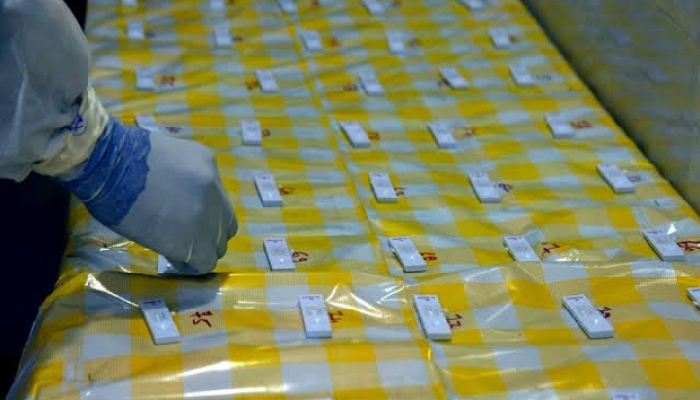
The minister said the Kasaragod district administration will resume issuing of passes for daily commuters between Kasaragod and Mangaluru. But they should undergo rapid antigen test for every week to renew their passes.

"Similarly, one-time interstate passes will be issued for those who want to take part in marriages, funeral and other functions in both states. Even they should undergo antigen test after returning from the functions,” the minister added.

As per the previous order, daily commuters, especially employees, had to stay in Mangaluru for 28 days before returning to Kasargod. Later, Kerala government relaxed rules on July 23 allowing only bank employees from Kasaragod to travel daily in their private vehicles to their workplace in Dakshina Kannada.

Comments

Add new comment

  • Coastaldigest.com reserves the right to delete or block any comments.
  • Coastaldigset.com is not responsible for its readers’ comments.
  • Comments that are abusive, incendiary or irrelevant are strictly prohibited.
  • Please use a genuine email ID and provide your name to avoid reject.
News Network
January 24,2020

Bengaluru, Jan 24: Karnataka Chief Minister BS Yediyurappa on Friday said the much-delayed Cabinet expansion will take place in the next three days.

At the Kempegowda International Airport, after his arrival from Davos, he informed that he would discuss the matter with Union Home Minister Amit Shah to take a final decision on the distribution of important portfolios.

Deputy CM Ashwanath Narayna, Home Minister Basavaraj Bommai and others received the Chief Minister at the airport. The issue of Cabinet expansion was kept in abeyance, ever since the spectacular victory of 12 Assembly seats for BJP, for which the by-elections were held recently. The bypolls were necessitated, following the resignation of about 17 sitting Congress and JD (S) MLAs, which resulted in the collapse of the JDS-Congress coalition government in the state.

BJP had reportedly lured the Congress and JD (S) MLAs into their camp, after promising them to give party ticket to contest the elections, as well as ministerial berths. The Chief Minister had kept as many as 16 Cabinet berths, along with plum portfolios, vacant, after forming the BJP government, with the support of the deserted Congress and JD (S) MLAs, in July last. However, the issue of Cabinet expansion had postponed on one reason or the other, as Yediyurappa was struggling to keep the promise he had made to the former Congress and the JDS MLAs, on whose sacrifice the BJP came back to power.

With the strong demand for ministerial berths within the loyal BJP MLAs, the BJP high command had reportedly advised Yediyurappa to accommodate only a few of the turncoat MLAs and strike balance between the groups.

However, Yediyurappa, who had assured the Congress and JD (S) MLAs of giving them Cabinet berths, had been in dilemma ever since and found it tough to convince the party's Central leaders.

According to party sources, the Chief Minister is not only facing problems over the expansion of his Cabinet, but is also worried over the demand for creation of more number of Deputy Chief Ministers, adding to the present list of three.

Comments

Add new comment

  • Coastaldigest.com reserves the right to delete or block any comments.
  • Coastaldigset.com is not responsible for its readers’ comments.
  • Comments that are abusive, incendiary or irrelevant are strictly prohibited.
  • Please use a genuine email ID and provide your name to avoid reject.