Mangalurean Amoghavarsha Bhat enters ‘Voice of UAE 2017’ finale

Shodhan Prasad
November 23, 2017

Dubai, Nov 23: 10-year-old Master Amoghavarsha Bhat, a Grade 4 student of Delhi Private School in Dubai has entered the finale of ‘Voice of UAE 2017’ singing competition scheduled to be held on 1st December, 2017 at Sh. Rashid Auditorium, Dubai. Bollywood singing sensation Kavitha Krishnamurthy will be the judge.

Amoghavarsha Bhat hails from Puttur in Mangaluru region of Karnataka. Son of Prasanna T N and Smitha Bhat, who is also a trained singer and dancer from Puttur, Amoghavarsha  is well groomed by his parents into singing from childhood.  Amoghavarsha is formally getting trained in Carnatic Classical Music and is also learning Mrudanga and Guitar simultaneously.

Amoghavarsha has made a name for himself through his singing in Dubai’s Global Village 2017 platform. He has also performed in Sharjah Karnataka Sangha annual programmes and also had won second runner-up in UAE Level Kannada Film Song competition held by the Sangha in the year 2016. His performances in Ocean Kids Extravaganza 2017, 2nd Kannada Sahitya Sammelana, Basava Jayanthi Celebrations, KADAM Annual Events, 20th Anniversary Event of UAE Havyaka Sangha and received thunderous appreciation and name for himself everywhere he performed.

Some of his achievements/credentials are:

•  Second runner-up in UAE Level Kannada Film song Competition held by KSS Sharjah, 2016

•  Semi Finalist in WAFI Superstars 2017 in ‘Kids HQ Super Star’ Contest

•  Emerging Talent recognition in ‘Amazing Stars 2015’ contest

•  Recognized as ‘Child Prodigies in UAE’ held by BIG IDEA Group

•  2nd Place in Hindi Light Music competition held by Red Inter-school Youth Fest

•  Team Member in winning Cadence Choral Recitation of his school at the Inter Junior School Fest

•  TMS Idol in ‘Chrysalis’ in his School Event

•  ‘Song Bird’ Awards bestowed to him in various occasions for being the youngest musician

•  ‘Golden Star’ Award received in his school for achieving high grades

•  His interview was aired on UAE Radio Chanel ‘radio Spice 105.4 FM

•  His voiced songs ‘Hadu Santhoshakke’ & ‘Gaata Rahe Mera dil’ in U.S.Radio channel 1170 FM

•  Rendered Concerts in Carnatic classical Music at Puttur and Pavanje Temples in Mangaluru.

Prasanna T.N. & Smitha Bhat

Comments

Ibrahim
 - 
Thursday, 23 Nov 2017

How to vote for Amogavarsha. Please give vote format

Suresh
 - 
Thursday, 23 Nov 2017

He has a bright future. He will be a good playback singer. All the best little brother

Danish
 - 
Thursday, 23 Nov 2017

All the best Amogavarsha.

Kumar
 - 
Thursday, 23 Nov 2017

Songs available in youtube. If not please make some arrangement to download songs.

Hari
 - 
Thursday, 23 Nov 2017

Wow. great.

All the best little champ

Add new comment

  • Coastaldigest.com reserves the right to delete or block any comments.
  • Coastaldigset.com is not responsible for its readers’ comments.
  • Comments that are abusive, incendiary or irrelevant are strictly prohibited.
  • Please use a genuine email ID and provide your name to avoid reject.
News Network
February 11,2020

Bengaluru, Feb 11: Onion price dropped to Rs 25-30 per kg on Monday, down from the dizzying Rs 200/kg in December and January. The price had spiked because of excess rain, which ruined the crop in several parts of the country.

With supply stabilising, especially from Maharashtra and northern Karnataka, and exports banned, the rate is now easing, officials said.

Consumers may be smiling but farmers are worried as they are not able to make more than Rs 17/kg as against the expected Rs 40.

"We get onions from Nasik and Sholapur in Maharashtra. Nasik onions used to be exported but since that is currently banned, they are landing in Bengaluru, leaving the market here with a surplus," said K Lokesh, president, Karnataka State Onion Merchants Association.

A farmer from Sholapur wh o was part of a onion growers' delegation which met traders in Bengaluru, said, "The cost of everything has gone up. Labour charges and fuel prices are draining us. How can we survive? How can I pay for my children's education?"

Another Sholapur farmer rued: "My daughter's wedding is in March. How am I going to meet all the expenses? I have to pay for labour, transportation, gunny bags and when everything adds up, I don't get to save more than Rs 30,000 in a month."

Comments

Add new comment

  • Coastaldigest.com reserves the right to delete or block any comments.
  • Coastaldigset.com is not responsible for its readers’ comments.
  • Comments that are abusive, incendiary or irrelevant are strictly prohibited.
  • Please use a genuine email ID and provide your name to avoid reject.
News Network
April 2,2020

The current physical distancing guidelines provided by the World Health Organisation (WHO) and by the US Centers for Disease Control and Prevention (CDC) may not be adequate to curb the coronavirus spread, according to a research which says the gas cloud from a cough or sneeze may help virus particles travel up to 8 metres. The research, published in the Journal of the American Medical Association, noted that the the current guidelines issued by the WHO and CDC are based on outdated models from the 1930s of how gas clouds from a cough, sneeze, or exhalation spread.

Study author, MIT associate professor Lydia Bourouiba, warned that droplets of all sizes can travel 23 to 27 feet, or 7-8 metres, carrying the pathogen.

According to Bourouiba, the current guidelines are based on "arbitrary" assumptions of droplet size, "overly simplified", and "may limit the effectiveness of the proposed interventions" against the deadly pandemic.

 She explained that the old guidelines assume droplets to be one of two categories, small or large, taking short-range semi-ballistic trajectories when a person exhales, coughs, or sneezes.

However based on more recent discoveries, the MIT scientist said, sneezes and coughs are made of a puff cloud that carries ambient air, transporting within it clusters of droplets of a wide range of sizes.

Bourouiba warned that this puff cloud, with ambient air entrapped in it, can offer the droplets moisture and warmth that can prevent it from evaporation in the outer environment.

"The locally moist and warm atmosphere within the turbulent gas cloud allows the contained droplets to evade evaporation for much longer than occurs with isolated droplets," she said.

"Under these conditions, the lifetime of a droplet could be considerably extended by a factor of up to 1000, from a fraction of a second to minutes," the researcher explained in the study.

The MIT scientist, who has researched the dynamics of coughs and sneezes for years, added that these droplets settle along the trajectory of a cough or sneeze contaminating surfaces, with their residues staying suspended in the air for hours.

"Even when maximum containment policies were enforced, the rapid international spread of COVID-19 suggests that using arbitrary droplet size cutoffs may not accurately reflect what actually occurs with respiratory emissions, possibly contributing to the ineffectiveness of some procedures used to limit the spread of respiratory disease," Bourouiba wrote in the study

Comments

Add new comment

  • Coastaldigest.com reserves the right to delete or block any comments.
  • Coastaldigset.com is not responsible for its readers’ comments.
  • Comments that are abusive, incendiary or irrelevant are strictly prohibited.
  • Please use a genuine email ID and provide your name to avoid reject.
coastaldigest.com news network
August 8,2020

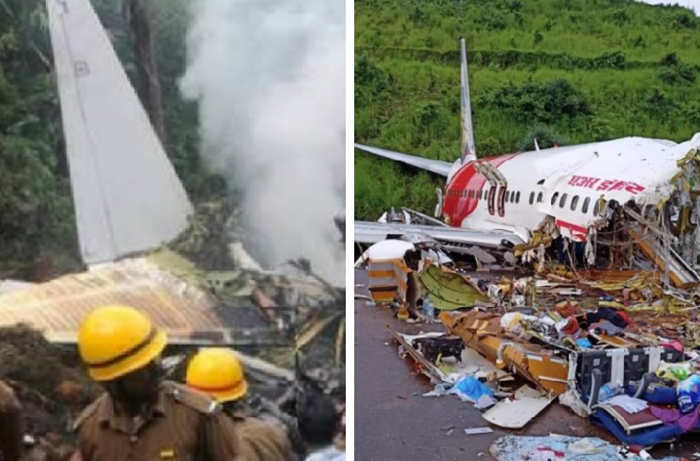
Mangaluru, Aug 8: As visuals of the Air India Express flight crash at Kozhikode international airport emerge, one cannot help but be reminded of an eerily similar and unfortunate accident that occurred a decade ago. The August 7, 2020 tragedy brought back memories of the 2010 crash.

It was on May 22, 2010 that an Air India Express Boeing 737-800 flight from Dubai to Mangaluru over shot the runway while landing at Bajpe airport and fell into a cliff. Of the 160 passengers and 6 crew members on board, 158 were killed (all crew members and 152 passengers) and only 8 survived.

Even back then, the plane had split into two. The crash has been termed as one of India's worst aviation disasters.

The final conversations between Air traffic control (ATC) and the pilot prior to the landing showed no indication of any distress.

Like the Mangaluru accident, Karipur crash too happened when the flight was attempting to land.

The captain of the aircraft which crashed at Mangaluru, Z Glucia, was an experienced pilot with 10,000 hours of flying experience and had 19 landings at the Mangalore airport. Co-pilot S S Ahluwalia, with 3,000 hours of flying experience had as many as 66 landings at this airport. Both the pilot and co-pilot were among the victims.

An investigation into the accident later found that the cause of the accident was the captain’s failure to discontinue an ‘unstabilised approach’ and his persistence to continue with the landing, despite three calls from the First Officer to ‘go-around’.

Comments

Add new comment

  • Coastaldigest.com reserves the right to delete or block any comments.
  • Coastaldigset.com is not responsible for its readers’ comments.
  • Comments that are abusive, incendiary or irrelevant are strictly prohibited.
  • Please use a genuine email ID and provide your name to avoid reject.