First 3D planetarium to be opened in Mangaluru in Jan

DHNS
December 8, 2017

Bengaluru, Dec 8: Bengaluru India Nano 2017, the 9th edition of India's flagship Nano-science and Nanotechnology event, kicked-off to a flying start with overwhelming participation of policy makers from the state and the Centre and academia.

Karnataka Minister for Planning, Statistics and Science and Technology

M R Seetharam said Bengaluru is gaining strong foothold in the emerging field of nanotechnology, which is considered as the next big technological revolution.

"To create awareness about astronomical concepts and to help students to learn science, technology, engineering and mathematics, we are establishing first 3D planetarium with state-of-the-art projection systems in Mangaluru at an estimated cost of Rs 35.69 crore," he said.

Five more to come up

The planetarium will be open to the public in January 2018.

"The government is planning to establish five more mini planetariums; one each in Dharwad, Bagalkot, Vijayapura, Madikeri and Gadag," M R Seetharam said.

Award presented

Prof Ashok K Ganguli, Institute of Nano Science and Technology at Mohali in Punjab was awarded the Prof C N R Rao Bangalore INDIA NANO Science 2017 Award with a cash prize of Rs one lakh by C N R Rao Foundation. The award was presented by Prof C N R Rao at the event.

Comments

Hari
 - 
Friday, 8 Dec 2017

Great. Is it first time in India?

Kumar
 - 
Friday, 8 Dec 2017

It will be more helpful to both students, teachers, astronomy enthusiasts.

Ganesh
 - 
Friday, 8 Dec 2017

Wow. I used to sleep while watching planetorium. In mangalore I couldnt find anything

Add new comment

  • Coastaldigest.com reserves the right to delete or block any comments.
  • Coastaldigset.com is not responsible for its readers’ comments.
  • Comments that are abusive, incendiary or irrelevant are strictly prohibited.
  • Please use a genuine email ID and provide your name to avoid reject.
News Network
May 8,2020

Bengaluru, May 8: Karnataka Minister for Primary and Secondary Education S Suresh Kumar on Friday said that the next academic year will have to be shortened as it will delayed due to the COVID-19.

Mr Kumar in a meeting with Education Department officials said that the syllabus and curriculum for the academic year will have to be designed according to time available. Additional content in the syllabus will have to be removed, according to a statement issued here by the education department here on Friday.

The Minister also stated that plans are underway to conduct CET examination meant for admission into professional courses immediately after the SSLC examination.

He also advised the officials to make the Department’s YouTube channel feature more subject-wise and chapter-wise content for the aid of the students.

Additionally, a booklet will be launched to teach students on how to adjust to life in the post-COVID-19 world.

Comments

Add new comment

  • Coastaldigest.com reserves the right to delete or block any comments.
  • Coastaldigset.com is not responsible for its readers’ comments.
  • Comments that are abusive, incendiary or irrelevant are strictly prohibited.
  • Please use a genuine email ID and provide your name to avoid reject.
News Network
March 19,2020

Bengaluru, Mar 19: In the backdrop of coronavirus pandemic, Karnataka State Road Transport Corporation (KSRTC) has reported huge revenue losses in March.

According to official data, the cumulative revenue loss in all services from March 1 till March 18 has amounted to around Rs 8,58,86,462 crores.

This includes cumulative revenue loss of Rs 5,33,82,456 in premium services, and cumulative revenue loss of Rs 3,25,04,006 in non-premium services.

The highest reported revenue loss in all services was reported on March 18, which amounted to Rs 1,90,25,183.

The total number of coronavirus cases in the state have reached 15, according to the Karnataka Health Minister.

A total of 169 positive cases of coronavirus have been reported in India so far, the Union Ministry of Health and Family Welfare said on Thursday.

Comments

Add new comment

  • Coastaldigest.com reserves the right to delete or block any comments.
  • Coastaldigset.com is not responsible for its readers’ comments.
  • Comments that are abusive, incendiary or irrelevant are strictly prohibited.
  • Please use a genuine email ID and provide your name to avoid reject.
News Network
August 2,2020

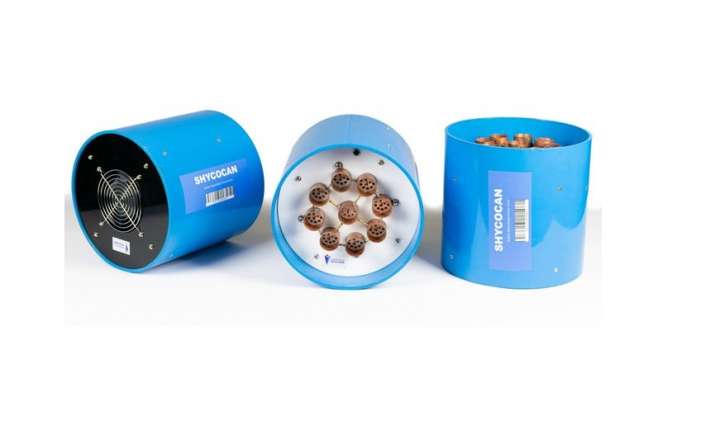
Bengaluru, Aug 2: Bengaluru based Centre for Advanced Research and Development (CARD), the research wing of organisation De scalene has come up with a device called "SHYCOCAN" (Scalene Hypercharge Corona Canon) which neutralizes the coronavirus.

Speaking to news agency Dr Rajah Vijay Kumar, Chairman, Organisation De Scalene said that the device will not kill any bacteria or fungus, however, neutralizes the coronavirus particles.

"The device was tested for its safety and efficacy and is soon going to be manufactured and marketed in the US under the Enforcement Discretion policy of USFDA and in Europe as the device is CE compliant and is CE marked," said Kumar.

He also added the device will cover a volume of 10,000 cubic feet.

The device Scalene Hypercharge Corona Canon (SHYCOCAN) is intended to be used in the residential, industrial and commercial environment and is designed for active containment by attenuation of Corona family of viruses. (Laboratories de Especialidades Immunological S.A. de C.V, Virucidal Activity concludes 99.9 per cent virus elimination), Kumar asserted.

"SHYCOCAN operates on regular 110/240V - 50/60 Hz wall socket and is a plug and play device, that delivers the necessary signals to a photon mediated electrons emitters (PMEE), that produces hypercharge high-velocity electrons by photon mediation that interacts with the negative seeking S-protein of Corona family of viruses thus reducing infectivity and prevent air and surface borne transmission of corona family of viruses," said Kumar.

The device does not use any chemicals, or any other consumables and does not produce harmful ozone gas or any other substances and is completely safe for use in any environment, he added.

"The attack mechanism of the Virus starts with the initial attachment of the virion to the host cell, it is initiated by interactions between the S-protein and its receptor on the "negative" cell membrane. The sites of receptor binding domains (RBD) within the S1 region of a coronavirus S-protein vary depending on the virus. 

The S-protein/receptor interaction is the primary determinant for a coronavirus to infect a host species and governs the tissue tropism of the virus. However, the end result is the fusion and release of the viral genome into the cytoplasm," said Kumar.

He continued saying that the counter mechanism by the device SHYCOCAN is that if negative seeking is the guidance mechanism of the S- Protein, attracted by the transmembrane potential of the host cells, then breaking this mechanism would block the Coronavirus infectivity and spread.

"The device has been in use for more than a year at the S-CARD campus, the headquarters of Scalene," said Kumar.


Comments

Add new comment

  • Coastaldigest.com reserves the right to delete or block any comments.
  • Coastaldigset.com is not responsible for its readers’ comments.
  • Comments that are abusive, incendiary or irrelevant are strictly prohibited.
  • Please use a genuine email ID and provide your name to avoid reject.

