


Mani Shankar Aiyar calls Modi ‘neech’; suspended from Congress

Agencies
December 8, 2017

New Delhi/Surat, Dec 8: Congress suspended Mani Shankar Aiyar on Thursday after the former Union minister stoked yet another acrimonious row by describing Prime Minister Narendra Modi as a "neech aadmi".

Aiyar's choice of words not only drew a ferocious attack from Modi in Surat but riled his own party functionaries who feared potential damage to its electoral prospects due to the diplomat-turned-politician's foot-in-the-mouth penchant. "He (Modi) is neech kism ka aadmi who has no sabhyata (civility)," Aiyar had said earlier in the day after Modi accused Congress of using Dalit icon B R Ambedkar merely to get votes and trying to erase his contribution in building India.

Addressing an election rally in Surat, Modi hit back at Aiyar and said dejected Congress functionaries had lost their mental balance and crossed all limits of decency. "Mani Shankar Aiyar has called me neech and from nichli jaati (lower caste). Is this not an insult to Gujarat? Is it not an insult to India's great values? But people of Gujarat will take revenge on December 18 and teach you the precise meaning of neech," Modi said.

The PM said Aiyar's remarks smacked of Congress's "Mughal mindset" that discriminated between the lower and upper castes. "I, as chief minister of Gujarat for 14 years and now as PM, have done nothing that has forced citizens to hang their heads in shame. If Congress feels that working for the poor and distressed is something too low, I can only wish them good luck," he said amid chants of "Modi Modi".

The PM even recalled Congress chief Sonia Gandhi's 10-year-old "maut ka saudagar" remark against him as he accused the rival of constantly insulting and conspiring against him. "Despite so many insults, I have not been vindictive as PM and BJP will always work to uphold the values of public life," he said.

With a procession of BJP functionaries alleging that Aiyar's controversial remark was a reflection of the Nehru-Gandhi family's arrogance and their sense of entitlement, and fear growing that the indiscretion might hurt the party in Gujarat, Congress led by Rahul Gandhi went into damage control. The party vice-president took to Twitter to disapprove of Aiyar's remark and asked him to apologise. "BJP and PM routinely use filthy language to attack the Congress party. The Congress has a different culture and heritage. I do not appreciate the tone and language used by Mani Shankar Aiyar to address the PM. Both the Congress and I expect him to apologise for what he said," Rahul said.

Though Aiyar can stubbornly hold his ground, he promptly obliged and blamed the derogatory remark on his poor Hindi. "My Hindi is not very good. Yes, I called Modi 'neech' but did not mean it as a low-born; I meant it as low," he said, recalling that his poor grasp of Hindi had failed him earlier too when he called former PM Atal Bihari Vajpayee a "nalayak" PM.

However, this did not fully assuage the worry of the potential fallout of Aiyar's slur against the PM in a state where in 2007, Sonia calling Modi "maut ka saudagar" had badly boomeranged on her party. Coming just after the controversy over Kapil Sibal for allegedly seeking to delay resolution of the Ayodhya dispute by seeking postponement of hearing in the SC until after the 2019 Lok Sabha elections, many in the party expressed concern over "self-goals" during the last lap of the Gujarat polls. Former Delhi CM Sheila Dikshit, in fact, suspected an effort to sabotage Rahul when he is about to take over as party president.

Comments

FairMan
 - 
Friday, 8 Dec 2017

All Congees are tomorrows BjP / RSS

Add new comment

  • Coastaldigest.com reserves the right to delete or block any comments.
  • Coastaldigset.com is not responsible for its readers’ comments.
  • Comments that are abusive, incendiary or irrelevant are strictly prohibited.
  • Please use a genuine email ID and provide your name to avoid reject.
Agencies
June 14,2020

New Delhi, Jun 14: Petrol price on Sunday was hiked by a record 62 paise per litre and that of diesel by 64 paise as oil companies for the eighth day in a row adjusted retail rates in line with cost since ending an 82-day hiatus in rate revision.

Petrol price in Delhi was hiked to Rs 75.78 per litre from Rs 75.16 while diesel rates were increased to Rs 74.03 a litre from Rs 73.39, according to a price notification of state oil marketing companies.

Rates have been increased across the country and vary from state to state depending on the incidence of local sales tax or VAT.

The 62 paise a litre increase in petrol and 64 paise hike in diesel price is the highest surge in rates since the daily price revision was started in June 2017.

This is the eighth daily increase in rates in a row since oil companies on June 7 restarted revising prices in line with costs, after ending an 82-day hiatus.

In eight hikes, petrol price has gone up by Rs 4.52 per litre and diesel by Rs 4.64 -- a record increase in rates in any eight days since the daily price revision was introduced.

The freeze in rates was imposed in mid-March soon after the government hiked excise duty on petrol and diesel to shore up additional finances.

Oil PSUs Indian Oil Corp (IOC), Bharat Petroleum Corp Ltd (BPCL) and Hindustan Petroleum Corp Ltd (HPCL), instead of passing on the excise duty hikes to customers, adjusted them against the fall in the retail rates that was warranted because of international oil prices falling to two-decade lows.

The government had first raised excise duty on petrol and diesel by Rs 3 per litre each on March 14 and then again on May 5 by a record Rs 10 per litre in case of petrol and Rs 13 on diesel. The two hikes gave the government Rs 2 lakh crore in additional tax revenues.

State-owned fuel retailers IOC, BPCL and HPCL had frozen petrol and diesel prices since March 16, as if anticipating the government move and set off gains they accrued from continuing drop in international oil prices against the excise duty hike.

They, however, promptly passed the increase in local sales tax or VAT by state governments such as Rs 1.67 increase in VAT on petrol and Rs 7.10 in diesel by the Delhi government on May 4.

The total incidence of excise duty on petrol has risen to Rs 32.98 per litre and that on diesel to Rs 31.83. The excise tax on petrol was Rs 9.48 per litre when the Narendra Modi government took office in 2014 and that on diesel was Rs 3.56 a litre.

The government had between November 2014 and January 2016 raised excise duty on petrol and diesel on nine occasions to take away gains arising from plummeting global oil prices.

In all, duty on petrol rate was hiked by Rs 11.77 per litre and that on diesel by 13.47 a litre in those 15 months that helped government's excise mop up more than double to Rs 2,42,000 crore in 2016-17 from Rs 99,000 crore in 2014-15.

It cut excise duty by Rs 2 in October 2017 and by Rs 1.50 a year later. But it raised excise duty by Rs 2 per litre in July 2019.

It again raised excise duty on March 14 by Rs 3 per litre.

Comments

Add new comment

  • Coastaldigest.com reserves the right to delete or block any comments.
  • Coastaldigset.com is not responsible for its readers’ comments.
  • Comments that are abusive, incendiary or irrelevant are strictly prohibited.
  • Please use a genuine email ID and provide your name to avoid reject.
Agencies
August 2,2020

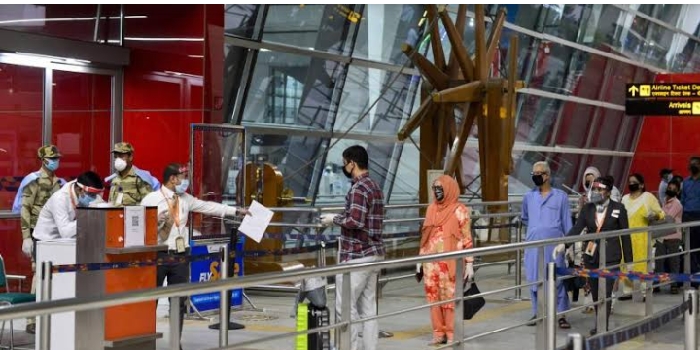
New Delhi, Aug 2: The Ministry of Health and Family Welfare on Sunday issued fresh guidelines for international passengers coming to India amid the COVID-19 pandemic. The new guidelines will be implemented from 12:01 am on August 8.

The ministry has also asked all passengers to submit a self-declaration form online at least 72 hours before travel.

"All travellers should submit self-declaration form on the on the online portal (www.newdelhiairport.in) at least 72hours before the scheduled travel," the guidelines said.

It also said that those coming to India must give an undertaking that they would undergo mandatory quarantine for 14 days as prescribed by the government. "They should also give an undertaking on the portal that they would undergo mandatory quarantine for 14 days i.e. 7 days paid institutional quarantine at their own cost, followed by 7 days isolation at home with self-monitoring of health," it added.

Giving exemptions in some cases, the guidelines mentioned, "Only for compelling reasons/cases of human distress such as pregnancy, death in the family. Serious illness and parent (s) with children of 10 years or below, home quarantine may be permitted for 14 days."

"If they wish to seek such exemption, they shall apply to the online portal at least 72 hours before boarding. The decision taken by the government as communicated on the online portal will be final," it said further.

The guidelines further said that travellers could request for exemption from institutional quarantine by submitting a negative RT-PCR test report on arrival.

"This test should have been conducted within 96 hours prior to undertaking the journey. The test report should be uploaded on the portal for consideration," it added.

Passengers have also been asked to download the Aarogya Setu app on their mobile phones.

Comments

Add new comment

  • Coastaldigest.com reserves the right to delete or block any comments.
  • Coastaldigset.com is not responsible for its readers’ comments.
  • Comments that are abusive, incendiary or irrelevant are strictly prohibited.
  • Please use a genuine email ID and provide your name to avoid reject.
Agencies
May 28,2020

Several India-based firms are spoofing the World Health Organisation (WHO) by creating fake Gmail accounts and luring business leaders in disguise of informing them of latest COVID-19 announcements and hack their personal and financial information, Google has warned.

These "hack-for-hire" firms, many based in India, have been creating Gmail accounts spoofing the WHO, largely targeting business leaders in financial services, consulting, and healthcare corporations within numerous countries including, the US, Slovenia, Canada, India, Bahrain, Cyprus, and the UK.

"The lures themselves encourage individuals to sign up for direct notifications from the WHO to stay informed of COVID-19 related announcements, and link to attacker-hosted websites that bear a strong resemblance to the official WHO website," security researchers from Google's Threat Analysis Group said on Wednesday.

The sites typically feature fake login pages that prompt potential victims to give up their Google account credentials, and occasionally encourage individuals to give up other personal information, such as their phone numbers.

On any given day, Google's Threat Analysis Group (TAG) said it is tracking more than 270 targeted or government-backed attacker groups from more than 50 countries.

Last month, it sent 1,755 warnings to users whose accounts were targets of government-backed attackers.

"Our team of analysts and security experts is focused on identifying and stopping issues like phishing campaigns, zero-day vulnerabilities and hacking against Google, our products and our users," said the tech giant.

Google continues to see attacks from groups like Charming Kitten on medical and healthcare professionals, including WHO employees.

"We're seeing a resurgence in COVID-related hacking and phishing attempts from numerous commercial and government-backed attackers," said the company.

Government-backed or state-sponsored groups have different goals in carrying out their attacks: Some are looking to collect intelligence or steal intellectual property; others are targeting dissidents or activists, or attempting to engage in coordinated influence operations and disinformation campaigns.

Google said that since March, it has removed more than 1,000 YouTube channels that were part of a large campaign and behaving in a coordinated manner.

"These channels were mostly uploading spammy, non-political content, but a small subset posted primarily Chinese-language political content similar to the findings of a recent Graphika report," said the company.

Several cybersecurity firms have seen a spike in COVID-19 related scams and hacking attempts. Hackers are also creating scam sites similar to COVID-19 relief packages.

Researchers at Check Point Software Technologies revealed in mid-May that they have seen 192,000 coronavirus-related cyber-attacks per week over the past three weeks, a 30 % increase compared to previous weeks.

Comments

Add new comment

  • Coastaldigest.com reserves the right to delete or block any comments.
  • Coastaldigset.com is not responsible for its readers’ comments.
  • Comments that are abusive, incendiary or irrelevant are strictly prohibited.
  • Please use a genuine email ID and provide your name to avoid reject.