


Air India seeks Rs 1,100 cr loan to modify planes for VVIPs

Agencies
December 10, 2017

New Delhi, Dec 10: Disinvestment-bound Air India is seeking loan worth over Rs 1,100 crore for modification of two Boeing aircraft scheduled to be acquired next month for ferrying VVIPs, according to an official document.

The two Boeing 777-300 ER aircraft are to be delivered in January 2018 and the cost for "modification in its (planes) interior configuration" is estimated to be USD 180 million. At current exchange rates, the amount will translate to over Rs 1,160 crore.

These planes will be used to ferry the President, Vice President and Prime Minister.

In a tender document, the national carrier said it would like to avail a bridge loan of up to USD 180 million to finance the cost of modification.

"Government of India has indicated that they would issue its guarantee for the financing cost of modification of the two B777-300 ER aircraft for a period of 12 months or less," the document issued last week said.

These planes will undergo re-configuration.

The proposed loan amount will be availed during the period from January to April 2018. The first instalment of USD 135 million would be taken next month, while the remaining amount will be borrowed in a quantum of USD 15 million each in February, March and April, respectively.

Last month, an Air India official had said after required modifications, the two planes will join the fleet used to carry the President, the Vice President and the Prime Minister.

According to the airline, no commitment fee would be paid to the lender for the USD 180 million loans. "Prepayment/ short closure of the loan should be allowed without any extra cost to Air India as the loan would be repaid as soon as the funds are made available by Government of India," it added.

"The Indian Income Tax Act imposes withholding tax on interest payments to lenders outside India. The rate of withholding tax on interest payments will be considered in the financial evaluation of the offers to determine the all-in cost of your offer," the document said.

Last month, Air India had sought a loan to the tune of USD 535 million to finance the acquisition of three Boeing planes, including the two aircraft to be used for ferrying VVIPs. At that time, the amount was around Rs 3,460 crore.

Air India has a debt burden of more than Rs 50,000 crore and these loans would further increase the debt level.

In 2006, Air India placed orders with Boeing for 68 aircraft 27 Dreamliners, 15 B777-300 ERs, eight B777-200 LRs and 18 B737-800s. Of these, the state-run carrier has already taken the delivery of 65 planes. At present, the flagship airline has a fleet of 115 aircraft.

The government is in the process of finalising the modalities for the strategic disinvestment of debt-laden Air India as part of efforts to revive the carrier.

Comments

Wellwisher
 - 
Monday, 11 Dec 2017

What is the meaning of VVIP.  Passengers who lost their life during air india express crash landung due to arrogant pilots error not respected or they compensated per Montreal law  no they want to arrange special arrangements for very very illegal persons. Over all in India there is no value for common man. All benifits and facility''s  only for giant Wales and politicians. For common man only one facility by the present govt to fight with name of caste. We the people doing the same fighting with fellow INDIAN.


Jai Hind!

Add new comment

  • Coastaldigest.com reserves the right to delete or block any comments.
  • Coastaldigset.com is not responsible for its readers’ comments.
  • Comments that are abusive, incendiary or irrelevant are strictly prohibited.
  • Please use a genuine email ID and provide your name to avoid reject.
coastaldigest.com news network
July 27,2020

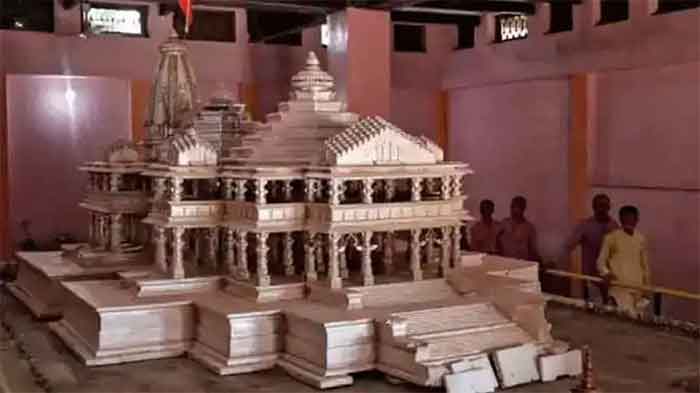
Ayodhya, Jul 27: With days to go for the August 5 "bhoomi pujan" ceremony of the Ram temple in Ayodhya, the mosques adjacent to the demolished Babri Masjid premises are spreading the message of a peaceful coexistence of Hindus and Muslims.

There are eight mosques and two mausoleums located close to the 70-acre Babri Masjid premises mandated by the Supreme Court for a temple of Sri Ram.

Azaan and namaaz are offered in the mosques and the annual "Urs" is held at the mausoleums without any objection from the local Hindus.

The eight mosques located near the upcoming Ram temple premises are Masjid Dorahikuan, Masjid Mali Mandir ke Bagal, Masjid Kaziyana Achchan ke Bagal, Masjid Imambara, Masjid Riyaz ke Bagal, Masjid Badar Paanjitola, Masjid Madaar Shah and Masjid Tehribazar Jogiyon ki.

The two mausoleums are Khanqaahe Muzaffariya and Imambara.

"It is the greatness of Ayodhya that the mosques surrounding the Ram temple are giving a strong message of communal harmony to the rest of the world," Haji Asad Ahmad, the corporator of the Ram Kot ward, said. The Ram temple area is situated in Ahmad's ward.

"Muslims take out the 'juloos' of Barawafaat that goes through the periphery of Ram Janmabhoomi. All religious functions and rituals of Muslims are respected by their fellow citizens," the corporator said.

Asked for a comment on the presence of mosques near the upcoming Ram temple premises, the chief priest of the temple, Acharya Satyendra Das, said, "We had a dispute only with the structure that was connected to the name of (Mughal emperor) Babur. We have never had any issue with the other mosques and mausoleums in Ayodhya. This is a town where Hindus and Muslims live in peace."

"Muslims offer namaaz, we perform our puja. The mosques around us will strengthen Ayodhya's communal harmony and peace will prevail," he added.

Both Hindus and Muslims have accepted the Supreme Court verdict over Ram Janmabhoomi, Das said, adding, "We have no dispute with each other."

Sayyad Akhlaq Ahmad Latifi, the "sajjada nasheen" and "pir" of the 500-year-old Khanqaahe Muzaffariya mausoleum, said Muslims in Ayodhya are performing all religious practices freely.

"We offer prayers five times a day in the mosque at Khanqaah and hold the yearly 'Urs'," he added.

"What a scene would it be -- a grand Ram temple surrounded by small mosques and mausoleums and everyone offering prayers according to their beliefs. That will be representative of the true culture of India," Mahant Yugal Kishore Sharan Shastri, the chief priest of the Sarayu Kunj temple adjacent to the Ram Janmabhoomi premises, said.

Reacting to the presence of mosques and mausoleums near the Ram Janmabhoomi premises, Triloki Nath Pandey, the decree holder of the land as the "first friend of Ram Lalla" as mandated by the Supreme Court, said, "We do not have any objection to either those mosques or any other mosques. We will not trigger a dispute regarding any structure, Ayodhya must live in peace and communal harmony."

Mahant Raju Das, the priest of the Hanumangarhi temple, said, "The presence of the mosques tells the story of Ayodhya's communal harmony. A Ram mandir will be built and there will be no objection to the mosques or religious practices of Muslims."

Comments

Add new comment

  • Coastaldigest.com reserves the right to delete or block any comments.
  • Coastaldigset.com is not responsible for its readers’ comments.
  • Comments that are abusive, incendiary or irrelevant are strictly prohibited.
  • Please use a genuine email ID and provide your name to avoid reject.
Agencies
March 15,2020

New Delhi, Mar 15: The new rules for debit and credit cards to increase security and reduce frauds kick in from Monday. In January, the Reserve Bank of India (RBI) had issued new rules to improve user convenience and increase the security of card transactions. These rules will help in curbing the misuse of debit and credit cards.

RBI has directed banks to allow only domestic card transactions at ATMs and PoS terminals in India at the time of issuance/reissuance of card. For international transactions, online transactions, card-not-present transactions and contactless transactions, customers will have to separately set up services on their card.

These rules will be applicable for new cards from March 16. Those with old cards can decide whether to disable any of these features.

As per the existing rules, these services used to come automatically with the card, but now it will start at the request of the customer.

Debit or credit card customers who have not yet done any online transaction, contactless transaction or international transaction with the card, then these services on the card will automatically stop from March 16.

The Reserve Bank has asked all banks to provide mobile banking, net banking option to enable limit and enable and disable service 24 hours a day, seven days a week.

If the customer makes any change in the status of the card, the bank will alert the customer through SMS/email and send the information.

Issuers shall provide to all cardholders facility to switch on/off and set/modify transaction limits (within the overall card limit, if any, set by the issuer) for all types of transactions -- domestic and international, at PoS/ATMs/online transactions/contactless transactions, etc.,

The provisions, however, are not mandatory for prepaid gift cards and those used at mass transit systems.

The latest instructions come in the wake of rising instances of cyber frauds and the huge increase in the use of cards.

Comments

Add new comment

  • Coastaldigest.com reserves the right to delete or block any comments.
  • Coastaldigset.com is not responsible for its readers’ comments.
  • Comments that are abusive, incendiary or irrelevant are strictly prohibited.
  • Please use a genuine email ID and provide your name to avoid reject.
News Network
January 31,2020

New Delhi, Jan 31: Chief Economic Adviser K V Subramanian on Friday said India's GDP is expected to grow at 6-6.5 per cent next fiscal as the economic slowdown has bottomed out.

As per the first advance estimates released by the National Statistical Organisation (NSO), the country's economic growth is likely to hit an 11-year low of 5 per cent in the current fiscal ending March 2020.

The Economic Survey 2019-20, prepared by a team lead by Subramanian, has projected the GDP to expand in the range of 6-6.5 per cent during 2020-21.

The Indian economy has hit the bottom and it will see an uptick from here, he said in a media briefing post the Economic Survey.

Amidst a weak environment for global manufacturing, trade and demand, the Indian economy slowed down with GDP growth moderating to 4.8 per cent in the first half of 2019-20, lower than 6.2 per cent in H2 of 2018-19.

Based on NSO's first advance estimates of GDP growth for 2019-20 at 5 per cent, an uptick in GDP growth is expected in the second half of the fiscal, it said.

According to it, the uptick in second half of 2019-20 would be mainly due to ten positive factors like picking up of Nifty India Consumption Index for the first time this year, an upbeat secondary market, higher FDI flows, build-up of demand pressure, positive outlook for rural consumption, rebound of industrial activity, steady improvement in manufacturing, growth in merchandise exports, higher build-up of foreign exchange reserves and positive growth rate of GST revenue collection.

The survey also emphasised that merger of public sector banks may increase the financial strength of the merged entities, lower the risk aversion and result in lowering of lending rates.

Further, as the implementation of GST further settles down, the increased unification of the domestic market may reduce business costs and facilitate fresh investment.

Reforms in land and labour market may further reduce business costs, said the survey, presented a day before Sitharaman's Union Budget 2020-21.

Comments

Add new comment

  • Coastaldigest.com reserves the right to delete or block any comments.
  • Coastaldigset.com is not responsible for its readers’ comments.
  • Comments that are abusive, incendiary or irrelevant are strictly prohibited.
  • Please use a genuine email ID and provide your name to avoid reject.