


How media tried to drag UTK’s name into Deepak Rao murder case using an unrelated photo

coastaldigest.com news network
January 5, 2018

Everybody knows that social media platforms are notorious for baseless rumours and fake news. But, in a bizarre development, the mainstream media in Karnataka has apparently tried to drag a minister’s name to a murder case by using an old and unrelated photo.

Deepak Rao, a resident of Katipalla in Mangaluru taluk was hacked to death by a gang of notorious criminals on January 3 in his hometown. Police have arrested six persons in connection with the murder including Pinki Navaz, who is said to be an activist of the Minority Morcha of Bharatiya Janata Party. 

The BJP is holding PFI, SDPI and ruling Congress government of Karnataka responsible for the murder whereas Congress leader suspecting BJP’s hand behind the murder. The Congress leaders are claiming that murder of a Hindu youth by miscreants belonging to Muslim community will politically help BJP in the elections.

Meanwhile, the social media wing of the saffron party started spreading an old photo in which Food and Civil Supplies Minister U T Khader can be seen having food. The photo was taken a few months ago when Mr Khader had attended a wedding in his constituency on the request of localites when he was passing through that way. In the same photo Ilyas, a member of infamous Target Gang, also seen having food along with Mr Khader. Ilyas is said to be an associate of Pinki Navaz. While circulating the photo, the BJP activists claimed that Mr Khader has links with Pinki Navaz. Interestingly, a few television channels and newspapers too published the same photo. 

Reacting to the allegations made against him, Mr Khader said that in the past too, the miscreants had tried to malign him using the same photo. “My opponents also know that I do not support any criminals. But, some miscreants often try to malign me for political gains,” he said.

Comments

Viren Kotian
 - 
Friday, 5 Jan 2018

This is called putkosi journalism. Why CD team gets hurt if other media publish report against UTK with proof? There should be a limit for bias

Ismail
 - 
Friday, 5 Jan 2018

If you read the various statements of his opponents, it is clear that this was a part of their political strategy.

Add new comment

  • Coastaldigest.com reserves the right to delete or block any comments.
  • Coastaldigset.com is not responsible for its readers’ comments.
  • Comments that are abusive, incendiary or irrelevant are strictly prohibited.
  • Please use a genuine email ID and provide your name to avoid reject.
News Network
August 2,2020

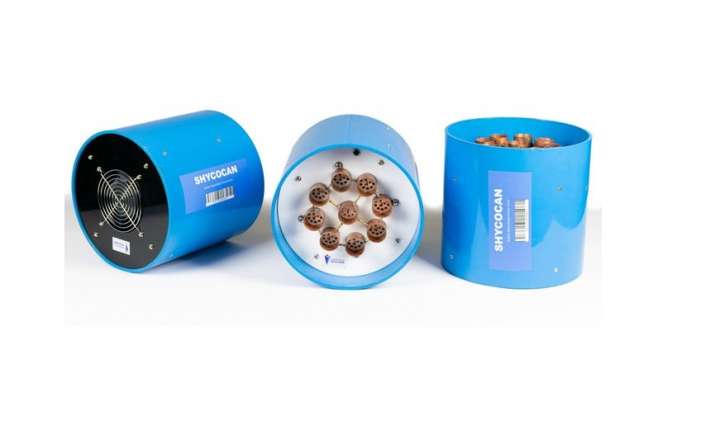
Bengaluru, Aug 2: Bengaluru based Centre for Advanced Research and Development (CARD), the research wing of organisation De scalene has come up with a device called "SHYCOCAN" (Scalene Hypercharge Corona Canon) which neutralizes the coronavirus.

Speaking to news agency Dr Rajah Vijay Kumar, Chairman, Organisation De Scalene said that the device will not kill any bacteria or fungus, however, neutralizes the coronavirus particles.

"The device was tested for its safety and efficacy and is soon going to be manufactured and marketed in the US under the Enforcement Discretion policy of USFDA and in Europe as the device is CE compliant and is CE marked," said Kumar.

He also added the device will cover a volume of 10,000 cubic feet.

The device Scalene Hypercharge Corona Canon (SHYCOCAN) is intended to be used in the residential, industrial and commercial environment and is designed for active containment by attenuation of Corona family of viruses. (Laboratories de Especialidades Immunological S.A. de C.V, Virucidal Activity concludes 99.9 per cent virus elimination), Kumar asserted.

"SHYCOCAN operates on regular 110/240V - 50/60 Hz wall socket and is a plug and play device, that delivers the necessary signals to a photon mediated electrons emitters (PMEE), that produces hypercharge high-velocity electrons by photon mediation that interacts with the negative seeking S-protein of Corona family of viruses thus reducing infectivity and prevent air and surface borne transmission of corona family of viruses," said Kumar.

The device does not use any chemicals, or any other consumables and does not produce harmful ozone gas or any other substances and is completely safe for use in any environment, he added.

"The attack mechanism of the Virus starts with the initial attachment of the virion to the host cell, it is initiated by interactions between the S-protein and its receptor on the "negative" cell membrane. The sites of receptor binding domains (RBD) within the S1 region of a coronavirus S-protein vary depending on the virus. 

The S-protein/receptor interaction is the primary determinant for a coronavirus to infect a host species and governs the tissue tropism of the virus. However, the end result is the fusion and release of the viral genome into the cytoplasm," said Kumar.

He continued saying that the counter mechanism by the device SHYCOCAN is that if negative seeking is the guidance mechanism of the S- Protein, attracted by the transmembrane potential of the host cells, then breaking this mechanism would block the Coronavirus infectivity and spread.

"The device has been in use for more than a year at the S-CARD campus, the headquarters of Scalene," said Kumar.

Comments

Add new comment

  • Coastaldigest.com reserves the right to delete or block any comments.
  • Coastaldigset.com is not responsible for its readers’ comments.
  • Comments that are abusive, incendiary or irrelevant are strictly prohibited.
  • Please use a genuine email ID and provide your name to avoid reject.
News Network
February 22,2020

Bengaluru, Feb 22: Thanks to joint efforts by the Protector of Emigrants in Bengaluru and Indian Embassy in Qatar, a 26-year-old woman from Karnataka who had been kept in confinement in Qatar has been rescued and brought back to India.

Anupama (name changed) from Holenarasipura in Hassan district arrived in Bengaluru on Thursday night. She was allegedly locked up in a house for 14 days, restrained from using a mobile and wasn't fed. There were three other women with her. On the midnight of February 12, they broke the window panes and fled before contacting local police.

Anupama, a diploma graduate in computer science, was jobless and her friend working in Kuwait suggested she try for a job abroad. She contacted an agency based in Chikkamagaluru which offered her a nanny's job in Qatar. After document verification, the agency demanded she pay Rs 2 lakh but she said she didn't have that kind of money.

The agency sent Anupama on a visitor visa but told her if questioned by immigration officials, she must claim she was visiting her sister. They also gave her a return ticket.

As Anupama was travelling abroad for the first time, she said she was ignorant about several things.

On January 12, Anupama left Bengaluru. But as she reached Qatar, all her documents, including passport, were confiscated by the agency. Her return ticket was cancelled and she was sent to a house to work as babysitter-cum-cook for Rs 30,000. She lived with four other maids in the same house, where they were made to work for 16-18 hours a day.

"I used to wake up around 5.30am every day and had to prepare breakfast for the employers by 6.30am. My work would end around 11pm every day. We never even got time to eat," Anupama told media on Friday. Four days into work, Anupama's nose started bleeding. However, the employers cared little and insisted she continue to work. After 18 days, she requested her employers that she be relieved.

The agency sent her to a house where three women were already present and locked her up with them. "They used to give us a glass of raw rice, an onion, tomato and potato to cook for ourselves. While we got rice every day, we had to use the vegetables for three days. We were not supposed to use mobiles or go out. Two people were monitoring us," she recalled.

Anupama and the others decided to approach police but for that they needed to escape. Around 1.30am on February 12, the four women managed to break window panes and jumped out. They ran for more than a kilometre and managed to approach police, who summoned the agency and got the women to speak to their families.

Anupama called her brother-in-law, who approached the Protector of Emigrants office in Koramangala, Bengaluru. Shubham Singh, PoE in Bengaluru, said they took up the issue with the Indian Embassy in Qatar, which immediately got in touch with Qatar police. Anupama said, "We were kept in prison for a couple of days and were sent to the deportation centre later."

Meanwhile, the Indian embassy got the agency to return the women's documents. However, the agents did not pay their salaries. Two of the women were sent to Hyderabad and the third to Kerala. On Friday, Anupama met Singh at his office, where her statement was recorded. "We have started the process of initiating action against the agency in India," he said.

Comments

Add new comment

  • Coastaldigest.com reserves the right to delete or block any comments.
  • Coastaldigset.com is not responsible for its readers’ comments.
  • Comments that are abusive, incendiary or irrelevant are strictly prohibited.
  • Please use a genuine email ID and provide your name to avoid reject.
News Network
May 30,2020

Bengaluru, May 30: Bengaluru City civic body Bruhat Bengaluru Mahanagara Palike (BBMP) has slapped a fine of Rs 50,000 on the food delivery startup Swiggy for irresponsible disposal of waste, an official said on Friday.

"Thinking of food is great - Swiggy. Hope you also think of segregating waste and disposing of it responsibly," tweeted BBMP Solid Waste Management Special Commissioner D. Randeep.

Randeep said a penalty of Rs 50,000 was imposed on Swiggy Kitchen at Katriguppe in the city for the violation.

"The incident with respect to waste segregation has been brought to our notice and happened at one of our kitchens in Bengaluru," confirmed a Swiggy spokesperson to IANS without revealing the exact details.

He said the startup is aware of its civic responsibility and has stringent processes to ensure high standards of compliance.

"While we investigate and rectify the root cause of the matter, we are reinforcing necessary awareness on the best practices to be followed amongst our teams and partner network to ensure complete compliance with waste management," the spokesperson added.

Swiggy has been penalised earlier as well for its irresponsible disposal of waste.

Recently, the BBMP’s solid waste management department has also fined an apartment complex Rs 15,000 for not segregating waste into dry, wet and reject categories.

Waste disposal norms for apartments

"Segregation of waste is mandatory in apartments. Onus of enforcing segregation rules lies on the (apartment) association and waste should be segregated as dry, wet and reject," said Randeep.

InClover Grand Apartments at Baiyappanhalli was penalised for the offence of improper waste disposal. Similarly, BBMP marshals also caught and fined some people openly discarding waste in public spaces.

"Dear citizens, please change your old habits. Our marshals are watching and will fine those who throw garbage in public spaces," BBMP Special Commissioner Randeep said.

He shared the photographs of two scooter-borne individuals being caught in the act and penalised at Kuvempunagar in Bengaluru.

Comments

Add new comment

  • Coastaldigest.com reserves the right to delete or block any comments.
  • Coastaldigset.com is not responsible for its readers’ comments.
  • Comments that are abusive, incendiary or irrelevant are strictly prohibited.
  • Please use a genuine email ID and provide your name to avoid reject.