BJP plotting to misuse EVMs alleges KPCC chief

DHNS
January 11, 2018

Kalaburagi, Jan 11: KPCC President Dr G Parameshwara said that BJP National President Amit Shah's assurance to party workers saying 'Do what I say and I will bring you victory', had given raise to suspicion.

Speaking to reporters in Kalaburagi on Thursday, state Congress chief alleged that BJP had plotted to misuse electronic voting machines (EVMs) and to win the election.

"We will appeal to the State Election Commission not to use EVMs in the upcoming polls," Parameshwara added.

Mahadayi dispute

On questions regarding the Mahadayi river water sharing dispute, Parameshwara said that Karnataka was waiting for Goa Chief Minister Manohar Parrikar to write to his counterpart Siddaramaiah.

"Post which, we will bear upon the Goa Congress not to oppose the sharing of the river water," he added. He criticised Parrikar for doing a flip-flop on the issue.

The Goa government, which was inclined to share water, did a complete reversal recently stating that it would contest the issue before the Mahadayi River Water Sharing Tribunal.

Comments

Sangeeth
 - 
Thursday, 11 Jan 2018

EVM cant be manipulated. Manipulation just a misconception

Kumar
 - 
Thursday, 11 Jan 2018

I dont know, you told "found" by mistake or intentionally. Anyway that makes sense. If 'found' or 'caught red handed' was few and you people did more than that.

Yogesh
 - 
Thursday, 11 Jan 2018

EVM issue found in one place. Not more than that. Still you people blaming with that to cover up the big defeat. Shame on you people

Shankar
 - 
Thursday, 11 Jan 2018

The headlines above shows that Congress knows its fate already. Losers need a reason. Go and ask Punjab CM Captain Amrinder Singh, he will tell whether the EVM's can be manipulated or not.

Ganesh
 - 
Thursday, 11 Jan 2018

Dont tell misusing EVM. Actually BJP people made alliance with EVM. That's correct

Add new comment

  • Coastaldigest.com reserves the right to delete or block any comments.
  • Coastaldigset.com is not responsible for its readers’ comments.
  • Comments that are abusive, incendiary or irrelevant are strictly prohibited.
  • Please use a genuine email ID and provide your name to avoid reject.
coastaldigest.com news network
July 30,2020

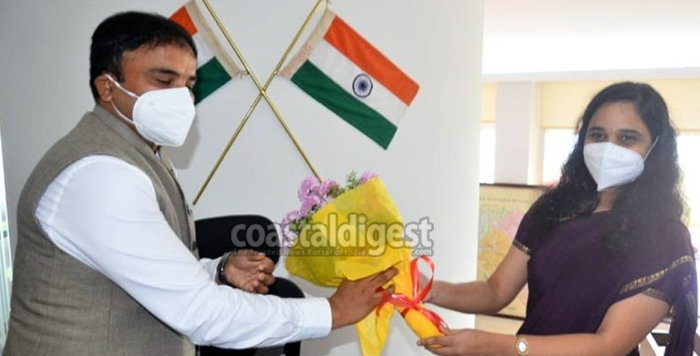
Mangaluru, July 30: Medical doctor turned IAS officer K V Rajendra assumed charge as the 130th deputy commissioner of Dakshina Kannada district here today.

The 2013 batch Karnataka cadre officer succeeds Sindhu B Rupesh, who was transferred as Director of Electronic Delivery of Citizen Services (EDCS), Bengaluru. The outgoing DC welcomed the new DC in the presence of staff. 

Dr Rajendra said that he expects cooperation from all stakeholders in administering the district, amidst the mounting Covid-19 cases.

Rajendra, an alumnus of JJM Medical College, Davanagere, was serving as the CEO of Belagavi zilla panchayat before being posted as DC of this coastal district. 

Having served as assistant commissioner of Puttur sub-division for nearly a year from December 2015, Dr Rajendra, hails from Thirthahalli in Shivamogga district, had his probationary training in Bidar. He posted as CEO of Ballari ZP where he worked for nearly three till 21, 2019.

He also had a brief stint as assistant secretary in the department of fertiliser with the ministry of chemicals and fertilisers.

Sindhu who was the CEO of Udupi zilla panchayat had succeeded Sasikanth Senthil, who resigned from the Indian Administrative Service on September 6, 2019. She had taken charge on September 7, 2019.

Comments

Add new comment

  • Coastaldigest.com reserves the right to delete or block any comments.
  • Coastaldigset.com is not responsible for its readers’ comments.
  • Comments that are abusive, incendiary or irrelevant are strictly prohibited.
  • Please use a genuine email ID and provide your name to avoid reject.
News Network
April 15,2020

Bengaluru, Apr 15: Amir-e-Shariat Maulana Sagir Ahmad Khan Rashadi, Maulanaon Wednesday urged people to compulsorily follow the lockdown restrictions during the month of Ramdan.

Ramazan fastings should not be missed without valid reasons. As already mentioned, five namaz of the day should be performed at home and do not go to Mosques.

Taraweeh Namaz should be performed at home along with family members, he said at a meeting of Imarat-e-Sharia leaders held at Darul Uloom Sabilurrashad (Arabic College) in the city.

Comments

Add new comment

  • Coastaldigest.com reserves the right to delete or block any comments.
  • Coastaldigset.com is not responsible for its readers’ comments.
  • Comments that are abusive, incendiary or irrelevant are strictly prohibited.
  • Please use a genuine email ID and provide your name to avoid reject.
News Network
April 2,2020

The current physical distancing guidelines provided by the World Health Organisation (WHO) and by the US Centers for Disease Control and Prevention (CDC) may not be adequate to curb the coronavirus spread, according to a research which says the gas cloud from a cough or sneeze may help virus particles travel up to 8 metres. The research, published in the Journal of the American Medical Association, noted that the the current guidelines issued by the WHO and CDC are based on outdated models from the 1930s of how gas clouds from a cough, sneeze, or exhalation spread.

Study author, MIT associate professor Lydia Bourouiba, warned that droplets of all sizes can travel 23 to 27 feet, or 7-8 metres, carrying the pathogen.

According to Bourouiba, the current guidelines are based on "arbitrary" assumptions of droplet size, "overly simplified", and "may limit the effectiveness of the proposed interventions" against the deadly pandemic.

 She explained that the old guidelines assume droplets to be one of two categories, small or large, taking short-range semi-ballistic trajectories when a person exhales, coughs, or sneezes.

However based on more recent discoveries, the MIT scientist said, sneezes and coughs are made of a puff cloud that carries ambient air, transporting within it clusters of droplets of a wide range of sizes.

Bourouiba warned that this puff cloud, with ambient air entrapped in it, can offer the droplets moisture and warmth that can prevent it from evaporation in the outer environment.

"The locally moist and warm atmosphere within the turbulent gas cloud allows the contained droplets to evade evaporation for much longer than occurs with isolated droplets," she said.

"Under these conditions, the lifetime of a droplet could be considerably extended by a factor of up to 1000, from a fraction of a second to minutes," the researcher explained in the study.

The MIT scientist, who has researched the dynamics of coughs and sneezes for years, added that these droplets settle along the trajectory of a cough or sneeze contaminating surfaces, with their residues staying suspended in the air for hours.

"Even when maximum containment policies were enforced, the rapid international spread of COVID-19 suggests that using arbitrary droplet size cutoffs may not accurately reflect what actually occurs with respiratory emissions, possibly contributing to the ineffectiveness of some procedures used to limit the spread of respiratory disease," Bourouiba wrote in the study


Comments

Add new comment

  • Coastaldigest.com reserves the right to delete or block any comments.
  • Coastaldigset.com is not responsible for its readers’ comments.
  • Comments that are abusive, incendiary or irrelevant are strictly prohibited.
  • Please use a genuine email ID and provide your name to avoid reject.