


Isolate the forces of violence; end political killings: Vice President

Agencies
February 17, 2018

Kozhikode, Feb 17: Vice President M Venkaiah Naidu today condemned political killings and asked people to isolate the forces of violence.

"Progress will not be possible without peace. I appeal to the people of Kerala to isolate the forces of violence," he said, speaking at the release of the 100th book of senior BJP leader in Kerala, P S Sreedharan Pillai. 

The Vice-President's statement assumes significance in the backdrop of killing of a Youth Congress leader Shuhaib, allegedly by ruling CPI(M) workers, at the politically sensitive Kannur district on February 13. 

Coming down heavily on political clashes, Naidu said such attacks were not good. "Murder and violence affect the social fabric. They will divert attention. I request the Kerala state to isolate violence," he said. 

"If there is tension, there cannot be attention towards development", Naidu said and exhorted the people to use the power of the ballot and not that of the bullet. "Everything should be decided by the ballot because the ballot is stronger than the bullet", he said. 

Urging for a "full stop" to the violence, Naidu said people should strengthen the democratic process in the country. "We have a long illustrious heritage spanning more than a million years. We as a nation are very young, but as a civilisation, we are very old." 

Indians believed in "Vasudeva Kutumbakam" (the world is one family, the Vice President said. Naidu said the essence of Indianness has been defined by noted American writer and philosopher Will Durant, who said "India will teach us the tolerance and gentleness of mature mind, understanding spirit and a unifying, pacifying love for all human being". 

"We may differ in language, religion, region and in worshipping Gods and Goddesses. But India is one and we are proud to be Indians", Naidu said. He said secularism in India was safe not because of the politicians, but because it is bred in the minds of the people. "It is in the DNA of the Indians who have concern for all others", he said. 

"People in Kozhikode are concerned about the people in Jammu and Kashmir and people in Kashmir are concerned about their brethren in Kanyakumari", Naidu said. 

On the economic front, Naidu said that in seven years, the economy would be the third largest in the world." To achieve this, everyone should make their contribution, he said. 
Quoting Mahatma Gandhi Naidu said "cleanliness is much more important than political freedom. Mana, Gana and Dhana should be clean". "If money is clean there will be no tension.

If the money earned is not clean then there will always be tension", Naidu said. India continued to make progress in various fields, he said, adding the country also has challenges in some sectors, including in public health care and education.

Comments

A Kannadiga
 - 
Sunday, 18 Feb 2018

Mr. Naidu, you should have changed your tune before becoming Vice President of India.

Bhageertha Bhaira
 - 
Saturday, 17 Feb 2018

Mr vice president, you should be well aware that forces of Gujarat genocide are ruling the country and you also came from same back ground.

Add new comment

  • Coastaldigest.com reserves the right to delete or block any comments.
  • Coastaldigset.com is not responsible for its readers’ comments.
  • Comments that are abusive, incendiary or irrelevant are strictly prohibited.
  • Please use a genuine email ID and provide your name to avoid reject.
Agencies
August 3,2020

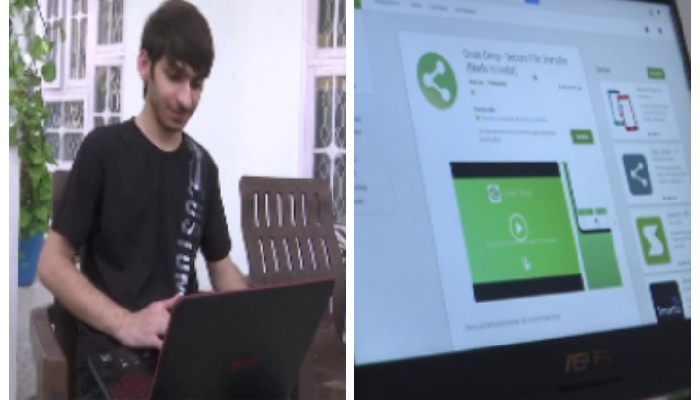
Rajouri, Aug 3: Ashfaq Mehmood Choudhary, a 17-year-old boy from Chattyear of Jammu and Kashmir's Rajouri district, has developed a file-sharing app 'Dodo Drop' which would enable users to share audios, videos, images, and texts between two devices without Internet access.

While speaking to media persons, Ashfaq Mehmood said that the 'Dodo Drop' application is an alternative to the Chinese 'SHAREit' app. "The Indian government has banned several Chinese apps due to data breaching, and among those apps was SHAREit which was used for sharing files.

Users faced a lot of problems due to the ban, and so I decided to make this file-sharing app. With 'Dodo Drop', users can share audios, videos, images, and even texts," he said.

Ashfaq said that it took him four weeks to develop the application, and it was launched on August 1 this year. The 'Dodo Drop' application has a transfer rate of up to 480 mbps, which is faster than the SHAREit app and is "quite easy" to use.

"Users can transfer data comprising photos, videos, audios, apps, texts, etc. between two devices with no Internet access. The transfers are fully encrypted and secure," he added.

"Our Prime Minister has always asserted the need for decreasing the dependency on foreign products and apps and to focus on the development of India-based apps. I tried to be part of the initiative of 'Aatmanirbhar Bharat' by developing an India-based file-sharing app. I want to develop global-standard apps for India," he added.

"We support and cooperate with him. He generates his own income by working on some projects and utilises it. We will continue to support him," said Parvez Ahmed Choudhary, Ashfaq's father.

In July, the Ministry of Electronics and Information Technology (MEITY) banned 47 apps, which were variants and cloned copies of the 59 apps banned earlier in June. These banned clones included SHAREit Lite, Tiktok Lite, Helo Lite, BIGO LIVE Lite, and VFY Lite.

The 59 apps had been banned by the Centre in June in view of the information available that they were engaged in activities which were "prejudicial to sovereignty and integrity and defence" of the country.

Almost all the apps banned had some preferential Chinese interest and the majority had parent Chinese companies.

The ban came amid border tensions with China in the Eastern Ladakh region.

Comments

Add new comment

  • Coastaldigest.com reserves the right to delete or block any comments.
  • Coastaldigset.com is not responsible for its readers’ comments.
  • Comments that are abusive, incendiary or irrelevant are strictly prohibited.
  • Please use a genuine email ID and provide your name to avoid reject.
Agencies
January 14,2020

Farukkhabad, Jan 14: In a shocking incident, a new-born baby was mauled to death by a dog inside the operation theatre (OT) of a private hospital in Farukkhabad on Monday.

Family members of the baby boy said that they noticed the hospital staff shooing a dog away from inside the operation theatre and soon after, they were told the baby boy, born just two hours ago, was dead.

The family members said that they found the baby's body on the floor and it had deep gashes around the neck and other parts of the body.

District magistrate Manvendra Singh has ordered an FIR and the Chief Medical Officer (CMO) Chandra Shekhar said the hospital has been sealed and an inquiry ordered into the incident.

Sources said that the hospital where the incident took place was unregistered and was being run adjacent to a government hospital.

According to the FIR lodged with Sadar Kotwali police, the infant's father Ravi Kumar said he had admitted his wife Kanchan in the hospital on Monday and she was taken for a C-section to the operation theatre.

After the delivery, Kanchan was shifted to the ward but the family was told that the baby would be shifted later.

An hour later, the family was informed that the baby had died.

The family members then saw the hospital staff trying to chase a dog out of the operation theatre.

The family members forced their way into the operation theatre and found the infant lying on the floor with several injuries on the neck.

The police said that the baby's body has been preserved for examination and post mortem.

The FIR has been registered against Dr Mohit Gupta, and some of the staff members who were present during the delivery.

The hospital owner, Vijay Patel, however, feigned complete ignorance about the incident and said that he had been told that the baby was born dead.

Comments

Add new comment

  • Coastaldigest.com reserves the right to delete or block any comments.
  • Coastaldigset.com is not responsible for its readers’ comments.
  • Comments that are abusive, incendiary or irrelevant are strictly prohibited.
  • Please use a genuine email ID and provide your name to avoid reject.
News Network
January 20,2020

Davos, Jan 20: India's richest 1 per cent hold more than four-times the wealth held by 953 million people who make up for the bottom 70 per cent of the country's population, while the total wealth of all Indian billionaires is more than the full-year budget, a new study said on Monday.

Releasing the study 'Time to Care' here ahead of the 50th annual meeting of the World Economic Forum (WEF), rights group Oxfam also said the world's 2,153 billionaires have more wealth than the 4.6 billion people who make up 60 per cent of the planet's population.

The report flagged that global inequality is shockingly entrenched and vast and the number of billionaires has doubled in the last decade, despite their combined wealth having declined in the last year.

"The gap between rich and poor can't be resolved without deliberate inequality-busting policies, and too few governments are committed to these," said Oxfam India CEO Amitabh Behar, who is here to represent the Oxfam confederation this year.

The issues of income and gender inequality are expected to figure prominently in discussions at the five-day summit of the WEF, starting Monday. The WEF's annual global risks Report has also warned that the downward pressure on the global economy from macroeconomic fragilities and financial inequality continued to intensify in 2019.

Concern about inequality underlies recent social unrest in almost every continent, although it may be sparked by different tipping points such as corruption, constitutional breaches, or the rise in prices for basic goods and services, as per the WEF report.

Although global inequality has declined over the past three decades, domestic income inequality has risen in many countries, particularly in advanced economies and reached historic highs in some, the Global Risks Report flagged last week.

The Oxfam report further said "sexist" economies are fuelling the inequality crisis by enabling a wealthy elite to accumulate vast fortunes at the expense of ordinary people and particularly poor women and girls.

Regarding India, Oxfam said the combined total wealth of 63 Indian billionaires is higher than the total Union Budget of India for the fiscal year 2018-19 which was at Rs 24,42,200 crore.

"Our broken economies are lining the pockets of billionaires and big business at the expense of ordinary men and women. No wonder people are starting to question whether billionaires should even exist," Behar said.

As per the report, it would take a female domestic worker 22,277 years to earn what a top CEO of a technology company makes in one year.

With earnings pegged at Rs 106 per second, a tech CEO would make more in 10 minutes than what a domestic worker would make in one year.

It further said women and girls put in 3.26 billion hours of unpaid care work each and every day -- a contribution to the Indian economy of at least Rs 19 lakh crore a year, which is 20 times the entire education budget of India in 2019 (Rs 93,000 crore).

Besides, direct public investments in the care economy of 2 per cent of GDP would potentially create 11 million new jobs and make up for the 11 million jobs lost in 2018, the report said.

Behar said the gap between rich and poor cannot be resolved without deliberate inequality-busting policies, and too few governments are committed to these.

He said women and girls are among those who benefit the least from today's economic system.

"They spend billions of hours cooking, cleaning and caring for children and the elderly. Unpaid care work is the 'hidden engine' that keeps the wheels of our economies, businesses and societies moving.

"It is driven by women who often have little time to get an education, earn a decent living or have a say in how our societies are run, and who are therefore trapped at the bottom of the economy,” Behar added.

Oxfam said governments are massively under-taxing the wealthiest individuals and corporations and failing to collect revenues that could help lift the responsibility of care from women and tackle poverty and inequality.

Besides, the governments are also underfunding vital public services and infrastructure that could help reduce women and girls' workload, the report said.

As per the global survey, the 22 richest men in the world have more wealth than all the women in Africa.

Besides, women and girls put in 12.5 billion hours of unpaid care work each and every day -- a contribution to the global economy of at least USD 10.8 trillion a year, more than three times the size of the global tech industry.

Getting the richest one per cent to pay just 0.5 per cent extra tax on their wealth over the next 10 years would equal the investment needed to create 117 million jobs in sectors such as elderly and childcare, education and health.

Governments must prioritise care as being as important as all other sectors in order to build more human economies that work for everyone, not just a fortunate few, Behar said.

Oxfam said its calculations are based on the latest data sources available, including from the Credit Suisse Research Institute's Global Wealth Databook 2019 and Forbes' 2019 billionaires list.

Comments

Add new comment

  • Coastaldigest.com reserves the right to delete or block any comments.
  • Coastaldigset.com is not responsible for its readers’ comments.
  • Comments that are abusive, incendiary or irrelevant are strictly prohibited.
  • Please use a genuine email ID and provide your name to avoid reject.