Mangaluru: BWF felicitates Beary Academy chief

Media Release
February 21, 2018

Mangaluru: Bearys Welfare Forum, Abu Dhabi, accorded a warm felicitation to Karambar Mohammed, President of Karnataka Beary Sahitya Academy, recently in the city in the presence of academy members.

Acknowledging the felicitation, he laid emphasis on the problems faced by the community and society in Gulf countries. He exhorted the community members to strive for the betterment of society and work together to achieve success in all spheres of life.

He lauded the BWF for its tremendous service to community like organizing mass marriages, undertaking Shouchalaya project and so on, which he said had uplifted the community and fulfilled people’s needs.

BWF president Mohamed Ali Uchil, vice-president Rafique Krishnapur, and Iqwan Ahmed felicitated the academy chief. Mohammed Ali Uchil explained the present situation in Gulf countries and problems faced by community members, and requested community leaders to look in to issue.

Basheer Baikampady, Attur Chayabba , Ansar Bellare, Aysha and Tansif were present on dais. Hussein Katipalla compered the program.

Comments

Jawed
 - 
Thursday, 22 Feb 2018

congrats team Beary Academy and BWF.Nice to see community organizations puts hands together to serve community

Iqbal ,Dubai
 - 
Thursday, 22 Feb 2018

Beary language should be given priority in our households; it is a pity that language is slowly diminishing. Academy should work on to restore old glory of beary language.

Congratulations to Kadambar Mohammed and Mohammed Ali Uchil- 2 stalwarts of community

Zulfi Mangalore
 - 
Wednesday, 21 Feb 2018

congrats Kadambar Mohammed on being feliciated by well reputed BWF.congrats to newly selected Academy members.Keep the team spirit.


Altaf Ahmed
 - 
Wednesday, 21 Feb 2018

well done BWF-,establishing bond with community back home is a noble deed.Keep it up

Add new comment

  • Coastaldigest.com reserves the right to delete or block any comments.
  • Coastaldigset.com is not responsible for its readers’ comments.
  • Comments that are abusive, incendiary or irrelevant are strictly prohibited.
  • Please use a genuine email ID and provide your name to avoid reject.
coastaldigest.com news network
August 3,2020

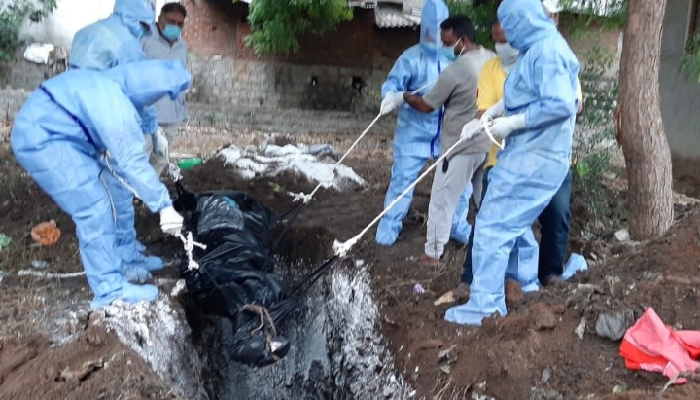
Koppal, Aug 3: The activists of Popular Front of India (PFI) have won the heart of the people by performing the last rites of a local leader of Bharatiya Janata Party in Koppla district of Karnataka. 

Somashekhara Gowda, a senior BJP leader in Koppal’s Gangavathi died of covid-19. His family members were reportedly quarantined. His own party activists also were not ready to participate in the last rite due to the fear of coronavirus infection.

Following requests, a team of PFI comprised of district secretary Fayaz, and members Yaseen, Abdul Aalam, Shamid Razi and Husain Azarauddin performed the last rites as per Veerashaiva Lingayat traditions. 

Speaking to media persons PFI district president Zaheer Abbas lamented that people still have plenty of misconceptions about covid-19. “Due to the misconceptions, performing the last rites of those who die of covid-19 has become a challenge,” he said.

He said that PFI activists followed all the health guidelines and took necessary precautions while performing the last rites. “Under the guidance of district health officials and with the consent of the family members of the deceased, the last rites were performed as per Veerashaiva Lingayat traditions,” he said.

Comments

Add new comment

  • Coastaldigest.com reserves the right to delete or block any comments.
  • Coastaldigset.com is not responsible for its readers’ comments.
  • Comments that are abusive, incendiary or irrelevant are strictly prohibited.
  • Please use a genuine email ID and provide your name to avoid reject.
Agencies
May 8,2020

Washington D.C., May 8: The prime time for brain development in a child's life is the first year, where the infant spends most of the time asleep. It is the time when neural connections form and sensory memories are encoded.

However, when sleep is disrupted, as occurs more often among children with autism, brain development may be affected, too.

New research led by the University of Washington finds that sleep problems in a baby's first 12 months may not only precede an autism diagnosis but also may be associated with altered growth trajectory in a key part of the brain, the hippocampus.

The study, which was published in the American Journal of Psychiatry, researchers report that in a sample of more than 400 taken of 6- to 12-month-old infants, those who were later diagnosed with autism were more likely to have had difficulty falling asleep.

It also states that this sleep difficulty was associated with altered growth trajectories in the hippocampus.

"The hippocampus is critical for learning and memory, and changes in the size of the hippocampus have been associated with poor sleep in adults and older children.

As many as 80 per cent of the children with autism spectrum disorder have sleep problems," said Annette Estes, director of the UW Autism Center and senior author of the study.

"In our clinical experience, parents have a lot of concerns about their children's sleep, and in our work on early autism intervention, we observed that sleep problems were holding children and families back," added Estes, who is also a UW professor of speech and hearing sciences.

"It could be that altered sleep is part-and-parcel of autism for some children. One clue is that behavioural interventions to improve sleep don't work for all children with autism, even when their parents are doing everything just right. This suggests that there may be a biological component to sleep problems for some children with autism," said Estes.

To consider links among sleep, brain development, and autism, researchers at the IBIS Network looked at MRI scans of 432 infants, surveyed parents about sleep patterns, and measured cognitive functioning using a standardized assessment.

At the outset of the study, infants were classified according to their risk for developing autism: Those who were at higher risk of developing autism -- about two-thirds of the study sample -- had an older sibling who had already been diagnosed.

Infant siblings of children with autism have a 20 per cent chance of developing autism spectrum disorder -- a much higher risk than children in the general population.

In the current study, 127 of the 432 infants were identified as "low risk" at the time the MRI scans were taken because they had no family history of autism.

They later evaluated all the participants at 24 months of age to determine whether they had developed autism. Of the roughly 300 children originally considered "high familial risk," 71 were diagnosed with autism spectrum disorder at that age.

Problems with sleep were more common among the infants later diagnosed with an autism spectrum disorder, as were larger hippocampi. No other subcortical brain structures were affected, including the amygdala, which is responsible for certain emotions and aspects of memory, or the thalamus, a signal transmitter from the spinal cord to the cerebral cortex.

The authors note that while parents reported more sleep difficulties among infants who developed autism compared to those who did not, the differences were very subtle and only observed when looking at group averages across hundreds of infants.

Sleep patterns in the first years of life change rapidly as infants transition from sleeping around the clock to a more adult-like sleep/wake cycle. Until further research is completed, Estes said, it is not possible to interpret challenges with sleep as an early sign of increased risk for autism.


Comments

Add new comment

  • Coastaldigest.com reserves the right to delete or block any comments.
  • Coastaldigset.com is not responsible for its readers’ comments.
  • Comments that are abusive, incendiary or irrelevant are strictly prohibited.
  • Please use a genuine email ID and provide your name to avoid reject.
News Network
June 11,2020

New Delhi, Jun 11: The Department of Pharmaceuticals has given its nod for lifting of ban on the export of hydroxychloroquine, Union Minister D V Sadananda Gowda said on Wednesday.

India had banned export of hydroxychloroquine on March 25, with some exceptions, amid views in some quarters that the drug could be used to fight COVID-19. On April 4, it completely banned the exports without any exception.

"Department of Pharmaceuticals has approved the lifting of ban on export of Hydroxychloroquine API as well as formulations. Manufacturers except SEZ/EOU Units have to supply 20 per cent production in the domestic market," the minister of chemicals and fertilisers said in a tweet.

The Directorate General of Foreign Trade (DGFT) has been asked to issue formal notification in this regard, he added.

In another tweet, Gowda said he held discussions with representatives of pharma companies along with some of his ministerial colleagues on the challenges being faced by the industry and on the roadmap to boost exports.

"Had detailed discussion with representatives of pharma companies & association, stakeholder Ministries along with Hon Ministers @piyushGoyal  ji, @HardeepSPuri  ji, & @MansukhMandviya  ji on entire gamut of challenges faced by the industry as well as strategies to boost pharma export," Gowda tweeted.

India exported hydroxychloroquine API (active pharmaceutical ingredient) worth USD 1.22 billion in April-January 2019-20.

During the same period, exports of formulations made from hydroxychloroquine was at USD 5.50 billion.

Comments

Add new comment

  • Coastaldigest.com reserves the right to delete or block any comments.
  • Coastaldigset.com is not responsible for its readers’ comments.
  • Comments that are abusive, incendiary or irrelevant are strictly prohibited.
  • Please use a genuine email ID and provide your name to avoid reject.