


Rakesh Asthana appointed CBI special director

Agencies
October 23, 2017

New Delhi, Oct 23: Gujarat-cadre IPS officer Rakesh Asthana was on Monday appointed the special director of the CBI. Asthana, a 1984-batch IPS officer, had been serving in the Central Bureau of Investigation (CBI) as additional director.

He is among seven other senior police officers of the 1984 batch promoted on Monday by the Appointments Committee of the Cabinet, according to a notification by the Department of Personnel and Training.

Javeed Ahmed, a 1984-batch IPS officer who served as DGP of Uttar Pradesh (UP) and launched key police modernisation projects such as the "Twitter Seva" in the state, was given the rank of special DG at the Centre.

Ahmed, a former CBI joint director who was posted at the National Institute of Criminology and Forensic Science under the home ministry, has been given the rank of special DG on "in-situ" basis, the notification said.

Deepak Mishra of AGMU cadre and Sudeep Lakhtakia of Telangana cadre have been promoted as special DG in the Central Reserve Police Force (CRPF).

Both were serving in the CRPF as additional DG. A P Maheshwari of UP cadre and Rajesh Ranjan of Bihar cadre, who held the post of additional DG in the Border Security Force, have been promoted as special DG in the force.

Gurbachan Singh of Odisha cadre and Arvind Kumar - posted as additional director in the Intelligence Bureau (IB) - have been given the ranks of a special director.

While Singh has been given the position against an existing vacancy, Kumar has been granted the rank and pay of special director on "in-situ" basis.

Comments

Hiren Prajapati
 - 
Wednesday, 28 Feb 2018

Daer sir  Wish to join CBI as  having a good knowledge of import and export today I read news about requirements bank officer for cbi department but it's iblo offered to public secrse bank officer i have been working 8 years in Pvt.banks . Kindly advice can i applied for said position.Regards hiren praPrajap 7227855576


Add new comment

  • Coastaldigest.com reserves the right to delete or block any comments.
  • Coastaldigset.com is not responsible for its readers’ comments.
  • Comments that are abusive, incendiary or irrelevant are strictly prohibited.
  • Please use a genuine email ID and provide your name to avoid reject.
Agencies
August 3,2020

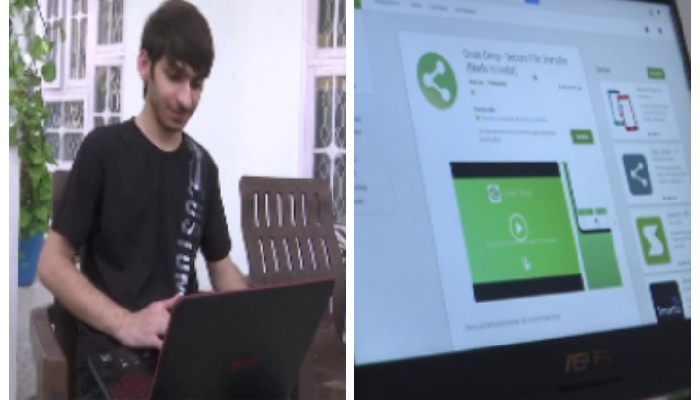
Rajouri, Aug 3: Ashfaq Mehmood Choudhary, a 17-year-old boy from Chattyear of Jammu and Kashmir's Rajouri district, has developed a file-sharing app 'Dodo Drop' which would enable users to share audios, videos, images, and texts between two devices without Internet access.

While speaking to media persons, Ashfaq Mehmood said that the 'Dodo Drop' application is an alternative to the Chinese 'SHAREit' app. "The Indian government has banned several Chinese apps due to data breaching, and among those apps was SHAREit which was used for sharing files.

Users faced a lot of problems due to the ban, and so I decided to make this file-sharing app. With 'Dodo Drop', users can share audios, videos, images, and even texts," he said.

Ashfaq said that it took him four weeks to develop the application, and it was launched on August 1 this year. The 'Dodo Drop' application has a transfer rate of up to 480 mbps, which is faster than the SHAREit app and is "quite easy" to use.

"Users can transfer data comprising photos, videos, audios, apps, texts, etc. between two devices with no Internet access. The transfers are fully encrypted and secure," he added.

"Our Prime Minister has always asserted the need for decreasing the dependency on foreign products and apps and to focus on the development of India-based apps. I tried to be part of the initiative of 'Aatmanirbhar Bharat' by developing an India-based file-sharing app. I want to develop global-standard apps for India," he added.

"We support and cooperate with him. He generates his own income by working on some projects and utilises it. We will continue to support him," said Parvez Ahmed Choudhary, Ashfaq's father.

In July, the Ministry of Electronics and Information Technology (MEITY) banned 47 apps, which were variants and cloned copies of the 59 apps banned earlier in June. These banned clones included SHAREit Lite, Tiktok Lite, Helo Lite, BIGO LIVE Lite, and VFY Lite.

The 59 apps had been banned by the Centre in June in view of the information available that they were engaged in activities which were "prejudicial to sovereignty and integrity and defence" of the country.

Almost all the apps banned had some preferential Chinese interest and the majority had parent Chinese companies.

The ban came amid border tensions with China in the Eastern Ladakh region.

Comments

Add new comment

  • Coastaldigest.com reserves the right to delete or block any comments.
  • Coastaldigset.com is not responsible for its readers’ comments.
  • Comments that are abusive, incendiary or irrelevant are strictly prohibited.
  • Please use a genuine email ID and provide your name to avoid reject.
News Network
May 18,2020

May 18: Goldman Sachs expects India will experience its deepest recession ever after a poor run of data underscored the damaging economic impact of lockdowns in the world’s second-most populous nation.

Gross domestic product will contract by an annualized 45% in the second quarter from the prior three months, compared with Goldman’s previous forecast of a 20% slump. A stronger rebound of 20% is now seen for the third quarter, while projections for the fourth quarter and first of next year are unchanged at 14% and 6.5%.

Those estimates imply that real GDP will fall by 5% in the 2021 fiscal year, which would be deeper than any other recession India has ever experienced, Goldman economists Prachi Mishra and Andrew Tilton wrote in a note dated May 17.

India’s government has extended its nationwide lockdown until May 31, while further easing restrictions in certain sectors to boost economic activity, as coronavirus cases escalate across the country. The announcement followed Finance Minister Nirmala Sitharaman’s fifth briefing in as many days, in which she outlined details of the country’s $265 billion virus rescue package, which is equivalent to 10% of India’s GDP.

 “There have been a series of structural reform announcements across several sectors over the past few days,” the Goldman economists wrote. “These reforms are more medium-term in nature, and we, therefore, do not expect these to have an immediate impact on reviving growth. We will continue to monitor their implementation to gauge their effect on the medium-term outlook.”

Infections are surging across the South Asian nation of 1.3 billion people, with more than 91,300 infections, including 2,897 deaths as of Sunday, according to data from Johns Hopkins University.

Comments

Add new comment

  • Coastaldigest.com reserves the right to delete or block any comments.
  • Coastaldigset.com is not responsible for its readers’ comments.
  • Comments that are abusive, incendiary or irrelevant are strictly prohibited.
  • Please use a genuine email ID and provide your name to avoid reject.
Agencies
July 23,2020

Expressing concern over the ban imposed on TikTok by the government of India, Facebook CEO Mark Zuckerberg has reportedly called the development in the south Asian country “worrisome”.

TikTok was amongst the 59 Chinese apps that were banned in India but why it hogs the maximum limelight because TikTok had the second-largest user base in India with over 200 million users.

As per The Verge writer Casey Newton, Zuckerberg was worried about TikTok’s India ban. Although it soon cashed into the opportunity and released a TikTok clone “Reels”, the government’s reason behind banning the app in India wasn’t received well by Mark Zuckerberg. 

He had said that if India can ban a platform with over 200 million users in India without citing concrete reasons, it can also ban Facebook if something goes amiss on the security and privacy front.

Why Mark finds it particularly worrisome because Facebook is already involved in a lot tussle with the governments across the world involving national security concerns. 

“Facebook already faces fights around the world from governments on both the left and the right related to issues that fit under the broad umbrella of national security: election interference, influence campaigns, hate speech, and even just plain-old democratic speech. Zuckerberg knows that the leap from banning TikTok on national security grounds to banning Facebook on national security grounds is more of a short hop,” the report by Casey read.

Facebook till now has not faced any kind of issue in India but considering the debacle with the other governments, it is not entirely wrong to worry about its future in India if any national security issue arises. Back in 2016, Facebook’s Free Basics service, which means a free but restricted internet service, was banned in India by the telecom regulators. 

The TRAI had said that the Free Basic services were banned in India because it violated the principles of net neutrality. With Free Basics services, Facebook had planned to bring more unconnected users online. But since 2016, there has been no major tussle between the Indian government and Zuckerberg due to national security issues.

Comments

Add new comment

  • Coastaldigest.com reserves the right to delete or block any comments.
  • Coastaldigset.com is not responsible for its readers’ comments.
  • Comments that are abusive, incendiary or irrelevant are strictly prohibited.
  • Please use a genuine email ID and provide your name to avoid reject.