IS propoganda has not affected Indian social fabric, says Rajnath Singh

Agencies
March 15, 2018

Gurgaon, Mar 15: Home Minister Rajnath Singh has said Indian social fabric has not been affected by the emergence of the Islamic State.

"I am, however, happy that Indian social fabric has not been affected by the emergence of the Islamic State and I am sure this will not have any further impact in our country," he said.

Addressing the fourth counter-terrorism conference -- 'Changing Contours of Global Terror' -- Singh, without taking Pakistan's name, said some countries are providing sponsorship and safe havens to terrorists and this has further played a major role in the phenomenal growth of terrorism globally.

"Radicalisation of populace, particularly youths, is another trend and one of the most challenging problems being faced the world over.

"Several countries in the world have identified the problem and have taken measures to check and control the process of radicalisation and I am happy to state that India has timely busted some modules that were planning to orchestrate terrorist attacks on her soil," he said.

The home minister said providing sponsorship and safe havens have further played a major role in the phenomenal growth of global terrorism.

In addition, state support has granted terrorist groups access to resources, guidance and logistics, which would normally be beyond their capabilities, Singh said.

"Any effort to counter the activities of terrorist groups carries the danger of placing the victim nation in direct confrontation with the host nation and its resources," he said.

Singh said in the recent years, the perception of global terrorism has undergone a massive makeover with the rise of armed terror groups especially in the Middle East, South Asia and Africa.

"This phenomenon could be attributed to the diminishing control in the terror space of the Al-Qaeda leadership, which just a decade ago was the face of terrorism. The shift of AQ Network from the Middle East to South Asia is a phenomenon, which is of serious concern to India," he said.

The home minister said a new dimension of terrorism is the networking of terrorist groups with the criminal underworld including organised crime gangs, gunrunners, smugglers, drug peddlers, with hawala and parallel banking channels being used for global flows of finance.

"It has enabled global terrorist groups to use the infrastructure and terrain knowledge of local outfits for launching attacks in countries, despite having no presence in the area," he said.

The home minister said the government has kept a keen watch on the growth of IS and their ways of using social media as a key tool for ideological indoctrination, recruitment and networking by targeting young generation and intellectual Muslims.

"The potential threat posed by the ISIS are large-scale radicalisation of Muslim youths throughout the world, the rise in 'lone-wolf' and terror attacks by returnee foreign fighters to their home countries. The terror attacks in Australia and France are telling examples of such threat," he said.

Singh said IS propaganda has significantly altered jihadi discourse in India, which, so far, was rooted in grievances against the Indian state and society.

"I am, however, happy that Indian social fabric has not been affected by the emergence of the Islamic State and I am sure this will not have any further impact in our country," he said.

The home minister said India has consistently taken steps to intensify and strengthen international cooperation through various means.

Terrorism, in all forms, including, Left Wing Extremism and Insurgency, poses a challenge on the sovereignty of India and the country already faces a serious challenge due to relentless efforts of Pakistan-sponsored anti-India Islamist groups like the LeT, JeM, HUJI and Hizbul Mujahideen, he said.

Singh said the emergence of India at the global level is also being challenged by the terrorist groups, due to its vibrant economy and plural character.

Comments

Abu Muhammad
 - 
Thursday, 15 Mar 2018

Rajnathji, it is because Muslim scholars exposed IS as anti-muslim, unislamic and US-Israel sponsored international terrorist group whose leader is a Jew with a muslim name.


Sirji, why did you left out RSS, BD, VHP, Gou Rakshas, Vahinis, Senas, brigades etc. affiliated to BJP from Radicalisation, Terrorism, extremism, communalism ?? World wants to know your answer???

Add new comment

  • Coastaldigest.com reserves the right to delete or block any comments.
  • Coastaldigset.com is not responsible for its readers’ comments.
  • Comments that are abusive, incendiary or irrelevant are strictly prohibited.
  • Please use a genuine email ID and provide your name to avoid reject.
News Network
January 7,2020

New Delhi, Jan 7: When a reign of terror was unleashed by "masked goons" in the Jawaharlal Nehru University (JNU) on Sunday, Delhi Police registered two cases against varsity students union president Aishe Ghosh, who was badly injured in the attack, within a span of five minutes.

The registration of cases on two separate complaints against Ghosh and other students filed by JNU security department on January 3 and January 4 were registered on Sunday night when the violence was on, triggering questions about the motive behind the timing.

While the FIRs against Ghosh and others were registered between 8.44 pm and 8.49 pm after the JNUSU president was admitted to AIIMS, an FIR on the Sunday violence was registered on Monday at 5.36 am against unknown persons. The Sunday violence case has been transferred to Crime Branch for further investigations.

Questions are being raised over the registration of FIRs on Sunday while the complaints were filed on the previous days. Students allege that it was an afterthought from the police and authorities, as a nationwide outrage erupted as soon as the violence was reported.

Delhi Police is under attack for not coming to the aid of students targeted by the mob of ABVP activists armed with iron rods and sticks who went on a rampage on the campus. While no single person in the Sunday violence was arrested, the police are also accused of being a "mute spectator" by allowing the rioters to leave the campus without being arrested.

In its complaints, the JNU Security Department has alleged that Ghosh and others entered into a verbal and physical scuffle with security guards, including women, when officials tried to open the Centre for Information System (CIS) that was blocked by students protesting against the fee hike and registration process.

While the January 3 complaint claims that the students switched off the power supply to the CIS and evicted staff forcefully, the January 4 complaint alleged that they damaged the information system.

They also claimed the students damaged the servers, made it dysfunctional, severely damaged optic fibre cables and broke the biometric system in the CIS. The complaint also cited a Supreme Court order that prevented any protest within 100 metres of Administration Block and claimed the students violated the direction.

The FIR filed on Sunday violence on the basis of the statement of Inspector Anand Yadav said that the first phase of violence was reported at 3.45 pm when "40-50 unidentified" people who had "covered their faces" attacked students in Periyar Hostel and the situation was brought under control.

However at around 7 pm, "50-60 people with rods in their hands" targeted students in Sabarmati Hostel in which students were attacked and public property destroyed.

The FIR said that students were injured but skipped the mention of the attack on teachers, who were injured. At least two faculty members Sucharita Sen and Ameet Parameswaran were taken to AIIMS while several other teachers suffered minor injuries.

Comments

Add new comment

  • Coastaldigest.com reserves the right to delete or block any comments.
  • Coastaldigset.com is not responsible for its readers’ comments.
  • Comments that are abusive, incendiary or irrelevant are strictly prohibited.
  • Please use a genuine email ID and provide your name to avoid reject.
Agencies
August 3,2020

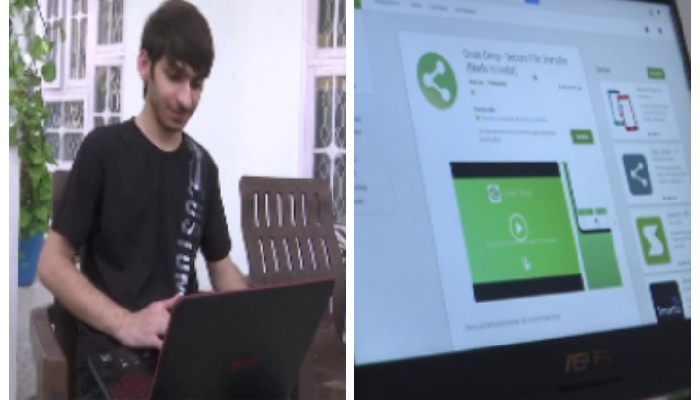
Rajouri, Aug 3: Ashfaq Mehmood Choudhary, a 17-year-old boy from Chattyear of Jammu and Kashmir's Rajouri district, has developed a file-sharing app 'Dodo Drop' which would enable users to share audios, videos, images, and texts between two devices without Internet access.

While speaking to media persons, Ashfaq Mehmood said that the 'Dodo Drop' application is an alternative to the Chinese 'SHAREit' app. "The Indian government has banned several Chinese apps due to data breaching, and among those apps was SHAREit which was used for sharing files.

Users faced a lot of problems due to the ban, and so I decided to make this file-sharing app. With 'Dodo Drop', users can share audios, videos, images, and even texts," he said.

Ashfaq said that it took him four weeks to develop the application, and it was launched on August 1 this year. The 'Dodo Drop' application has a transfer rate of up to 480 mbps, which is faster than the SHAREit app and is "quite easy" to use.

"Users can transfer data comprising photos, videos, audios, apps, texts, etc. between two devices with no Internet access. The transfers are fully encrypted and secure," he added.

"Our Prime Minister has always asserted the need for decreasing the dependency on foreign products and apps and to focus on the development of India-based apps. I tried to be part of the initiative of 'Aatmanirbhar Bharat' by developing an India-based file-sharing app. I want to develop global-standard apps for India," he added.

"We support and cooperate with him. He generates his own income by working on some projects and utilises it. We will continue to support him," said Parvez Ahmed Choudhary, Ashfaq's father.

In July, the Ministry of Electronics and Information Technology (MEITY) banned 47 apps, which were variants and cloned copies of the 59 apps banned earlier in June. These banned clones included SHAREit Lite, Tiktok Lite, Helo Lite, BIGO LIVE Lite, and VFY Lite.

The 59 apps had been banned by the Centre in June in view of the information available that they were engaged in activities which were "prejudicial to sovereignty and integrity and defence" of the country.

Almost all the apps banned had some preferential Chinese interest and the majority had parent Chinese companies.

The ban came amid border tensions with China in the Eastern Ladakh region.

Comments

Add new comment

  • Coastaldigest.com reserves the right to delete or block any comments.
  • Coastaldigset.com is not responsible for its readers’ comments.
  • Comments that are abusive, incendiary or irrelevant are strictly prohibited.
  • Please use a genuine email ID and provide your name to avoid reject.
News Network
May 21,2020

London, May 21: Working mothers in Europe and the United States are taking on most of the extra housework and childcare created by lockdown - and many are struggling to cope, a survey showed on Thursday.

Women with children now spend an average 65 hours a week on the unpaid chores - nearly a third more than fathers - according to the Boston Consulting Group, which questioned parents in five countries.

"Women have been doing too much household work for too long, and this crisis is pushing them to a point that's simply unsustainable," Rachel Thomas, of U.S.-based women's rights group LeanIn.Org, said in response to the data.

"We need a major culture shift in our homes and in our companies ... We should use this moment to build a better way to work and live – one that's fair for everybody."

Researchers say fallout from the pandemic weighs on women in a host of ways, be it in rising domestic violence or in lower wages, as some women cut paid work to take on the new duties.

With lockdowns shutting schools and keeping citizens at home, creating a mountain of domestic work, public campaigns from Georgia to Mexico have urged men to do their fair share.

But women, who on average already do more at home than men, are now shouldering most of the new coronavirus burden, too, said the survey of more than 3,000 working parents in the United States, Britain, Italy, Germany and France.

Women's unpaid hours at home have nearly doubled to 65 hours a week, said the survey, against 50 logged by an average father.

British women are more likely to support others in the COVID-19 pandemic and are finding it harder to stay positive, according to separate analysis released this week by polling firm Ipsos MORI and feminist organisation The Fawcett Society.

It is "no surprise" to see women do more childcare and housekeeping on top of their day jobs, Jacqui Hunt of women's rights group Equality Now, told the Thomson Reuters Foundation.

However, there are "hopeful signs" that men in West Africa are sharing more childcare during the pandemic in a shift in social norms, found a small rapid analysis by humanitarian organisation CARE International released on Wednesday.

Comments

Add new comment

  • Coastaldigest.com reserves the right to delete or block any comments.
  • Coastaldigset.com is not responsible for its readers’ comments.
  • Comments that are abusive, incendiary or irrelevant are strictly prohibited.
  • Please use a genuine email ID and provide your name to avoid reject.