


IS propoganda has not affected Indian social fabric, says Rajnath Singh

Agencies
March 15, 2018

Gurgaon, Mar 15: Home Minister Rajnath Singh has said Indian social fabric has not been affected by the emergence of the Islamic State.

"I am, however, happy that Indian social fabric has not been affected by the emergence of the Islamic State and I am sure this will not have any further impact in our country," he said.

Addressing the fourth counter-terrorism conference -- 'Changing Contours of Global Terror' -- Singh, without taking Pakistan's name, said some countries are providing sponsorship and safe havens to terrorists and this has further played a major role in the phenomenal growth of terrorism globally.

"Radicalisation of populace, particularly youths, is another trend and one of the most challenging problems being faced the world over.

"Several countries in the world have identified the problem and have taken measures to check and control the process of radicalisation and I am happy to state that India has timely busted some modules that were planning to orchestrate terrorist attacks on her soil," he said.

The home minister said providing sponsorship and safe havens have further played a major role in the phenomenal growth of global terrorism.

In addition, state support has granted terrorist groups access to resources, guidance and logistics, which would normally be beyond their capabilities, Singh said.

"Any effort to counter the activities of terrorist groups carries the danger of placing the victim nation in direct confrontation with the host nation and its resources," he said.

Singh said in the recent years, the perception of global terrorism has undergone a massive makeover with the rise of armed terror groups especially in the Middle East, South Asia and Africa.

"This phenomenon could be attributed to the diminishing control in the terror space of the Al-Qaeda leadership, which just a decade ago was the face of terrorism. The shift of AQ Network from the Middle East to South Asia is a phenomenon, which is of serious concern to India," he said.

The home minister said a new dimension of terrorism is the networking of terrorist groups with the criminal underworld including organised crime gangs, gunrunners, smugglers, drug peddlers, with hawala and parallel banking channels being used for global flows of finance.

"It has enabled global terrorist groups to use the infrastructure and terrain knowledge of local outfits for launching attacks in countries, despite having no presence in the area," he said.

The home minister said the government has kept a keen watch on the growth of IS and their ways of using social media as a key tool for ideological indoctrination, recruitment and networking by targeting young generation and intellectual Muslims.

"The potential threat posed by the ISIS are large-scale radicalisation of Muslim youths throughout the world, the rise in 'lone-wolf' and terror attacks by returnee foreign fighters to their home countries. The terror attacks in Australia and France are telling examples of such threat," he said.

Singh said IS propaganda has significantly altered jihadi discourse in India, which, so far, was rooted in grievances against the Indian state and society.

"I am, however, happy that Indian social fabric has not been affected by the emergence of the Islamic State and I am sure this will not have any further impact in our country," he said.

The home minister said India has consistently taken steps to intensify and strengthen international cooperation through various means.

Terrorism, in all forms, including, Left Wing Extremism and Insurgency, poses a challenge on the sovereignty of India and the country already faces a serious challenge due to relentless efforts of Pakistan-sponsored anti-India Islamist groups like the LeT, JeM, HUJI and Hizbul Mujahideen, he said.

Singh said the emergence of India at the global level is also being challenged by the terrorist groups, due to its vibrant economy and plural character.

Comments

Abu Muhammad
 - 
Thursday, 15 Mar 2018

Rajnathji, it is because Muslim scholars exposed IS as anti-muslim, unislamic and US-Israel sponsored international terrorist group whose leader is a Jew with a muslim name.


Sirji, why did you left out RSS, BD, VHP, Gou Rakshas, Vahinis, Senas, brigades etc. affiliated to BJP from Radicalisation, Terrorism, extremism, communalism ?? World wants to know your answer???

Add new comment

  • Coastaldigest.com reserves the right to delete or block any comments.
  • Coastaldigset.com is not responsible for its readers’ comments.
  • Comments that are abusive, incendiary or irrelevant are strictly prohibited.
  • Please use a genuine email ID and provide your name to avoid reject.
coastaldigest.com news network
August 8,2020

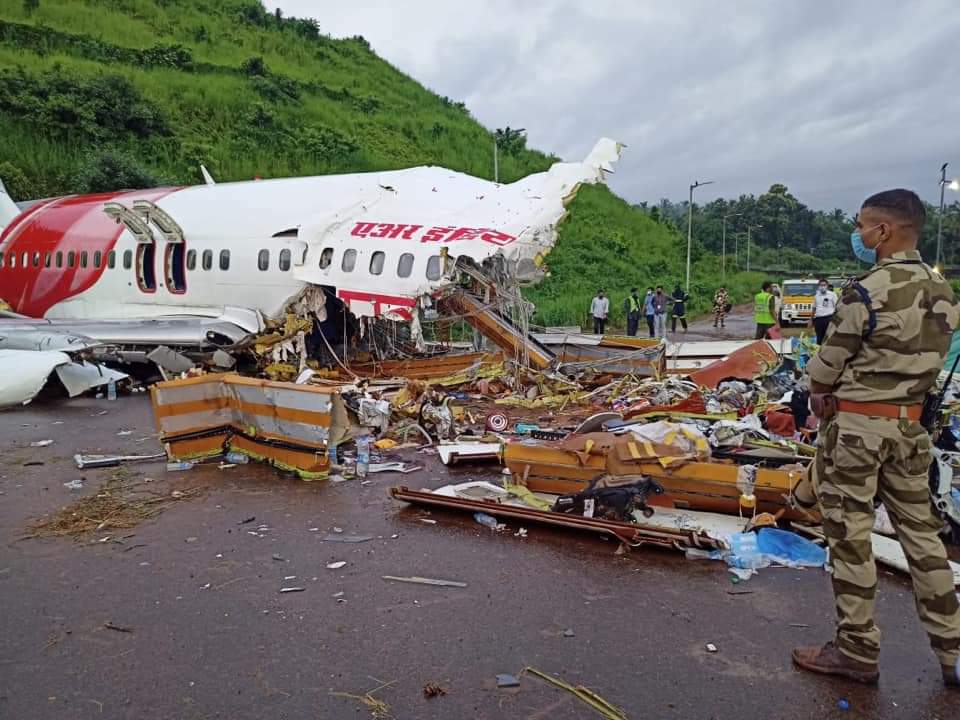
Kozhikode, Aug 8: A tailwind or crosswind could be the reason for the Air India Express flight mishap at Kozhikode international airport in Kerala, according to some aviation experts. 

Team of DGCA and AIE already reached the spot. With the death of the captain and co-pilot in the mishap, the investigation would be focusing mainly on the voice recorders and other technical aspects.

It is learnt that the ill-fated aircraft, IX 1344 with 190 onboard including crew, was initially planning to land on runway-28 of the airport. But later the pilot opted runway-10 which is toward the other direction. Pilots would be taking the decisions on the basis of inputs from ATC.

The questions now doing the rounds are what made the pilot opt runway-10 and whether the tabletop runway lacked adequate safety parameters.

An aviation expert, who didn't want to be quoted, said that Capt Deepak Sathe, who was commandeering the aircraft, was a well-experienced pilot and was also familiar with the terrains. Hence the chances of any error from his part was very unlikely. Hence a fair in-depth probe was required to find the exact cause.

Though the Kozhikode airport has an Instrument Landing System, it was of category-I for which pilot's visibility is very crucial toward a touchdown. Since it is a tabletop airport and rough weather prevailing in the region, the chances of tailwind was also high, said sources.

There had been safety concerns about the airport over quite some time. In 2011 aviation safety consultant captain Mohan Ranganathan reportedly gave a report citing the safety issues, especially the buffer zones at the end of the runway.

However, an AAI officer said that rectification steps were already done by last year by widening the Runway End Safety Area (RESA) from 90 metre to 240 metre. However, the length of the runway had to be reduced to 2,700 metre from 2,850. The AAI was also constantly pressing for increasing the runway length to 3,150 metres. But that was getting delayed due to land acquisition issues pending with the state government.

stm88 info live rtp slot

slot auto scatter hitam

Comments

Add new comment

  • Coastaldigest.com reserves the right to delete or block any comments.
  • Coastaldigset.com is not responsible for its readers’ comments.
  • Comments that are abusive, incendiary or irrelevant are strictly prohibited.
  • Please use a genuine email ID and provide your name to avoid reject.
News Network
July 22,2020

New Delhi, Jul 22: India is responding with utmost urgency to coronavirus from the very beginning and has been continuously strengthening preparedness and response measures, WHO Regional Director (South-East Asia) Poonam Khetrapal Singh said on Wednesday.

"India is responding with utmost urgency to COVID-19 from the start. It's been continuously strengthening preparedness and response measures, including ramping up testing capacities, readying more hospitals, arranging and stocking up medicines and essentials," Singh said at a virtual briefing.

"India took bold, decisive and early measures earlier in the outbreak. The country did not witness an exponential increase in cases like some other countries which reported their first few cases along with India. Like in any other country the transmission of COVID-19 is not homogenous in India. There are areas yet to see a confirmed case, some have sporadic cases, in some areas some small clusters while we are witnessing large clusters in some megacities from the densely populated areas," Singh said.
She said WHO was aware of varying capacities at sub-national levels.

"Not unusual in a country as big as India and its population size that measures taken may often not be uniformly sufficient across all areas. Scaling up capacities and response remains a constant need in India."

Replying on the question of what more needs to be done in controlling the spread of COVID-19, she said all countries including India must continue to implement core public health and social distancing measures.

"Local epidemiology to guide our response for finding hotspots and testing, detecting, isolating and providing care to the affected, promoting safe hygiene practices and respiratory etiquette, protecting health workers and increasing health system capacity is also key," she said.

Comments

Add new comment

  • Coastaldigest.com reserves the right to delete or block any comments.
  • Coastaldigset.com is not responsible for its readers’ comments.
  • Comments that are abusive, incendiary or irrelevant are strictly prohibited.
  • Please use a genuine email ID and provide your name to avoid reject.
Agencies
July 24,2020

New Delhi, Jul 24: Telecom companies lost 82.3 lakh subscribers during the COVID-19 lockdown period of April, data released by the Telecom Regulatory Authority of India (TRAI) on Friday showed.

As per the reports received from 342 operators in April, TRAI said the number of broadband subscribers decreased from 68.7 crore at the end of March to 67.6 crore at the end of April with a monthly decline rate of 1.64 per cent.

Top five service providers constituted 98.98 per cent market share of total broadband subscribers with Reliance Jio Infocomm (38.9 crore), Bharti Airtel (14.4 crore), Vodafone Idea (11.1 crore), BSNL (2.1 crore) and Atria Convergence (16 lakh).

The number of overall telephone subscribers decreased from 117.7 crore at the end of March to 116.9 crore at the end of April, showing a monthly decline rate of 0.72 per cent.

The TRAI said total wireless subscribers (2G, 3G and 4G) decreased from 115.7 crore at the end of March to 115 crore at the end of April, thereby registering a monthly decline rate of 0.71 per cent.

Wireless subscription in urban areas decreased from 63.8 crore to 62.9 crore but increased in rural areas from 51.9 crore to 52 crore. Monthly growth rates of urban and rural wireless subscription were minus 1.42 per cent and 0.16 per cent respectively.

Comments

Add new comment

  • Coastaldigest.com reserves the right to delete or block any comments.
  • Coastaldigset.com is not responsible for its readers’ comments.
  • Comments that are abusive, incendiary or irrelevant are strictly prohibited.
  • Please use a genuine email ID and provide your name to avoid reject.