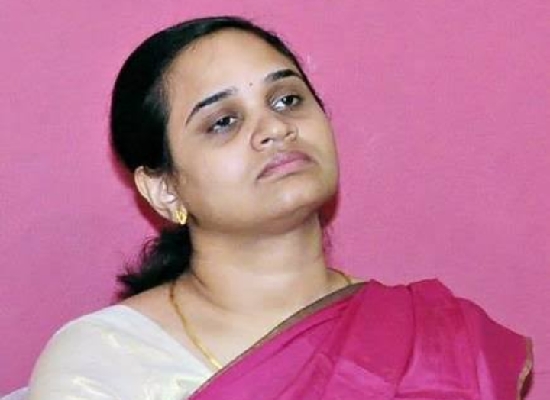
Hindu-Muslim hate story: NIA questions wife of tax officer in Karnataka

News Network
July 1, 2018

Bengaluru, Jul 1: The wife of a senior officer of commercial taxes in Karnataka had to face questions from the sleuths of the National Investigating Agency (NIA) after the love story of a Hindu woman from Gujrat and Muslim man from Kerala culminated in exhibition of communal hatred.

A section of media had called the inter-faith wedding a case of love-jihad, a term used by Indian Christian missionaries and saffron outfits to describe the relationships wherein Hindu and Christian girls marry Muslim boys and follow boy’s faith.

Irshadulla Khan, Deputy Commissioner of Commercial Tax, Kalaburagi, confirmed that a team of officials from NIA recently visited his Bengaluru flat and recorded his wife’s statement before returning with the laptop and mobile phone for analysis.

They recorded the statement to ascertain whether she was in touch with the Gujarati woman, while the latter was studying in Bengaluru in 2014-15.

However, Mr. Khan said that his wife who is an engineer met her once in the city but the victim had not stayed in their house.

“I refute the allegations and I’m ready to cooperate with any kind of investigation,” the government official said.

A police official said that the Gujarati woman and the Kerala man met in 2014-15 when they were studying in Bengaluru. After the woman converted to Islam, the man married her and took her to Jeddah where his parents stayed.

However, later the woman left her husband’s family and returned to Gujarat to her parents’ home. She then lodged a complaint alleging that she was forced to convert to Islam after which she was taken to Jeddah from where they had plans to send her to Syria to fight for Islamic State, a dreaded terror outfits, which normally carries out attacks in Muslim countries tries to destabilize them. The case was handed over to NIA for investigation.

The NIA on January 28, 2018 recorded statements of the woman at their Chennai office, where she gave details of people whom she knew while in Bengaluru in 2014-15. Based on her statements, the sleuths visited Mr. Khan’s house.

Comments

Thinkers
 - 
Monday, 2 Jul 2018

Why Cant The NON MUSLIMs understand?? When WE know our CREATOR who created all that exists And REJECT the man mad Gods and statues and animals as gods... U SEE the Brightness in your LIFE coming out of DARKNESS. There may be some who change their religion for boyfriend... But Majority of the coversion happened upon their OWN WILL which is important when U recognize YOUR LORD who created U me and all that exists... TO know YOUR CREATOR ... God has kept his scriptures untouched and its in the ORIGINAL form... "THE QURAN" - Never changed, Never Altered, billions read it, Millions memorized it...   I request my NON MUSLIM brother/Sisters to READ the QURAN before U fall trap to some evil propagandist who deviate U all from knowing the TRUTH of ONE GOD who CREATED all that EXISTS. Read The QURAN - PONDER on what it expects from U and Contemplate on the LIFE which is around YOU.


Well Wisher
 - 
Sunday, 1 Jul 2018

Ha ha ha ha. Nothing but a Mr. Bean comedy

Add new comment

  • Coastaldigest.com reserves the right to delete or block any comments.
  • Coastaldigset.com is not responsible for its readers’ comments.
  • Comments that are abusive, incendiary or irrelevant are strictly prohibited.
  • Please use a genuine email ID and provide your name to avoid reject.
coastaldigest.com news network
July 28,2020

Mangaluru, July 28: A screenshot of a death threat message against IAS officer Sindhu B Rupesh, the deputy commissioner of Dakshina Kannada, is now going viral on social media.

The threat comes in the wake of the Deputy Commissioner’s warning against attack on cattle traders by anti-social elements ahead of Eid al-Adha. 

It is learnt that a discussion was held about DC’s warning in a pro-Hindutva WhatsApp group. The death threat was issued in the same group in Tulu language. 

A police officer said that if the deputy commissioner doesn’t lodge a complaint, the police will file a suo motu case in this regard.

Also Read: Sindhu B Rupesh transferred; Dr Rajendra K V is new DC of Dakshina Kannada

Comments

Add new comment

  • Coastaldigest.com reserves the right to delete or block any comments.
  • Coastaldigset.com is not responsible for its readers’ comments.
  • Comments that are abusive, incendiary or irrelevant are strictly prohibited.
  • Please use a genuine email ID and provide your name to avoid reject.
Media Release
February 14,2020

Veteran journalist P. Sainath has said that the nation is in a crisis. And this crisis is not limited to just the rural area. It has become a national crisis at various areas such as agriculture, education, economy, job creation etc.

He was delivering the endowment lecture on the topic ‘Indian democracy at the post-liberalization and post-truth era’ at Media Manthan 2020 organized by the PG department of journalism and mass communication at St Aloysius College (Autonomous). 

Mr Sainath said that the many policies adopted in the 90s led to India becoming unusually unequal. Referring to the speech Ambedkar had made at the Constituent Assembly while handing over the draft of the Constitution, Mr Sainath said, “Ambedkar had warned about the weakness of Indian democracy that liberty without equality allows the supremacy of a few over the multitude. Liberty, equality and fraternity must be kept together as we cannot have one without the other.” 

Mr Sainath stated that the agrarian crisis was no longer about the loss of productivity, employment or about farmer suicide; it was a societal, civilizational crisis. Commenting on the lopsided policies such as cow-slaughter ban, he explained how cow slaughter ban had adversely affected many industries due to their interdependency. While Muslims who slaughtered cows were rendered helpless, the cattle traders who were mostly OBCs lost their earnings as the cattle prices crashed. An important industry like Kolhapur sandals industry in Maharashtra went bankrupt as a result of the cow slaughter ban in Maharashtra. He said the policymakers had no idea how the rural industries were interconnected. Demonetisation too devastated the rural economy as 98 percent of rural transactions happen through cash. 

Mr Sainath also spoke about the crisis of inequality which affects the Dalits and the Adivasis far more than anyone else as 90 percent of the rural households take home less than Rs 10,000/- per month. “Women are yet another group whose labour is never counted in the gross domestic product. Women and girls globally do unpaid work which amounts to about 12.5 billion working hours per year. Monetarily speaking, this is worth 10.8 trillion dollars,” Mr Sainath added. 

Speaking about the crisis of jobs Mr Sainath said that major companies were laying off employees just to create more profits for the investors and the adoption of artificial intelligence in the industry would further destroy millions of jobs.

Rector of St Aloysius College Institutions Fr Dionysius Vaz SJ, Principal Dr (Fr) Praveen Martis SJ, HOD of Journalism and Mass Communication department Dr (Fr) Melwyn Pinto SJ were present.

‘Veerappan and Vijay Mallya’s business models are interesting!’

Addressing the gathering during his endowment lecture on Friday, Mr Sainath made an interesting comment on the so called ‘revenue model’. “Whenever I visit IIMs and IITs for lectures on my PARI project, the students there ask me what my revenue model for my project is. I tell them that I do not have a revenue model. In fact, journalism does not begin with a revenue model. Gandhiji, Ambedkar, Bhagat Singh were all great journalists. But they did not have a revenue model,” Mr Sainath said.

On a lighter note, he said that the best revenue model that he liked was that of forest brigand Veerappan and liquor baron Vijay Mallya. “Veerappan ruled the forest for forty years and from the top ministers to the villagers he could dictate terms and liver royally. Similarly, Mallya’s revenue model was to steal the banks and run away abroad and live like a king,” Mr Sainath added.

Journalism is not and can never be a business. It is a calling, he opined. While newspaper can be a business, television can be a business, journalism per se cannot be reduced to a business. “Unfortunately today, journalists are recruited on a contract basis and they have no bargaining power; and there are no unions to fight for their cause. Hence, they are at the mercy of the corporate media houses for their survival and are made to write stories that cannot be called journalism,” Mr Sainath said.

Answering a question as to the pressures he faced as a journalist, he said that external pressures from the government or others could be very well handled. It is the internal pressures from once own media house that journalists find it difficult to manage.


 

Comments

Add new comment

  • Coastaldigest.com reserves the right to delete or block any comments.
  • Coastaldigset.com is not responsible for its readers’ comments.
  • Comments that are abusive, incendiary or irrelevant are strictly prohibited.
  • Please use a genuine email ID and provide your name to avoid reject.
coastaldigest.com web desk
June 30,2020

Ballari, June 30: A video clip of dead bodies of covid-19 victims being disgracefully thrown into a pit said to be in Karnataka’s Ballari has gone viral on social media triggering outrage from netizens.

Ballari Deputy Commissioner SS Nakul ordered a probe. He told media persons that the veracity of the video is still under question and that it still needs to be established if the video was taken in Ballari.

In the video, a pit is seen which appears to be disinfected. The video features masked men covered in body suits bringing dead bodies from a black hearse van in black body bags one by one and throwing the dead bodies into the same pit. In all, three dead bodies are thrown into the same pit in the video.

"We have assigned an Additional Deputy Commissioner (ADC) to enquire and verify the same. We are awaiting reports. We don't know yet if it (the video) is from Ballari or not," Nakul said.

The district which has so far reported around 800 cases in the last three months has also witnessed around two dozen deaths.

Twitterati on Tuesday raised questions about the handling of the bodies. "Even dead have some respect and they deserved a decent burial," said a social activist from Ballari. Similar reactions echoed on social media and some also pointed out on how the family members who have to stay away from burials feel about it.

Covid burial protocol

According to the protocol set by the Union Health Ministry for the burial of Covid-19 patients, the patients' orifices (nose, mouth and ears) have to be sealed and the body has to be wrapped in three layers of personal protective equipment (PPE). Thereafter it should be placed in a body bag. Family members should not be allowed to accompany the body in the hearse van. Covid-19 victims have to be given a deep burial. The grave should be minimum 10-feet deep.

The grave should be disinfected with bleaching powder and the area should be cordoned off so that the general public is not in the vicinity.  The vehicle used to transport the dead body of a Covid-19 victim -- ambulance or a hearse van -- has to be disinfected for 16 hours before being used again. Most Covid-19 victims in the state have had burials in the absence of family members as they are generally in quarantine for being the primary contacts of the patient.

Comments

Add new comment

  • Coastaldigest.com reserves the right to delete or block any comments.
  • Coastaldigset.com is not responsible for its readers’ comments.
  • Comments that are abusive, incendiary or irrelevant are strictly prohibited.
  • Please use a genuine email ID and provide your name to avoid reject.