Mangaluru: Nearly 200 conductors booked for not issuing tickets

coastaldigest.com news network
August 4, 2018

Mangaluru, Aug 4: Cases were slapped against as many as 193 conductors by the Mangaluru City Traffic Police in a single day for not issuing tickets to passengers. The cops also collected a fine of Rs 19,300 through Friday’s operation.

The unexpected action was a fallout of the weekly phone-in programme of City Police Commissioner T.R. Suresh, wherein many callers used to complain about non-issue of tickets by conductors and their rude behaviour. This Friday too, Mr. Suresh heard a couple of complaints on this issue.

Having promised to crack the whip against errant conductors last week, Mr. Suresh directed MCTP to immediately take action, which should be done at regular intervals. He also asked traffic police to take the help of civil police in the operation.

Almost one-third of complaints received, during the phone-in programme, pertained to Route No. 15 and its sub-numbers plying between Mangaladevi and Surathkal and beyond.

Though there are allegations that bus owners, with permits, have sub-leased the buses to the crew on fixed daily payment, neither the transport department nor the MCTP have taken any action against the illegal practice.

A caller from Jeppu complained that these buses instead of plying via Morgan’s Gate directly reach Mangaladevi via Marnamikatte.

Another caller complained about shrill horns being used and the overspeeding of these buses while one more caller rued about non issue of tickets.

The Commissioner promised stringent action on all complaints.

A caller from Kadri had a list of complaints and suggestions, including the free-left turn at Vas Bakery Junction near St. Agnes being occupied by parked vehicles; vehicle parking on the road at Kankanadi and Balmatta Juice Junction; vehicles being driven on the wrong-direction to reach Kadri petrol pump etc. The Commissioner promised to attend them.

Another caller rued about city buses halting on the main road on either side of the Railway level crossing at Pandeshwara blocking movement of other vehicles and pedestrians.

Comments

ashok
 - 
Saturday, 4 Aug 2018

please arrange traffic staff near mangaldevi temple ...

ahmed
 - 
Saturday, 4 Aug 2018

traffic controlling police staff on duty will be busy with watsup kindly take qucik action 

Add new comment

  • Coastaldigest.com reserves the right to delete or block any comments.
  • Coastaldigset.com is not responsible for its readers’ comments.
  • Comments that are abusive, incendiary or irrelevant are strictly prohibited.
  • Please use a genuine email ID and provide your name to avoid reject.
News Network
July 29,2020

Bengaluru, Jul 29: The Karnataka High Court’s division bench of Chief Justice Abhay Oka and Justice H P Sandesh today rejected an application that wanted Amulya Leona’s case to be transferred from Karnataka Police to the National Investigation Agency (NIA).

The bench, while observing that extraordinary jurisdiction can’t be exercised for transferring the case to the NIA, asked “What is so special that investigation should be transferred to NIA?”

The court, in its previous hearing, had questioned the maintainability of the petition seeking transfer of the sedition case against Leona to the NIA.

According to the petitioner, advocate Pavana Chandra Shetty, the case is a serious matter against national integration and unity and has not been investigated properly by the police. The state police also failed to file the chargesheet within 90 days, he said, and also asked for cancellation of her bail.

The bench asked the petitioner as to how a bail, already granted to a person, can be cancelled. “Is it not the indefeasible right of the accused to be released on bail if chargesheet is not filed within stipulated time? How can you make a prayer for cancellation of bail?”  the Court asked.

The counsel for the petitioner also stated that in cases of a cognizable offence, when the chargesheet is purposely not filed within the stipulated time, the matter will have to transferred to the appropriate authority.

The court responded to his contention by asking him how could the court override law and cancel the bail. “Where is the question of cancellation of bail? Can we override the law and say that bail should be cancelled?” said the bench.

Advocate Vishal Raghu had filed the petition for transfer of Leona’s case, who was accused of raising pro-Pakistan slogans at an anti-CAA rally on February 20 at Freedom Park. The advocate had blamed the probe team for not filing a chargesheet on time and has asked the state government to approach the higher court against bail granted to Leona.

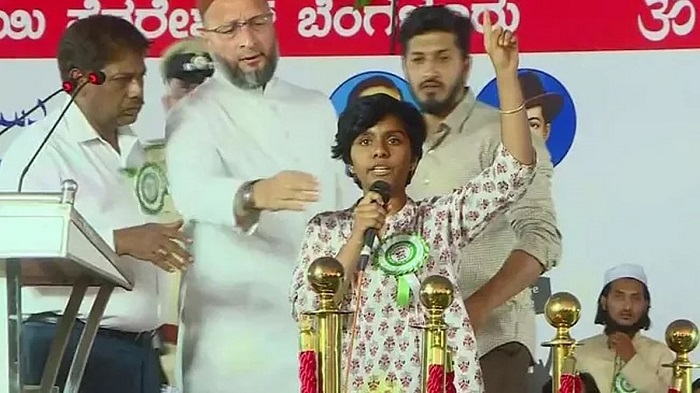
Bengaluru student Amulya Leona was charged with sedition for her actions in the presence of All India Majlis-e-Ittehad-ul-Muslimeen chief Asaduddin Owaisi. She was arrested by the Bengaluru police for allegedly shouting ‘Pakistan Zindabad’ slogans at an anti- CAA Protest in Bengaluru in February this year. On June 11, she was granted conditional bail by the Bengaluru civil court.

Her bail plea was earlier rejected by a Bengaluru court, after she had spent a three-month period in jail, stating that she may abscond if she is released. The sessions judge Vidhyadhar Shirahatti had also stated that if the petitioner is granted bail, she may abscond and may involve in similar offence which affects peace at large and hence her petition is liable to be rejected. The court had also noted that Amulya Leona is an influential person who may threaten and influence the witness and hamper the case in case of the prosecution and will abscond if released on bail.

Comments

Add new comment

  • Coastaldigest.com reserves the right to delete or block any comments.
  • Coastaldigset.com is not responsible for its readers’ comments.
  • Comments that are abusive, incendiary or irrelevant are strictly prohibited.
  • Please use a genuine email ID and provide your name to avoid reject.
News Network
April 2,2020

The current physical distancing guidelines provided by the World Health Organisation (WHO) and by the US Centers for Disease Control and Prevention (CDC) may not be adequate to curb the coronavirus spread, according to a research which says the gas cloud from a cough or sneeze may help virus particles travel up to 8 metres. The research, published in the Journal of the American Medical Association, noted that the the current guidelines issued by the WHO and CDC are based on outdated models from the 1930s of how gas clouds from a cough, sneeze, or exhalation spread.

Study author, MIT associate professor Lydia Bourouiba, warned that droplets of all sizes can travel 23 to 27 feet, or 7-8 metres, carrying the pathogen.

According to Bourouiba, the current guidelines are based on "arbitrary" assumptions of droplet size, "overly simplified", and "may limit the effectiveness of the proposed interventions" against the deadly pandemic.

 She explained that the old guidelines assume droplets to be one of two categories, small or large, taking short-range semi-ballistic trajectories when a person exhales, coughs, or sneezes.

However based on more recent discoveries, the MIT scientist said, sneezes and coughs are made of a puff cloud that carries ambient air, transporting within it clusters of droplets of a wide range of sizes.

Bourouiba warned that this puff cloud, with ambient air entrapped in it, can offer the droplets moisture and warmth that can prevent it from evaporation in the outer environment.

"The locally moist and warm atmosphere within the turbulent gas cloud allows the contained droplets to evade evaporation for much longer than occurs with isolated droplets," she said.

"Under these conditions, the lifetime of a droplet could be considerably extended by a factor of up to 1000, from a fraction of a second to minutes," the researcher explained in the study.

The MIT scientist, who has researched the dynamics of coughs and sneezes for years, added that these droplets settle along the trajectory of a cough or sneeze contaminating surfaces, with their residues staying suspended in the air for hours.

"Even when maximum containment policies were enforced, the rapid international spread of COVID-19 suggests that using arbitrary droplet size cutoffs may not accurately reflect what actually occurs with respiratory emissions, possibly contributing to the ineffectiveness of some procedures used to limit the spread of respiratory disease," Bourouiba wrote in the study

Comments

Add new comment

  • Coastaldigest.com reserves the right to delete or block any comments.
  • Coastaldigset.com is not responsible for its readers’ comments.
  • Comments that are abusive, incendiary or irrelevant are strictly prohibited.
  • Please use a genuine email ID and provide your name to avoid reject.
Ram Puniyani
March 14,2020

In the wake of Citizenship Amendment Act (CAA) UN High Commissioner, Michele Bachelet, has filed an intervention in the Supreme Court petition challenging the constitutionality of the Citizenship Amendment Act, as she is critical of CAA. Responding to her, India’s Foreign Minister S. Jai Shanker strongly rebutted her criticism, saying that the body (UNHCR) has been wrong and is blind to the problem of cross border terrorism. The issue on hand is the possibility of scores of people, mainly Muslims, being declared as stateless. The problem at hand is the massive exercise of going through the responses/documents from over 120 crore of Indian population and screening documents, which as seen in Assam, yield result which are far from truthful or necessary.

The issue of CAA has been extensively debated and despite heavy critique of the same by large number of groups and despite the biggest mass opposition ever to any move in Independent India, the Government is determined on going ahead with an exercise which is reminiscent of the dreaded regimes which are sectarian and heartless to its citizens, which have indulged in extinction of large mass of people on grounds of citizenship, race etc. The Foreign minister’s assertion is that it is a matter internal to India, where India’s sovereignty is all that matters! As far as sovereignty is concerned we should be clear that in current times any sovereign power has to consider the need to uphold the citizenship as per the principle of non-discrimination which is stipulated in Art.26 of the International Covenant on Civil and Political (ICCPR) rights.

Can such policies, which affect large number of people and are likely to affect their citizenship be purely regarded as ‘internal’? With the World turning into a global village, some global norms have been formulated during last few decades. The norms relate to Human rights and migrations have been codified. India is also signatory to many such covenants in including ICCPR, which deals with the norms for dealing with refugees from other countries. One is not talking of Chicago speech of Swami Vivekanand, which said that India’s greatness has been in giving shelter to people from different parts of the World; one is also not talking of the Tattariaya Upanishad’s ‘Atithi Devovhav’ or ‘Vasudhaiva Kutumbkam’ from Mahaupanishad today.

What are being talked about are the values and opinions of organizations which want to ensure to preserve of Human rights of all people Worldwide. In this matter India is calling United Nations body as ‘foreign party’; having no locus standi in the case as it pertains to India’s sovereignty. The truth is that since various countries are signatories to UN covenants, UN bodies have been monitoring the moves of different states and intervening at legal level as Amicus (Friend of the Court) to the courts in different countries and different global bodies. Just to mention some of these, UN and High Commissioner for Human Rights has often submitted amicus briefs in different judicial platforms. Some examples are their intervention in US Supreme Court, European Court of Human Rights, International Criminal Court, and the Inter-American Court of Human Rights. These are meant to help the Courts in areas where UN bodies have expertise.

 Expertise on this has been jointly formulated by various nations. These interventions also remind the nations as to what global norms have been evolved and what are the obligations of individual states to the values which have evolved over a period of time. Arvind Narrain draws our attention to the fact that, “commission has intervened in the European Court of Human Rights in cases involving Spain and Italy to underscore the principle of non-refoulement, which bars compulsory expulsion of illegal migrants… Similarly, the UN has intervened in the International Criminal Court in a case against the Central African Republic to explicate on the international jurisprudence on rape as a war crime.”

From time to time organizations like Amnesty International and Human Rights Watch have been monitoring the status of Human rights of different countries. This puts those countries in uncomfortable situation and is not welcome by those establishments. How should this contradiction between ‘internal matter’, ‘sovereignty’ and the norms for Human rights be resolved? This is a tough question at the time when the freedom indices and democratic ethos are sliding downwards all over the world. In India too has slid down on the scale of these norms.

In India we can look at the intervention of UN body from the angle of equality and non discrimination. Democratic spirit should encourage us to have a rethink on the matters which have been decided by the state. In the face of the greatest mass movement of Shaheen bagh, the state does need to look inwards and give a thought to international morality, the spirit of global family to state the least.

The popular perception is that when Christians were being persecuted in Kandhmal the global Christian community’s voice was not strong enough. Currently in the face of Delhi carnage many a Muslim majority countries have spoken. While Mr. Modi claims that his good relations with Muslim countries are a matter of heartburn to the parties like Congress, he needs to relook at his self gloating. Currently Iran, Malaysia, Indonesia and many Muslim majority countries have spoken against what Modi regime is unleashing in India. Bangladesh, our neighbor, has also seen various protests against the plight of Muslims in India. More than the ‘internal matter’ etc. what needs to be thought out is the moral aspect of the whole issue. We pride ourselves in treading the path of morality. What does that say in present context when while large section of local media is servile to the state, section of global media has strongly brought forward what is happening to minorities in India.   

The hope is that Indian Government wakes up to its International obligations, to the worsening of India’s image in the World due to CAA and the horrific violence witnessed in Delhi.


Comments

Add new comment

  • Coastaldigest.com reserves the right to delete or block any comments.
  • Coastaldigset.com is not responsible for its readers’ comments.
  • Comments that are abusive, incendiary or irrelevant are strictly prohibited.
  • Please use a genuine email ID and provide your name to avoid reject.