Religious tolerance exists in India; Hindu-Muslim problem created by politicians: Dalai Lama

News Network
August 11, 2018

Bengaluru, Aug 11: Veteran Buddhist spiritual leader Dalai Lama has suggested that India should adopt the ancient education system in the present curriculum to build a strong nation and help generations to tackle modern day stress.

Speaking at the Vidyaloke Talks on "Courage and Compassion in the 21st Century" for young professionals and students, organised by Vana Foundation in Bengaluru on Saturday, the Dalai Lama said that India is the only country where religious tolerance exists even today.

The spiritual leader said that he is committed to reviving the ancient Indian wisdom, which could address the present day crisis. "Indian traditions and texts contain material to tackle modern-day stressors, but modern India is not paying enough attention to their immense treasure and knowledge," added the Dalai Lama.

He said Indian meditative practices, which stem from Indian texts can provide peace of the mind that provide inner strength to a person and help them tackle all the problems of the modern world. Ancient Indian knowledge needs to be revived in this country by one and all – be it a non-believer or a believer of religion.

He said that the present day education system in India is slightly tilted towards creating a material life, society and culture. India’s educational system should be able to teach students to tackle their emotions, while the Indian yoga practices can be used to build a healthy body, he added.

The powerful combination of modern education and ancient Indian knowledge will attract other countries like China, Vietnam, Korea and the rest of the world to adopt the same in their countries as well. India has an opportunity to serve millions of people around the world in Asia, Europe and other continents with their treasure-trove of ancient wisdom and knowledge.

Recalling how he solved issues between Ladakhi Muslims and Buddhists in Zanskar region on Ladakh, the Dalai Lama said that Indian Muslims should play an active role in promoting harmony among Sunni and Shia communities.

These two communities are fighting and killing each other without any basis. India should take a lead and hold an International Religious conference to bring all religion together.

The difference between the Hindus and the Muslims are generally created by politicians, who manipulate for their political reasons. People in India should not pay much attention to this, he added.

Comments

Add new comment

  • Coastaldigest.com reserves the right to delete or block any comments.
  • Coastaldigset.com is not responsible for its readers’ comments.
  • Comments that are abusive, incendiary or irrelevant are strictly prohibited.
  • Please use a genuine email ID and provide your name to avoid reject.
coastaldigest.com web desk
June 9,2020

With the steep hike in excise duty in the past couple of months, an average consumer of petrol now pays over 275% in taxes to centre and states on a litre of the fuel.  The base price of petrol is just about Rs 18. The taxes are close to Rs 50 and the pump price is over Rs 72.

India imports 85% of all its crude oil demand.  After a steep hike in excise duty in the past two months despite a hold on daily price revisions by the oil public sector undertakings (PSUs), Indian consumers now pay 275% collectively in excise duty to state and centre. 

The central government hiked excise on petrol and diesel by Rs 10 and Rs 13 respectively last month. The excise duty on petrol is taxed around Rs 33-a-litre while the same on diesel it is Rs 32.

The Value-Added Tax (VAT) on both petrol and diesel is Rs 16.44 and Rs 16.26 respectively. Both the taxes together are around Rs 49 while it is sold at petrol pumps at 73-per-litre.

These two taxes cumulatively account for 69% of tax which is higher than anywhere else in the world. The same is taxed at 19% in the US, 47% in Japan, UK 62% and 63% in France. The government does not pass on the benefit of lower crude oil prices to the customer.

It is to be noted that Indian consumers continued to pay Rs 70-a-litre even when crude oil prices hit a paltry US $ 20-a-barrel on April 12.

Former finance minister and Congress leader recently took a jab at the Centre over rising prices stating, “Fuel selling prices raised twice in two days, following tax hikes two weeks ago. This time to benefit oil companies. Government is poor, it needs more taxes. Oil companies are poor, they need better prices. Only the poor and middle class are not poor, so they will pay”.

Comments

Lovely indian
 - 
Wednesday, 10 Jun 2020

Acche din for modi bakth....lets enjoy


you need only ram mandir and NRC

Add new comment

  • Coastaldigest.com reserves the right to delete or block any comments.
  • Coastaldigset.com is not responsible for its readers’ comments.
  • Comments that are abusive, incendiary or irrelevant are strictly prohibited.
  • Please use a genuine email ID and provide your name to avoid reject.
Agencies
February 7,2020

New Delhi, Feb 7: The Supreme Court on Friday issued a notice to the Central government on a plea challenging the Constitutional validity of the Citizenship Amendment Act (CAA) and effective implementation of the Assam Accord.

A bench of Chief Justice of India (CJI) SA Bobde also sought Centre's response on the plea filed by Assam Social Justice Forum.

The petition sought appropriate directions for taking effective steps for the implementation of Assam Accord, 1985 in letter and spirit and for conservation and preservation of the of a distinct culture, heritage and traditions of the indigenous people of Assam.

The Assam Accord, 1985, had fixed March 24, 1971, as the cut-off date for deportation of all illegal immigrants irrespective of their religion.

The Bench also sought Centre's response on another fresh batch of pleas challenging CAA and tagged them along with other petitions pending in the matter.

One of the petitions, filed by the Association of Advocates from Maharashtra among others, sought to declare the Citizenship Amendment Act as discriminatory, arbitrary, and illegal and consequently set aside the impugned act as ultra-vires the Constitution of India.

On the other hand, over a hundred petitions have been filed in the apex court, for and against the amended citizenship law, which is facing opposition and protests across the country.

CAA grants citizenship to Hindus, Sikhs, Buddhists, Jains, Parsis and Christians who fled religious persecution in Afghanistan, Bangladesh, and Pakistan and took refuge in India on or before December 31, 2014.

Comments

Add new comment

  • Coastaldigest.com reserves the right to delete or block any comments.
  • Coastaldigset.com is not responsible for its readers’ comments.
  • Comments that are abusive, incendiary or irrelevant are strictly prohibited.
  • Please use a genuine email ID and provide your name to avoid reject.
coastaldigest.com news network
August 4,2020

Mangaluru, Aug 4: The Kasaragod district administration has decided to restore the e-pass system for daily commuters between Kasaragod and Mangaluru amid covid-19 crisis. 

As covid-19 cases began to increase in Dakshina Kannada, the Kasargod district administration had unilaterally newly introduced of daily pass system on July 6 for entry and exit from Talapady border. This had inconvenienced hundreds of employees, who visited Mangaluru daily to eke a living. 

The decision to resume the pass system was taken in a video conference of Kerala Revenue Minister Chandrasekharan with officials and elected representatives on August 3.

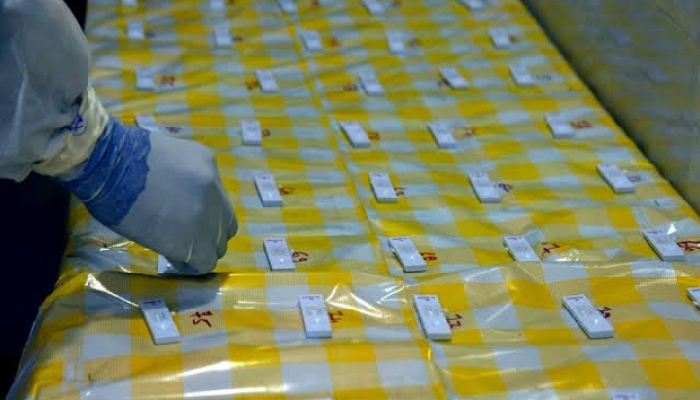
The minister said the Kasaragod district administration will resume issuing of passes for daily commuters between Kasaragod and Mangaluru. But they should undergo rapid antigen test for every week to renew their passes.

"Similarly, one-time interstate passes will be issued for those who want to take part in marriages, funeral and other functions in both states. Even they should undergo antigen test after returning from the functions,” the minister added.

As per the previous order, daily commuters, especially employees, had to stay in Mangaluru for 28 days before returning to Kasargod. Later, Kerala government relaxed rules on July 23 allowing only bank employees from Kasaragod to travel daily in their private vehicles to their workplace in Dakshina Kannada.

Comments

Add new comment

  • Coastaldigest.com reserves the right to delete or block any comments.
  • Coastaldigset.com is not responsible for its readers’ comments.
  • Comments that are abusive, incendiary or irrelevant are strictly prohibited.
  • Please use a genuine email ID and provide your name to avoid reject.