Indian-origin loses job for posting torn Singapore flag

Agencies
August 29, 2018

Singapore, Aug 29: An Indian-origin employee of Singapore's DBS Bank has lost his job after he posted on Facebook an image of the country's torn flag to reveal the Indian flag underneath on the eve of India's Independence Day.

Avijit Das Patnaik had on August 14 posted a picture on the Facebook page of the Singapore Indians & Expats group, showing the Singapore flag on a T-shirt being ripped up to reveal the Indian flag underneath. The group has 11,000 members, according to a Channel News Asia report.

Patnaik, who had been living in Singapore for a decade, had posted the image along with the caption -- Phir Bhi dil hai (Still my heart is Indian)and alludes to a popular bollywood song.

The post had caused outrage in the city-state, with many netizens terming it "offensive" and "insulting to Singapore". The post has since been taken down.

Singapore-headquartered DBS Bank, in a comment to complaints on its Facebook page on August 19, had said that Patnaik had posted the image because he "wanted to show that even as he is in Singapore, he remains Indian at heart".

"Upon realising the graphic was offensive, he took it down immediately," DBS said, adding that it had counselled Patnaik.

Today, the Bank released a statement on its Facebook page, saying that Patnaik was no longer its employee.

"Since the incident, a disciplinary committee has been convened and as of August 24, he (Patnaik) is no longer with the bank," the DBS Bank said in the post.

"DBS strongly disapproves of such actions by our employees. At the same time, it is fair and right that all employees are given the benefit of due process," it said.

When asked about the circumstances surrounding Patnaik's departure, including whether he resigned or was sacked, a DBS spokesman declined to elaborate, according to the report.

"We have nothing further to share beyond the post," it said quoting the bank as saying.

According to the Singapore Arms and Flag National Anthem Act, any person that treats the flag with disrespect may be fined a maximum of 1,000 Singapore dollar.

Meanwhile, according to the Channel NewsAsia report, police have confirmed that a report has been made and investigations are underway.

Comments

Kumarrane
 - 
Wednesday, 29 Aug 2018

FEKU effect...now all the majority DOGS think that they can do anything...

Add new comment

  • Coastaldigest.com reserves the right to delete or block any comments.
  • Coastaldigset.com is not responsible for its readers’ comments.
  • Comments that are abusive, incendiary or irrelevant are strictly prohibited.
  • Please use a genuine email ID and provide your name to avoid reject.
News Network
May 30,2020

May 30: Warning of the tightrope walk ahead as governments battle the coronavirus crisis, Nobel laureate Peter Charles Doherty has expressed concern about densely populated countries such as India relaxing lockdown norms while also describing a complete shutdown as “an economic and social impossibility”.

The Australian immunologist, who cautioned that the number of COVID-19 cases will rise in the coming days, said the earliest time frame for an effective vaccine “going into large numbers of people” is nine to 12 months.

"If all goes well with testing, we could know if some of the candidate vaccines are both safe and effective as early as September/October. Then, rolling a vaccine out will depend on the type of product and how quickly it can be made, put in vials and so forth," Doherty told PTI in an email interview from Melbourne.

The novel coronavirus, he added, does not change fast like influenza and, from what is known so far, “the same vaccine should work everywhere”.

Doherty, who is with the Department of Microbiology and Immunology at the Doherty Institute, University of Melbourne, won the Nobel Prize for Medicine in 1996 for his discovery of how the body’s immune system distinguishes virus-infected cells from normal ones.

Discussing the lockdown, he said, "If it was purely a matter of hard science, everywhere should stay locked down. But that’s pretty much an economic and social impossibility.”

The expectation, he said, is the numbers will rise and limiting spread will depend on people acting responsibly and the capacity for rapid response and extensive contact testing.

“And in a densely populated country like India I think that it will be very difficult," the scientist said.

Several countries, including India, began relaxing lockdown norms in mid-May despite the WHO’s warning about a second wave. India’s lockdown began on March 25 and has since been extended. The fourth phase ends on Sunday.

Asked whether there are any alternatives to a lockdown, the 79-year-old said, "There is no other option other than closing borders. South Korea, for example, conducted massive, intensive testing and contact tracing in a wealthy country with a very disciplined population. Otherwise, not till we have effective vaccines."

He added that he personally doesn’t see the point of closing borders for people coming in if there’s already a high incidence of disease in the community, “unless it’s to avoid the need to care for them and use scarce hospital beds".

According to Doherty, the coronavirus "is a new virus which has come straight out of nature".

“It (the virus) has moved so rapidly across the world because of people travelling on international planes as well as tourist ships," he added.

The immunologist also warned against the use of hydroxychloroquine to treat COVID-19, and said current and planned trials of the anti-malaria drug should be stopped.

“My understanding is that the use of the drug in severe disease is definitely contra-indicated, but it’s not yet clear whether, if taken under medical supervision, it could have some useful effect if taken early on, or as a preventive. Those trials just haven’t been done properly," Doherty noted.

The Indian Council of Medical Research (ICMR) has backed the use of hydroxychloroquine as a preventive against COVID-19 even after the WHO suspended clinical trials of the drug citing safety concerns.

Asked whether plasma therapy can be an effective treatment for COVID-19, Doherty said, "We lack good properly controlled trials but, especially if the plasma has been tested for antibody levels and there’s evidence of good activity, it could be helpful. If I had the disease and was offered plasma therapy I would certainly accept, but I would not take hydroxychloroquine."

Doherty is also very optimistic about herd immunity developing against the SARS-CoV-2 infection.

"We think that (herd immunity) will cut in and have an obvious effect when, say, 60 per cent of people have been infected. Best hope is to boost herd immunity with a vaccine," he stated.

Herd immunity is a form of indirect protection from infectious disease that occurs when a large percentage of a population has become immune to an infection, whether through vaccination or previous infections.

The number of COVID-19 cases have crossed 5.9 million and the fatalities 3,65,000, according to the Johns Hopkins University on Saturday. 

In India, the death toll has risen to 4,971 and the number of cases to 1,73,763, according to the Union Health Ministry on Saturday.

Several states, including Bihar, Uttar Pradesh, Madhya Pradesh, Jharkhand and Chhattisgarh, have reported a rise in number since lockdown norms were relaxed in early May and migrant workers reached home.

In Uttar Pradesh, for instance, the number of infections rose from around 3,000 on May 4 to 6,532 on May 26. Similarly, Bihar’s numbers increased from around 500 to over 2,700 in the period.


Comments

Add new comment

  • Coastaldigest.com reserves the right to delete or block any comments.
  • Coastaldigset.com is not responsible for its readers’ comments.
  • Comments that are abusive, incendiary or irrelevant are strictly prohibited.
  • Please use a genuine email ID and provide your name to avoid reject.
News Network
August 7,2020

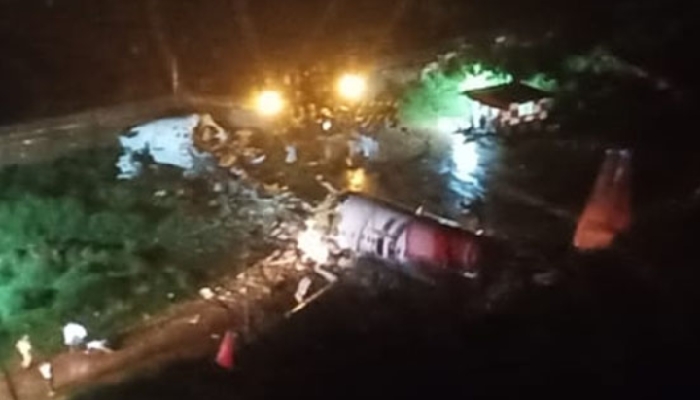
Kozhikode: An Air India Express flight from Dubai with 190 people on board overshot the Kozhikode tabletop runway on landing there today. The Boeing 737 “fell off” the runway into the valley, broke into two causing death and devastation. 

According to reports, around 20 people were dead including two pilots.

An Air India spokesperson said: “Air India Express flight IX 1344 operated by Boeing 737 aircraft from Dubai to Calicut overshot the runway at Kozhikode at 7.41 pm Friday. No fire reported at the time of landing. There are 174 passengers, 10 infants, two pilots and five cabin crew on board. Rescue operations are on and passengers are being taken to hospital for medical care. We will soon share the update in this regard.”

The Directorate General of Civil Aviation (DGCA) is probing this accident. “Prima facie, the aircraft landed beyond the touchdown point and fell into a valley. It has broken into two. We suspect some casualties. More information is awaited,” said a senior DGCA official.

Taking to twitter, defence minister Rajnath Singh wrote: “Devastating news from Kozhikode, Kerala. I am deeply anguished by the loss of lives due to an accident carrying several passengers on Air India flight. In this hour of grief, my thoughts are with the bereaved families. I pray for the speedy recovery of the injured.”

Foreign minister S Jaishankar tweeted: “Deeply distressed to hear about the Air India Express tragedy at Kozhikode. Prayers are with the bereaved families and those injured. We are ascertaining further details.”

While, senior BJP leader from Kerala K J Alphons tweeted: “Second tragedy of the day in Kerala: Air India Express skids off the run way at Kozhikode, front portion splits , pilot dies and lots of passengers injured . All passengers evacuated. Very lucky the aircraft didn’t catch fire.”

More details are awaited.

Comments

Add new comment

  • Coastaldigest.com reserves the right to delete or block any comments.
  • Coastaldigset.com is not responsible for its readers’ comments.
  • Comments that are abusive, incendiary or irrelevant are strictly prohibited.
  • Please use a genuine email ID and provide your name to avoid reject.
News Network
July 20,2020

The International Cricket Council (ICC) today confirmed the ICC Men’s T20 World Cup in Australia 2020 has been postponed due to the ongoing COVID-19 pandemic

At today’s meeting of the IBC Board (the commercial subsidiary of the ICC), windows for the next three ICC men’s events were also agreed to bring clarity to the calendar and give the sport the best possible opportunity over the next three years to recover from the disruption caused by COVID-19.

The windows for the Men’s events are:

1. ICC Men’s T20 World Cup 2021 will be held October – November 2021 with the final on 14 November 2021

2. ICC Men’s T20 World Cup 2022 will be held October – November 2022 with the final on 13 November 2022

3. ICC Men’s Cricket World Cup 2023 will be held in India October – November 2023 with the final on 26 November 2023

The IBC Board agreed to continue to monitor the rapidly changing situation and assess all the information available in order to make a considered decision on future hosts to ensure the sport is able to stage safe and successful global events in 2021 and 2022.

The IBC Board will also continue to evaluate the situation in relation to being able to stage the ICC Women’s Cricket World Cup 2021 in New Zealand in February next year. In the meantime, planning for this event continues as scheduled.

The Board will also continue to evaluate the situation in relation to being able to stage the ICC Women’s Cricket World Cup 2021.

ICC Chief Executive Manu Sawhney said: “We have undertaken a comprehensive and complex contingency planning exercise and through this process, our number one priority has been to protect the health and safety of everyone involved in the sport.

“The decision to postpone the ICC Men’s T20 World Cup was taken after careful consideration of all of the options available to us and gives us the best possible opportunity of delivering two safe and successful T20 World Cups for fans around the world.

“Our Members now have the clarity they need around event windows to enable them to reschedule lost bilateral and domestic cricket. Moving the Men’s Cricket World Cup to a later window is a critical element of this and gives us a better chance of maintaining the integrity of the qualification process. This additional time will be used to reschedule games that might be lost because of the pandemic ensuring qualification can be decided on the field of play.

“Throughout this process we have worked closely with our key stakeholders including governments, Members, broadcasters, partners and medical experts to enable us to reach a collective decision for the good of the game and our fans. I would like to thank everyone involved for their commitment to a safe return to cricket.”

Comments

Add new comment

  • Coastaldigest.com reserves the right to delete or block any comments.
  • Coastaldigset.com is not responsible for its readers’ comments.
  • Comments that are abusive, incendiary or irrelevant are strictly prohibited.
  • Please use a genuine email ID and provide your name to avoid reject.