Naseeruddin Shah, Aamir Khan are like ‘traitors’, says RSS leader Indresh Kumar

Agencies
January 29, 2019

Aligarh, Jan 29: Veteran actors Naseeruddin Shah and Aamir Khan have been called "traitors" by senior leader of Rashtriya Swyamsevak Sangh (RSS) Indresh Kumar. "They may be good actors but they don't deserve respect as they are traitors. They are like Mir Jafar and Jaichand," Indresh Kumar said at a public event in Aligarh on Monday. He also targeted Congress leader Navjot Singh Sidhu.

This is not the first time that Naseeruddin Shah is facing the Sangh parivaar's wrath. Both the RSS and the BJP leaders had called him a "traitor" after he had claimed that India has turned into a land where a cow is given more importance than a policeman, after the killing of Inspector Subodh Kumar Singh in Bulandshahr mob violence.

The Uttar Pradesh BJP chief, Mahendranath Pandey had said "In one of his movies, he played the role of a Pakistani agent. I think he is growing into that character now." Mr Pandey was referring to Sarfarosh, a 1999 Bollywood movie that had Naseeruddin Shah playing the role of a Pakistani spy. His performance had won him widespread critical acclaim.

The RSS leader said that India needs Muslims like former president Dr APJ Abdul Kalam and not like Ajmal Kasab, the terrorist who was caught alive after 26/11 attacks. "India doesn't need Muslim youth like Kasab, Yakub, and Ishrat Jahan but rather those who walk on the path shown by Kalam. Those who walk on the path of Kasab will be considered only as traitors," said the RSS leader.

Indresh Kumar also alleged that that the Congress, Left parties, communal forces and few judges are responsible for the delay in the Ayodhya case hearing. 

"The first reason for the delay in the construction of Ram Temple is Congress, second are the Left parties, third is the communal religious forces and the fourth are a few judges who are delaying justice. I appeal to the saints and sadhus to sit on dharna outside the Congress office, offices of the Left parties and outside the house of Judges who are delaying the matter," he added.

The Supreme Court cancelled the hearing in the Ayodhya title suit case, slated for January 29, due to the unavailability of one of the judges, Justice SA Bobde.

Comments

Puresanghi
 - 
Wednesday, 30 Jan 2019

Killer of Mahtma Gandhi, supported the Britishers during India's freedom fight, satying in INDIA not

respecting Indias National Flag not respecting Constitutuion always igniting communal clash. Deviiding the religion as  non sense Upper and Lower caste. No they planning to devide our nation with HINDU and MUSLIM.

And there are plenty evidence and endless.

Now  what  we have to call this rss and their blind followers  to Desh Drohi or Terrorists ?

Dodanna
 - 
Wednesday, 30 Jan 2019

Killer of Mahatma Gandhi supported the Britishers and against Indians great freedom struggle divided the community with self styled upper not lower cast. Now threatening to spoil Indias unity and constitution.Not hoisting Indias National Flag and creating communal clash all over India so what we all have to call and label this rss group and their criminals.  Desh Drohi or Terrorists ?


Add new comment

  • Coastaldigest.com reserves the right to delete or block any comments.
  • Coastaldigset.com is not responsible for its readers’ comments.
  • Comments that are abusive, incendiary or irrelevant are strictly prohibited.
  • Please use a genuine email ID and provide your name to avoid reject.
News Network
April 30,2020

Mumbai, Apr 30: Rishi Kapoor, the romantic star of many a Bollywood film who was diagnosed with leukemia in 2018, died in a Mumbai hospital on Thursday, his brother Randhir Kapoor said. He was 67.

Rishi, a third generation actor of the famous Kapoor dynasty, is survived by his wife Neetu Kapoor, actor son Ranbir and daughter Ridhima.

"He is no more. He has passed away," Randhir said.

Rishi was taken to the H N Reliance hospital by his family on Wednesday.

His death comes a day after after his "D-Day" co-star Irrfan Khan passed away, also of cancer. Three months ago, the disease claimed his sister Ritu Nanda.

"Our dear Rishi Kapoor passed away peacefully at 8:45am IST in hospital today after a two-year battle with leukemia. The doctors and medical staff at the hospital said he kept them entertained to the last.

He remained jovial and determined to live to the fullest right through two years of treatment across two continents. Family, friends, food and films remained his focus and everyone who met him during this time was amazed at how he did not let his illness get the better of him, the family said in a statement.

Rishi returned to India last September after undergoing treatment for his cancer in the US for almost a year.

In February, he was hospitalised twice.

He was first admitted to a hospital in Delhi where he was attending a family function. At the time, he had said he was suffering from an "infection".

After his return to Mumbai, he was again admitted to a hospital with viral fever. He was discharged soon after.

Rishi made his first screen appearance as a child artiste in his father Raj Kapoor's film Shri 420 , where he appeared in the song Pyaar hua ekraar hua . This was followed by "Mera Naam Joker". But it was in 1973, with the blockbuster Bobby , again directed by his father, that he made his debut as a romantic hero. He continued to be a favourite romantic hero for almost three decades.

His notable films as a romantic hero are "Laila Majnu", "Rafoo Chakkar", "Karz", "Chandni", "Heena" and "Saagar".

He was, however, more proud of his second innings as an actor, which he found more satisfying. His notable films as a character artiste are "Do Dooni Chaar" with wife Neetu, "Agnipath" and "Kapoor & Sons".

Comments

Add new comment

  • Coastaldigest.com reserves the right to delete or block any comments.
  • Coastaldigset.com is not responsible for its readers’ comments.
  • Comments that are abusive, incendiary or irrelevant are strictly prohibited.
  • Please use a genuine email ID and provide your name to avoid reject.
News Network
June 9,2020

Jun 9: Prime Minister Narendra Modi wants all 1.3 billion Indians to be “vocal for local” — meaning, to not just use domestically made products but also to promote them. As an overseas citizen living in Hong Kong, I’m doing my bit by very vocally demanding Indian mangoes on every trip to the grocery. But half the summer is gone, and not a single slice so far.

My loss is due to India’s COVID-19 lockdown, which has severely pinched logistics, a perennial challenge in the huge, infrastructure-starved country. But more worrying than the disruption is the fruity political response to it. Rather than being a wake-up call for fixing supply chains, the pandemic seems to be putting India on an isolationist course. Why?

Granted that the liberal view that trade is good and autarky bad isn’t exactly fashionable anywhere right now. What makes India’s lurch troublesome is that the pace and direction of economic nationalism may be set by domestic business interests. The Indian liberals, many of whom are Western-trained academics, authors and — at least until a few years ago — policy makers, want a more competitive economy. They will be powerless to prevent the slide.

Modi’s call for a self-reliant India has been echoed by Home Minister Amit Shah, the cabinet’s unofficial No. 2, in a television interview. If Indians don’t buy foreign-made goods, the economy will see a jump, he said. The strategy — although it’s too nebulous yet to call it that — has a geopolitical element. A military standoff with China is under way, apparently triggered by India’s completion of a road and bridge near the common border in the tense Himalayan region of Ladakh. It’s very expensive to fight even a limited war there. With India’s economy flattened by COVID, New Delhi may be looking for ways to restore the status quo and send Beijing a signal.

Economic boycotts, such as Chinese consumers’ rejection of Japanese goods over territorial disputes in the East China Sea, are well understood as statecraft. In these times, it’s not even necessary to name an enemy. An undercurrent of popular anger against China, the source of both the virus and India’s biggest bilateral trade deficit, is supposed to do the job. But is it ever that easy?

A hastily introduced policy to stock only local goods in police and paramilitary canteens became a farcical exercise after the list of banned items ended up including products by the local units of Colgate-Palmolive Co., Nestle SA, and Unilever NV, which have had significant Indian operations for between 60 and 90 years, as well as Dabur India Ltd., a New Delhi-based maker of Ayurveda brands. The since-withdrawn list demonstrates the practical difficulty of bureaucrats trying to find things in a globalized world that are 100% indigenous.

Free-trade champions fret that the prime minister, whom they saw as being on their side six years ago, is acting against their advice to dismantle statist controls on land, labor and capital to help make the country more competitive. Engage with the world more, not less, they caution. But Modi also has to satisfy the Rashtriya Swayamsevak Sangh, the umbrella Hindu organisation that gets him votes. Its backbone of small traders, builders and businessmen — the RSS admits only men — was losing patience with the anemic economy even before the pandemic. Now, they’re in deep trouble, because India’s broken financial system won’t deliver even state-guaranteed loans to them.

The U.S.-China tensions — over trade, intellectual property, COVID responsibility and Hong Kong’s autonomy — offer a perfect backdrop. A dire domestic economy and trouble at the border provide the foreground. Big business will dial economic nationalism up and down to hit a trifecta of goals: Block competition from the People's Republic; make Western rivals fall in line and do joint ventures; and tap deep overseas capital markets. The first goal is being achieved with newly placed restrictions on investment from any country that shares a land border with India. The second aim is to be realized by corporate lobbying to influence India's whimsical economic policies. As for the third objective, with the regulatory environment becoming tougher for U.S.-listed Chinese companies like Alibaba Group Holding Ltd., an opportunity may open up for Indian firms.

All this may bring India Shenzhen-style enclaves of manufacturing and trade, but it will concentrate economic power in fewer hands, something that worries liberals. They’re moved by the suffering of India’s low-wage workers, who have borne the brunt of the COVID shutdown. But when their vision of a more just society and fairer income distribution prompts them to make common cause with the ideological Left, they’re quickly repelled by the Marxist voodoo that all cash, property, bonds and real estate held by citizens or within the nation “must be treated as national resources available during this crisis.” Who will invest in a country that does that instead of just printing money?

At the same time, when liberals look to the business class, they see a sudden swelling of support for ideas like a universal basic income. They wonder if this isn’t a ploy by industry to outsource part of the cost of labor to the taxpayer. Slogans like Modi’s vocal-for-local stir the pot and thicken the confusion. The value-conscious Indian consumer couldn’t give two hoots for calls to buy Indian, but large firms will know how to exploit economic nationalism. One day soon, I’ll get my mangoes — from them.


Comments

Add new comment

  • Coastaldigest.com reserves the right to delete or block any comments.
  • Coastaldigset.com is not responsible for its readers’ comments.
  • Comments that are abusive, incendiary or irrelevant are strictly prohibited.
  • Please use a genuine email ID and provide your name to avoid reject.
News Network
August 8,2020

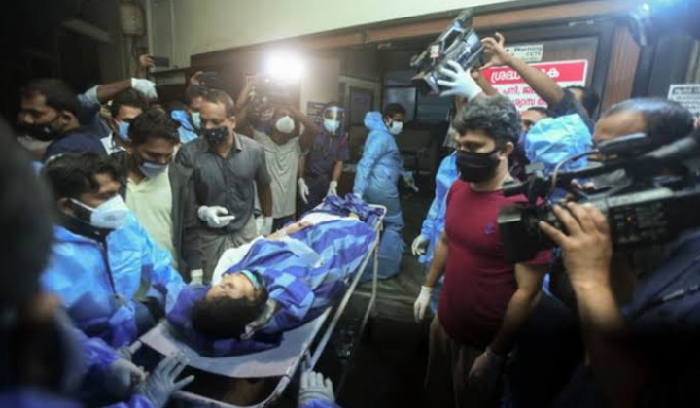
Kozhikode, Aug 8: A family of five, returning to their hometown at Koducalli in Kozhikode from Dubai, were aboard the fateful Air India Express flight that crash-landed at the Kozhikode airport claiming at least 18 lives on Friday.

Saifudheen, 40, is a businessman in Dubai. During the vacation when schools were closed here, his wife Fasalunnisa travelled, along with their children Muhammad Shahil, Fathima Sana and Aysha Shanza, to meet her husband.

On Friday, they were all travelling in the Air India aircraft to Kozhikode.

All five have received injuries and have been admitted to Baby Memorial Hospital Kozhikode except Sana, who is admitted to Al Shifa Hospital at Perinthalmanna in Malappuram.

"Saifudheen is my uncle. He and his family members were returning from Dubai when this unfortunate incident occurred. We were informed about the mishap at 8 pm. Now the family members have been shifted to Baby Memorial Hospital and everyone is fine now," Muhammad Salih, nephew of Saifudheen said.

The death toll in the flight crash landing incident at Kozhikode International Airport in Kerala rose to 18, including two pilots, Civil Aviation Minister Hardeep Singh Puri said on Saturday.

The minister said that he will visit the Kozhikode airport to take stock of the situation.

Two special relief flights have been arranged from Delhi and one from Mumbai for rendering humanitarian assistance to all the passengers and the family members.

Aircraft Accident Investigation Bureau (AAIB), Directorate General of Civil Aviation (DGCA) and Flight Safety Departments have reached to investigate the incident, the Air India Express stated.

Comments

Add new comment

  • Coastaldigest.com reserves the right to delete or block any comments.
  • Coastaldigset.com is not responsible for its readers’ comments.
  • Comments that are abusive, incendiary or irrelevant are strictly prohibited.
  • Please use a genuine email ID and provide your name to avoid reject.