Check your name in voters' list online!

[email protected] (CD Network, Photo by Ahmed Anwar)
March 21, 2013
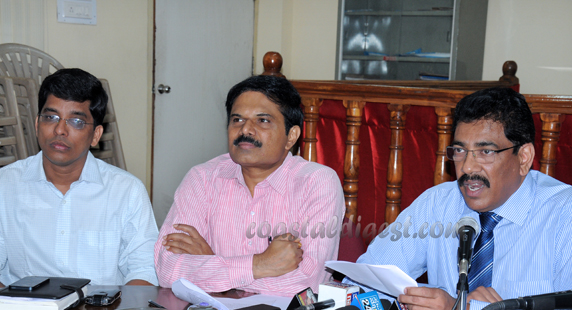
Mangalore, Mar 21: To ensure that all the eligible voters exercise their franchise and to create awareness on exercising franchise, under SVEEP (systematic voters education and electoral participation plan), a committee under the chairmanship of Zilla Panchayat CEO has been constituted in the district, said Deputy Commissioner N Prakash.

onlineSpeaking to presspersons here on Wednesday, he said that those who have been issued an election photo identity card can verify if their names are found on the voters' list by visiting the website of the Chief Election Officer, Bangalore, on www.ceokarnataka.kar.nic.in

Additional DC Dayanand said that using the EPIC ID card number, one can verify whether their names are found in the voters' list.

If there was no EPIC ID card number, then one can verify the  names by writing the name, father's name, and constituency name.

Taking note of several complaints from people that their names did not figure in the voters' list in the recently concluded elections to urban local bodies, the DC said mere possessing of EPIC is no guarantee that one can vote in elections. The final voters' list for Dakshina Kannada district has been published. “People have to verify if their names figure in the latest list.

Voters can also do so at the respective offices of the block level officer, village accountants, taluk offices, offices of the assistant commissioner and Mangalore City Corporation,” he added.

In case the names of voters missing from the list, people can get in touch with the respective offices and seek inclusion of their names using form 6 under the continuous updation of the voters' list.

The citizens can also register their name online in the chief election officer's website, he said and added that names can be included in the voters' list till the submission of nominations for the coming Assembly elections.

Zilla Panchayat CEO Dr K N Vijayaprakash said that awareness drive will be held across the districts. A campaign to motivate the citizens especially youth and women will be organised in the district. Handbills will be distributed in colleges, hostels, educational institutions, hospitals, malls, government offices, bus shelters to create awareness among the general public. Stickers with slogans on the need to exercise their franchise will be pasted on the buses and autorickshaws.

Theatres will be asked to show the slide on the need for exercising franchise and enrolling their names in the voters' list.

The DC said that as all the citizens can not visit the website to verify their names in the voters' list, a help desk will be started in every gram panchayat, TMCs, town panchayat, tahsildar's office and Mangalore City Corporation. The official in charge of the help desk will guide the citiznes.

MCC Commissioner Dr Harish was present.

dc

Comments

harish lennie jerome
 - 
Thursday, 25 Feb 2016

dont have voter s id. ref: 49/1357

harish lennie jerome
 - 
Thursday, 25 Feb 2016

i have been voting but dont have my voting card id.refer 49/1357

aishwarya
 - 
Saturday, 20 Feb 2016

i am newly apply. when came my voter id card?, how much days

K shamala
 - 
Monday, 8 Feb 2016

hw i should get my id number

muthusamy
 - 
Monday, 1 Feb 2016

i want to to the voter list of Moggapair West in Chennai, please help

RAVICHANDRA
 - 
Sunday, 31 Jan 2016

CHECK MY NAME IN VOTERLIST,,,RESIDENT OF BANGALORE

Bijayalaxmi PANDA
 - 
Sunday, 31 Jan 2016

i like to have e voter id

Bijayalaxmi PANDA
 - 
Sunday, 31 Jan 2016

i want to down load voter id

sathya.s
 - 
Sunday, 31 Jan 2016

i registered my name for new voter pls check and say as the got my registration

Mizanur Rahman
 - 
Wednesday, 6 Jan 2016

Dear Sir,

I want to download my voter ID Card.

Please help me.

Thanks

Md. Mizanur Rahman

ashish bardhan
 - 
Tuesday, 5 Jan 2016

i want to know my name is registered in new voter list or not.

My address is Ghugumali word no 36 niranjan nagar City- siliguri dist- jalpaiguri. west bengal

Ph no 9832648741

Add new comment

  • Coastaldigest.com reserves the right to delete or block any comments.
  • Coastaldigset.com is not responsible for its readers’ comments.
  • Comments that are abusive, incendiary or irrelevant are strictly prohibited.
  • Please use a genuine email ID and provide your name to avoid reject.
News Network
February 4,2020

Bengaluru, Feb 4: A 33-year old woman techie allegedly stabbed her mother to death and made a murderous assault on her younger brother before fleeing their home here, police said on Tuesday.

According to police, the woman fatally stabbed her mother using a knife and attacked the brother early on Monday.

The injured brother has been hospitalised here.

A search was on for the techie and the motive for her action under investigation, police said.

The woman, employed as a software engineer with a company here, earlier had told her mother and 30-year old brother that she has been transferred to Hyderabad and she may have to relocate.

The brother told police that in the early morning on Monday he saw his sister searching something desperately and offered to assist, which she refused.

However, minutes later she made a murderous assault on him, he told police, adding when he screamed for help and called his mother, his sister said she has killed their mother.

She stabbed him and attacked with an iron rod before fleeing, her brother told police.

The body of the mother was found in another room in the house.

"We are still investigating the matter. We are not clear about the motive behind the murder," a police officer told media adding the woman was yet to be arrested.

Comments

Add new comment

  • Coastaldigest.com reserves the right to delete or block any comments.
  • Coastaldigset.com is not responsible for its readers’ comments.
  • Comments that are abusive, incendiary or irrelevant are strictly prohibited.
  • Please use a genuine email ID and provide your name to avoid reject.
Ram Puniyani
January 14,2020

In the beginning of January 2020 two very disturbing events were reported from Pakistan. One was the attack on Nankana Sahib, the holy shrine where Sant Guru Nanak was born. While one report said that the place has been desecrated, the other stated that it was a fight between two Muslim groups. Prime Minister of Pakistan Imran Khan condemned the incident and the main accused Imran Chisti was arrested. The matter related to abduction and conversion of a Sikh girl Jagjit Kaur, daughter of Pathi (One who reads Holy Guru Granth Sahib in Gurudwara) of the Gurudwara. In another incident one Sikh youth Ravinder Singh, who was out on shopping for his marriage, was shot dead in Peshawar.

While these condemnable attacks took place on the Sikh minority in Pakistan, BJP was quick enough to jump to state that it is events like this which justify the Citizenship Amendment Act (CAA). Incidentally CAA is the Act which is discriminatory and relates to citizenship with Religion, which is not as per the norms of Indian constitution. There are constant debates and propaganda that population of Hindus has come down drastically in Pakistan and Bangla Desh. Amit Shah, the Home minister stated that in Pakistan the population of Hindus has come down from 23% at the time of partition to 3.7% at present. And in Bangla Desh it has come down from 22% to present 8%.

While not denying the fact that the religious minorities are getting a rough deal in both these countries, the figures which are presented are totally off the mark. These figures don’t take into consideration the painful migrations, which took place at the time of partition and formation of Bangla Desh later. Pakistan census figures tell a different tale. Their first census was held in 1951. As per this census the overall percentage of Non Muslim in Pakistan (East and West together) was 14.2%, of this in West Pakistan (Now Pakistan) it was 3.44 and in Eat Pakistan it was 23.2. In the census held in Pakistan 1998 it became 3.72%. As far as Bangla Desh is concerned the share of Non Muslims has gone down from 23.2 (1951) to 9.6% in 2011.

The largest minority of Pakistan is Ahmadis, (https://minorityrights.org/country/pakistan/) who are close to 4 Million and are not recognised as Muslims in Pakistan. In Bangla Desh the major migrations of Hindus from Bangla Desh took place in the backdrop of Pakistan army’s atrocities in the then East Pakistan.

As far as UN data on refugees in India it went up by 17% between 2016-2019 and largest numbers were from Tibet and Sri Lanka.  (https://www.un.org/en/development/desa/population/migration/publication…)

The state of minorities is in a way the index of strength of democracy. Most South Asian Countries have not been able to sustain democratic values properly. In Pakistan, the Republic began with Jinnah’s classic speech where secularism was to be central credo of Pakistan. This 11th August speech was in a way what the state policy should be, as per which people of all faiths are free to practice their religion. Soon enough the logic of ‘Two Nation theory” and formation of Pakistan, a separate state for Muslim took over. Army stepped in and dictatorship was to reign there intermittently. Democratic elements were suppressed and the worst came when Zia Ul Haq Islamized the state in collusion with Maulanas. The army was already a strong presence in Pakistan. The popular formulation for Pakistan was that it is ruled by three A’s, Army, America and Allah (Mullah).

Bangla Desh had a different trajectory. Its very formation was a nail in the coffin of ‘two nation theory’; that religion can be the basis of a state. Bangla Desh did begin as a secular republic but communal forces and secular forces kept struggling for their dominance and in 1988 it also became Islamic republic. At another level Myanmar, in the grip of military dictatorship, with democratic elements trying to retain their presence is also seeing a hard battle. Democracy or not, the army and Sanghas (Buddhist Sang has) are strong, in Myanmar as well. The most visible result is persecution of Rohingya Muslims.

Similar phenomenon is dominating in Sri Lanka also where Budhhist Sanghas and army have strong say in the political affairs, irrespective of which Government is ruling. Muslim and Christian minorities are a big victim there, while Tamils (Hindus, Christians etc.) suffered the biggest damage as ethnic and religious minorities. India had the best prospect of democracy, pluralism and secularism flourishing here. The secular constitution, the outcome of India’s freedom struggle, the leadership of Gandhi and Nehru did ensure the rooting of democracy and secularism in a strong way.

India so far had best democratic credentials amongst all the south Asian countries. Despite that though the population of minorities rose mainly due to poverty and illiteracy, their overall marginalisation was order of the day, it went on worsening with the rise of communal forces, with communal forces resorting to identity issues, and indulging in propaganda against minorities.

While other South Asian countries should had followed India to focus more on infrastructure and political culture of liberalism, today India is following the footsteps of Pakistan. The retrograde march of India is most visible in the issues which have dominated the political space during last few years. Issues like Ram Temple, Ghar Wapasi, Love Jihad, Beef-Cow are now finding their peak in CAA.

India’s reversal towards a polity with religion’s identity dominating the political scene was nicely presented by the late Pakistani poetess Fahmida Riaz in her poem, Tum bhi Hum Jaise Nikle (You also turned out to be like us). While trying to resist communal forces has been an arduous task, it is becoming more difficult by the day. This phenomenon has been variously called, Fundamentalism, Communalism or religious nationalism among others. Surely it has nothing to do with the religion as practiced by the great Saint and Sufi traditions of India; it resorts mainly to political mobilization by using religion as a tool.

Comments

Ashi
 - 
Tuesday, 14 Jan 2020

If Malaysia implement similar NRC/CAA, India and China are the loser.

Add new comment

  • Coastaldigest.com reserves the right to delete or block any comments.
  • Coastaldigset.com is not responsible for its readers’ comments.
  • Comments that are abusive, incendiary or irrelevant are strictly prohibited.
  • Please use a genuine email ID and provide your name to avoid reject.
News Network
June 1,2020

Bengaluru, Jun 1: Karnataka's Department of Health and Family Welfare on Sunday released the protocol for inter-state travellers to the State during phased reopening --#Unlock1.

Five points protocol in this regard are: 1. Mandatory Self- Registration on Seva Sindhu Portal by all travellers before entering Karnataka:

a. Name, Address and Mobile Number to be provided

b. No approval required

c. Use of same Mobile number for multiple registrations not allowed except in the case of a family.

d. Business visitors to give details (name, mobile and address of persons in Karnataka they intend to meet).

e. Transit travellers to provide an address in destination state and indicate exit check post from Karnataka.

2. Health Screening of all incoming persons at entry points.

a. Border Check-posts, Airports, Railway stations and Bus stand

b. Home Quarantine hand-stamping on hand for 14-days period as per quarantine norms

3. Quarantine norms are based on three parameters

I. Symptomatic on arrival from any State: 7 days of Hospital isolation at COVID Care Centre(CCC)/Dedicated COVID Health Centre (DCHC) followed by 7 days of home quarantine or manage as per symptoms.

II. Test immediately on arrival: If positive, shift to Dedicated COVID-19 Hospital (DCH). If negative, no further test required

III. Asymptomatic on arrival:

* For persons coming from Maharashtra

a) 7 days of institutional quarantine followed by 7 days of home quarantine

b) Test if they develop symptoms during the quarantine period

c) Exceptions for Special Category Asymptomatic persons--14-days home quarantine (one attendant to be permitted) and Special category passengers--Death in the family, Pregnant Women, Children aged below 10 years, Elderly aged above 60 years, Serious illness, Human Distress

d) Business travellers from Maharashtra: To establish that one is a business traveller, a person should show confirmed return flight/train ticket which should not be more than 7 days later from the date of arrival.

In case one is coming by road, he/she should provide the address proof of person in Karnataka he intends to meet. In addition, the person should produce -- one having COVID-19 negative test certificate, which is not more than two days old -- exempted from quarantine.

One does not have a COVID-19 negative test certificate, such a person should go for institutional quarantine of two days within which COVID-19 test should be conducted at his/her own cost. After the test result is negative, the person is exempted from quarantine. No hand stamping of the business visitor is required.

e) All travellers from Maharashtra who come with COVID-19 negative test certificate from an ICMR approved lab, which is not more than two days old from the date of arrival, are exempted from seven days of institution quarantine. They can be asked to go for 14 days of home quarantine.

f) Transit traveller from Maharashtra: To establish that one is a transit traveller, a person should show flight/ train ticket for the onward journey which should not be more than 1 day later from the date of arrival. In case one is travelling by road, he/she should provide the identity proof and address proof in the destination state. Such traveller should be hand stamped if travelling by road as "Transit Traveller."

*For persons coming from other States

a) 14 days of home quarantine

b) Test if they develop symptoms during the home quarantine period

c) For persons where home quarantine is not possible, then institutional quarantine should be done, especially when we have a large family or no separate room for home quarantine, slum or overcrowded areas where home quarantine can not be followed.

d) Business visitors from the Other States: To establish that one is a business traveller, a person should show confirmed return flight/train ticket which should not be more than 7 days later from the date of arrival. In case one is coming by road, he/she should provide the address proof of the native State. No quarantine, and no hand stamping for business visitors from other states.

e) Transit traveller from the other States: To establish that one is a transit traveller, the person should show flight/train ticket for the onward journey which should not be more than one day later from the date of arrival. In case one is travelling by road, he/she should provide the identity proof and address proof in the destination state. Such traveller should be hand stamped if travelling by road as "Transit Traveller."

4. Home Quarantine: Home quarantine follow-up for all incoming persons except business visitors and transit travellers

A. For Rural Areas--

* Home quarantine poster on the home door.

* Information to two neighbours

* Gram Panchayat Task Force to carry an overall responsibility of Home Quarantine

* 3-Member team in every village to monitor

* Flying Squad: FIR against violation of home quarantine and shift to institutional quarantine

* IVRS Call-centre outbound calls

* Quarantine watch App-daily self-monitoring upload-Temperature, Finger-tip pulse-oximetry for elderly and persons with co-morbidity

B. For BBMP and other Urban Areas--

* Home Quarantine Poster on the home door.

* Information to two neighbours and resident welfare/apartment owner's association.

* Ward level team to carry an overall responsibility of home quarantine

* 3-member team at booth level to monitor along with the involvement of Resident Welfare/Apartment Owners' Associations

* Flying Squad: FIR against violation of home quarantine and shift to institutional quarantine

* IVRS Call-centre outbound calls

* Quarantine watch App: Daily self-monitoring upload- temperature, finger-tip pulse-oximetry for elderly and persons with co-morbidity

Karnataka government on Sunday issued guidelines, which will come into force from June 1 and continue till June 30.

According to the new guidelines, religious places and places of worship for the public, hotels, restaurants and other hospitality services, and shopping malls will be permitted to open from June 8.

Union Ministry of Home Affairs (MHA) on Saturday announced new guidelines for phased re-opening of "all activities outside containment zones for the next one month beginning June 1.

In an order, Karnataka government said that phased re-opening of areas outside the containment zones, all activities will be permitted, except the following, which will be allowed, with the stipulation of following Standard Operating Procedures (SOPs) to be prescribed by the Ministry of Health and Family Welfare (MoHFW).

According to the Union Health Ministry, there are 2,922 confirmed COVID-19 cases in the State including 1,877 active cases, 997 recovered and 48 deaths.


Comments

Add new comment

  • Coastaldigest.com reserves the right to delete or block any comments.
  • Coastaldigset.com is not responsible for its readers’ comments.
  • Comments that are abusive, incendiary or irrelevant are strictly prohibited.
  • Please use a genuine email ID and provide your name to avoid reject.