Wanted Sri Lanka radical Hashim dies in hotel attack

Agencies
April 26, 2019

Colombo, Apr 26: An extremist believed to have played a key role in Sri Lanka’s deadly Easter bombings died in an attack on a Colombo hotel, the country’s president confirmed Friday.

“What intelligence agencies have told me is that Zahran was killed during the Shangri-La attack,” President Maithripala Sirisena told reporters, referring to Zahran Hashim, leader of a local extremist group.

Hashim appeared in a video released by the Daesh group after they claimed the bombings, but his whereabouts after the blasts was not immediately clear.

Sirisena did not immediately clarify what Hashim’s role was in the attack on the Shangri-La, one of six bomb blasts that killed over 250 people on Sunday.

Meanwhile, Sirisena also said police are looking for 140 people believed to have links with the Daesh group over the attacks.

Sirisena told reporters some Sri Lankan youths had been involved with the extremist group since 2013, and that top defense and police chiefs had not shared information with him about the impending attacks.

He also blamed Prime Minister Ranil Wickremesinghe’s government for weakening the intelligence system by focusing on the prosecution of military officers over alleged war crimes during a decade-long civil war with Tamil separatists.

Comments

Innocent-muslim
 - 
Saturday, 27 Apr 2019

GOD knows the reality behind the attack.....we should no trust any governmet or people...may be is to make muslim in terror angle and kill all his family....do they know why they killed innocent people ? whom should we ask now ? this is game plan to make muslim suffer.....if evil poeple plan...surely GOD will plan..muslim will not be elliminated what ever they try...muslim grow in numeber...this is the promise of GOD

Add new comment

  • Coastaldigest.com reserves the right to delete or block any comments.
  • Coastaldigset.com is not responsible for its readers’ comments.
  • Comments that are abusive, incendiary or irrelevant are strictly prohibited.
  • Please use a genuine email ID and provide your name to avoid reject.
Agencies
January 4,2020

New Delhi, Jan 4: "Sovereign, socialist, secular, democratic republic" is how India is referred to in the preamble of the Constitution. However, J Nandakumar, a key RSS leader and All India Convenor Prajna Pravah, a Sangh offshoot, wants India to reconsider the inclusion of the word "secular", claiming secularism is a "western, Semitic concept".

In an exclusive interview to news agency, Nandakumar said: "Secularism is a western, Semitic concept. It came into existence in the West. It was actually against Papal dominance."

He argued that India does not need a secular ethos as the nation has moved "way beyond secularism" since it believes in universal acceptance as against the western concept of tolerance.

The RSS functionary on Thursday released a book here named "Hindutva in the changing times". The book launch event was also attended by senior RSS functionary Krishna Gopal.

Nandakumar, who has attacked the Mamata Banerjee government in his book for alleged "Islamisation of West Bengal", told IANS: "We have to see whether we need to put up a board of being secular, or that whether we should prove this through our behaviour, actions and roles."

It is for society to take a call on this, rather than by any political class, on whether the preamble to the Indian Constitution should continue to have the word "secular" in it or not, he added.

In between signing his books and obliging wannabe Hindutva cadres with selfies, Nandakumar said that the very existence of the word "secular" in the preamble was not necessary and how the constitution founders too were against it.

"Baba Saheb Ambedkar, Ladi Krishnaswamy Aiyaar -- all debated against it and said it (secular) wasn't necessary to be included in the preamble. That time it was demanded, discussed and decided not to include it," he said.

Ambedkar's opinion was, however, disregarded when Indira Gandhi "bulldozed" the word "secular", in 1976, said the head of the Prajna Pravah, an umbrella body of several right-wing think-tanks

As Nandakumar prepared to return to his base in Kerala, where, he emphasises, the RSS has its work cut out in the "fight against the Kunnor model", he said that the inclusion of "secular" was done with the intent to damage the concept of Hindutva.

"It was to demolish, destroy the overarching principle of Hindutva that binds us together", he said.

Asked whether the Sangh would pressurise the BJP, which has 303 seats in the Lok Sabha, to omit "secular" from the Constitution preamble, Nandakumar smilingly refused to reply.


Comments

Add new comment

  • Coastaldigest.com reserves the right to delete or block any comments.
  • Coastaldigset.com is not responsible for its readers’ comments.
  • Comments that are abusive, incendiary or irrelevant are strictly prohibited.
  • Please use a genuine email ID and provide your name to avoid reject.
Agencies
July 28,2020

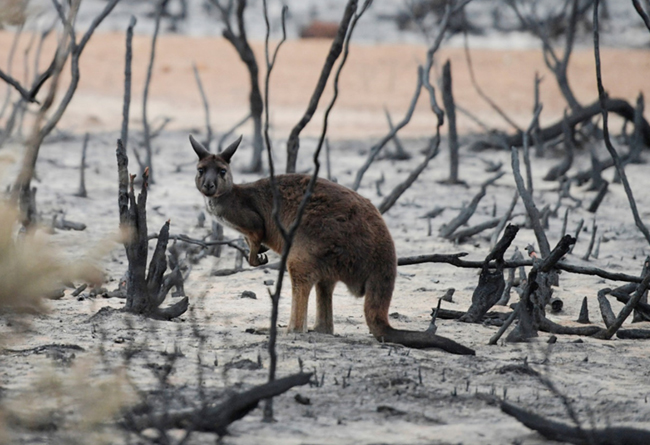
Sydney, Jul 28: Nearly 3 billion koalas, kangaroos and other native Australian animals were killed or displaced by bushfires in 2019 and 2020, a study by the World Wide Fund for Nature (WWF) said on Tuesday, triple the group's earlier estimates.

Some 143 million mammals, 2.46 billion reptiles, 180 million birds and 51 million frogs were impacted by the country's worst bushfires in decades, the WWF said.

When the fires were still blazing, the WWF estimated the number of affected animals at 1.25 billion. The fires destroyed more than 11 million hectares (37 million acres) across the Australian southeast, equal to about half the area of the United Kingdom.

"This ranks as one of the worst wildlife disasters in modern history," said WWF-Australia Chief Executive Officer Dermot O'Gorman in a statement.

The project leader Lily Van Eeden, from the University of Sydney, said the research was the first continent-wide analysis of animals impacted by the bushfires, and "other nations can build upon this research to improve understanding of bushfire impacts everywhere".

The total number included animals which were displaced because of destroyed habitats and now faced lack of food and shelter or the prospect of moving to habitat that was already occupied.

The main reason for raising the number of animal casualties was that researchers had now assessed the total affected area, rather than focusing on the most affected states, they said.

After years of drought made the Australian bush unusually dry, the country battled one of its worst bushfire seasons ever from September 2019 to March 2020, resulting in 34 human deaths and nearly 3,000 homes lost.

Comments

Add new comment

  • Coastaldigest.com reserves the right to delete or block any comments.
  • Coastaldigset.com is not responsible for its readers’ comments.
  • Comments that are abusive, incendiary or irrelevant are strictly prohibited.
  • Please use a genuine email ID and provide your name to avoid reject.
News Network
May 24,2020

New Delhi, May 24: The Indian economy is likely to slip into recession in the third quarter of this fiscal as loss in income and jobs and cautiousness among consumers will delay recovery in consumer demand even after the pandemic, says a report.

According to Dun & Bradstreet's latest Economic Observer, the country's economic recovery will depend on the efficacy and duration of implementation of the government's stimulus package.

"The multiplier effect of the stimulus measures on the economy will depend on three key aspects i.e. the time taken for effecting the withdrawal of the lockdown, the efficacy of implementation and duration of execution of the measures announced," Dun & Bradstreet India Chief Economist Arun Singh said.

The report noted that the government's larger-than-expected stimulus package is likely to re-start economic activities.

Besides, measures taken by the Reserve Bank of India like reducing the repo rate by a further 40 basis points to 4 per cent, extending the moratorium period by three months and facilitating working capital financing will also help stimulate the momentum.

Singh said while the measures announced by the government are "positive", most of them have been directed towards strengthening the supply side of the economy, and "it is to be noted that supply needs to be matched with demand", he said.

Besides, "in the absence of cash-in-hand benefits under the government's stimulus package, demand for goods and services is expected to remain depressed", he added.

He further said the loss in income and employment opportunities, and cautiousness among consumers, will lead to a delayed recovery in consumer demand, even after the pandemic. As debt and bad loan levels increase, the banking sector might face challenges.

The report further noted that even as the monetary stimulus is expected to inject liquidity and stimulate demand for a wider section of the economy, the channelisation of funds from the financial institutions will be subjected to several constraints.

The foremost concern being increase in risk averseness, as the balance sheets of firms, households, and banks/NBFCs have weakened considerably and low demand for funds by firms as production activities have been on a standstill during the lockdown period, Singh said.

India has been under lockdown since March 25 to contain the spread of the coronavirus, resulting in supply disruptions and demand compression.

Prime Minister Narendra Modi imposed a nationwide lockdown to control the spread of coronavirus on March 25. It has been extended thrice, with some relaxations. The fourth phase of the lockdown is set to expire on May 31. 

Comments

Add new comment

  • Coastaldigest.com reserves the right to delete or block any comments.
  • Coastaldigset.com is not responsible for its readers’ comments.
  • Comments that are abusive, incendiary or irrelevant are strictly prohibited.
  • Please use a genuine email ID and provide your name to avoid reject.