Wanted Sri Lanka radical Hashim dies in hotel attack

Agencies
April 26, 2019

Colombo, Apr 26: An extremist believed to have played a key role in Sri Lanka’s deadly Easter bombings died in an attack on a Colombo hotel, the country’s president confirmed Friday.

“What intelligence agencies have told me is that Zahran was killed during the Shangri-La attack,” President Maithripala Sirisena told reporters, referring to Zahran Hashim, leader of a local extremist group.

Hashim appeared in a video released by the Daesh group after they claimed the bombings, but his whereabouts after the blasts was not immediately clear.

Sirisena did not immediately clarify what Hashim’s role was in the attack on the Shangri-La, one of six bomb blasts that killed over 250 people on Sunday.

Meanwhile, Sirisena also said police are looking for 140 people believed to have links with the Daesh group over the attacks.

Sirisena told reporters some Sri Lankan youths had been involved with the extremist group since 2013, and that top defense and police chiefs had not shared information with him about the impending attacks.

He also blamed Prime Minister Ranil Wickremesinghe’s government for weakening the intelligence system by focusing on the prosecution of military officers over alleged war crimes during a decade-long civil war with Tamil separatists.

Comments

Innocent-muslim
 - 
Saturday, 27 Apr 2019

GOD knows the reality behind the attack.....we should no trust any governmet or people...may be is to make muslim in terror angle and kill all his family....do they know why they killed innocent people ? whom should we ask now ? this is game plan to make muslim suffer.....if evil poeple plan...surely GOD will plan..muslim will not be elliminated what ever they try...muslim grow in numeber...this is the promise of GOD

Add new comment

  • Coastaldigest.com reserves the right to delete or block any comments.
  • Coastaldigset.com is not responsible for its readers’ comments.
  • Comments that are abusive, incendiary or irrelevant are strictly prohibited.
  • Please use a genuine email ID and provide your name to avoid reject.
News Network
July 27,2020

Tokyo, Jul 27: Gold hit an all-time high on Monday as tit-for-tat consulate closures in China and the United States rattled investors, boosting the allure of safe-haven assets, although sentiment was mixed with tech gains supporting some Asian stocks.

MSCI's ex-Japan Asia-Pacific index rose 1.3 percent as Taiwan's TSMC, Asia's third-largest company by market capitalisation, rose almost 10 percent.

The chipmaker's gains boosted other tech stocks in the region and came after rival Intel signalled it may give up manufacturing its own components due to delays in new 7-nanometer chip technology.

Also soothing sentiment, Chinese shares eked out gains after big falls late last week, with CSI300 index rising 0.5 percent.

S&P500 futures were last up 0.4 percent in choppy trade while Japan's Nikkei fell 0.5 percent, resuming trade after a long weekend and catching up with falls in global shares late last week.

Global shares had lost steam last week after Washington ordered China's consulate in Houston to close, prompting Beijing to react in kind by closing the US consulate in Chengdu.

US Secretary of State Mike Pompeo took fresh aim at China last week, saying Washington and its allies must use "more creative and assertive ways" to press the Chinese Communist Party to change its ways.

"US President (Donald) Trump used to say China's President Xi Jinping is a great leader. But now Pompeo's wording is becoming so aggressive that markets are starting to worry about further escalation," said Norihiro Fujito, chief investment strategist at Mitsubishi Securities.

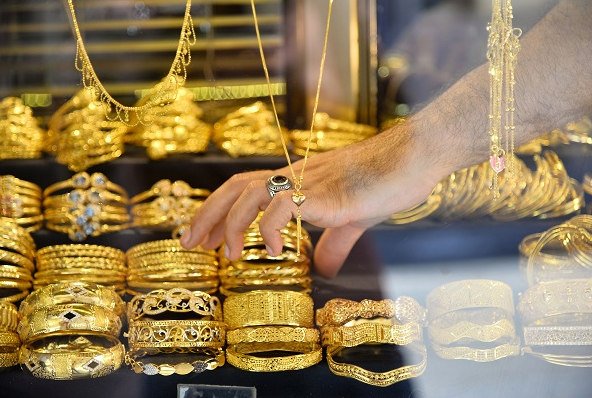
Gold rose 1.0 percent to a record high of $1,920.9 per ounce, surpassing a peak touched in September 2011, as Sino-US tensions boosted the allure of safe-haven assets, especially those not tied to any specific country.

The yellow metal is also helped by aggressive monetary easing adopted by many central banks around the world since the pandemic plunged the global economy into a recession.

Some investors fret such an unprecedented level of money-printing could eventually lead to inflation.

MORE STIMULUS

Hopes of a quick US economic recovery are fading as coronavirus infections showed few signs of slowing.

That means the economy could capitulate without fresh support from the government, with some of earlier steps such as enhanced jobless benefits due to expire this month.

Investors hope US Congress will agree on a deal before its summer recess but there are some sticking points including the size of the stimulus and enhanced unemployment benefits.

US Treasury Secretary Steve Mnuchin said the package will contain extended unemployment benefits with 70 percent "wage replacement".

Democrats, who control the House of Representatives, want enhanced benefits of $600 per week to be extended and look to much bigger stimulus compared with the Republicans' $1 trillion plan.

Investors are looking to corporate earnings from around the world for hints on the pace of recovery in the global economy.

"It looks like rising coronavirus cases are starting to slow down recovery in many countries," said Masahiro Ichikawa, senior strategist at Sumitomo Mitsui DS Asset Management.

Concerns about the US economic outlook started to weigh on the dollar, reversing its inverse correlation with the economic well-being over the past few months.

The dollar index dropped 0.3 percent to its lowest level in nearly two years.

The euro gained 0.3 percent to $1.1693, hitting a 22-month high of $1.16590 as sentiment on the common currency improved after European leaders reached a deal on a recovery fund in a major step towards more fiscal co-operation.

Against the yen, the dollar slipped 0.5 percent to 105.605 yen, a four-month low while the British pound hit a 4 1/2-month high of $1.2832.

Oil prices dipped on worries about the worsening Sino-US relations.

Brent futures fell 0.46 percent to $43.14 per barrel while US crude futures lost 0.44 percent to $41.11.


Comments

Add new comment

  • Coastaldigest.com reserves the right to delete or block any comments.
  • Coastaldigset.com is not responsible for its readers’ comments.
  • Comments that are abusive, incendiary or irrelevant are strictly prohibited.
  • Please use a genuine email ID and provide your name to avoid reject.
News Network
February 3,2020

Beijing, Feb 3: The first batch of patients arrived on Monday at a specialised hospital built in just 10 days as part of China's intensive efforts to fight a new virus.

Huoshenshan Hospital and a second facility with 1,500 beds that's due to open this week were built by construction crews who are working around the clock in Wuhan, the city in central China where the outbreak was first detected in December.

The Wuhan treatment centres mark the second time Chinese leaders have responded to a new disease by building specialised hospitals almost overnight. As severe acute respiratory syndrome, or SARS, spread in 2003, a facility in Beijing for patients with that viral disease was constructed in a week.

The first batch of patients arrived at the Huoshenshan Hospital at 10 am on Monday, according to state media. The reports gave no details of the patients' identities or conditions.

The ruling Communist Party's military wing, the People's Liberation Army, sent 1,400 doctors, nurses and other personnel to staff the Wuhan hospital, the official Xinhua News Agency said. The government said earlier some have experience fighting SARS and other outbreaks.

Authorities have cut most road, rail and air access to Wuhan and surrounding cities, isolating some 50 million people, in efforts to contain the viral outbreak that has sickened more than 17,000 and killed more than 360 people.

The Huoshenshan Hospital was built by a 7,000-member crew of carpenters, plumbers, electricians and other specialists, according to the Xinhua News Agency.               Photos in state media showed workers in winter clothing, safety helmets and the surgical-style masks worn by millions of Chinese in an attempt to avoid contracting the virus.

About half of the two-storey, 600,000-square-foot building is isolation wards, according to the government newspaper Yangtze Daily. It has 30 intensive care units.

Doctors can talk with outside experts over a video system that links them to Beijing's PLA General Hospital, according to the Yangtze Daily. It said the system was installed in less than 12 hours by a 20-member "commando team" from Wuhan Telecom Ltd.

The building has specialised ventilation systems and double-sided cabinets that connect patient rooms to hallways and allow hospital staff to deliver supplies without entering the rooms.

The hospital received a donation of "medical robots" from a Chinese company for use in delivering medicines and carrying test samples, according to the Shanghai newspaper The Paper.

In other cities, the government has designated hospitals to handle cases of the new virus.

In Beijing, the Xiaotangshan Hospital built in 2003 for SARS is being renovated by construction workers. The government has yet to say whether it might be used for patients with the new disease.

Comments

Add new comment

  • Coastaldigest.com reserves the right to delete or block any comments.
  • Coastaldigset.com is not responsible for its readers’ comments.
  • Comments that are abusive, incendiary or irrelevant are strictly prohibited.
  • Please use a genuine email ID and provide your name to avoid reject.
News Network
March 4,2020

Tokyo, Mar 4: Takeda Pharmaceutical Co said on Wednesday it was developing a drug to treat COVID-19, the flu-like illness that has struck more than 90,000 people worldwide and killed over 3,000.

The Japanese drugmaker is working on a plasma-derived therapy to treat high-risk individuals infected with the new coronavirus and will share its plans with members of the U.S. Congress on Wednesday, it said in a statement.

Takeda is also studying whether its currently marketed and pipeline products may be effective treatments for infected patients.

"We will do all that we can to address the novel coronavirus threat...(and) are hopeful that we can expand the treatment options," Rajeev Venkayya, president of Takeda's vaccine business, said in the statement.

Takeda said it was in talks with various health and regulatory agencies and healthcare partners in the United States, Asia and Europe to move forward its research into the drug.

Its research requires access to the blood of people who have recovered from the respiratory disease or who have been vaccinated, once a vaccine is developed, Takeda said.

Comments

Add new comment

  • Coastaldigest.com reserves the right to delete or block any comments.
  • Coastaldigset.com is not responsible for its readers’ comments.
  • Comments that are abusive, incendiary or irrelevant are strictly prohibited.
  • Please use a genuine email ID and provide your name to avoid reject.


