SP supports what Quran says: Azam Khan on Triple Talaq Bill

Agencies
June 21, 2019

New Delhi, Jun 21: On being asked about his party's stand on the Triple Talaq Bill, Samajwadi Party leader Azam Khan on Friday said that they support what is written in the Quran.

On the day when the government tabled the Bill in Lok Sabha to ban the practice of instant triple talaq, the Samajwadi Party MP said, "Our stand is similar to what is written in the Quran."

"No religion has given more rights to women than Islam. 1500 years ago, Islam was the first religion to have given the right of equality to women. Today, we witness the lowest divorce rate and the lowest cases of violence on women in Islam. Women are not burnt or killed", said Azam Khan, MP from Uttar Pradesh's Rampur Constituency.

"Triple Talaq is a religious issue, not a political issue and nothing is more supreme for a Muslim than Quran. On marriage, on divorce, for everything, the Quran has clear instructions and we follow it", he further added.

The Muslim Women (Protection of Rights on Marriage) Bill, 2019 was included in the list of business for Lok Sabha for Friday, as it seeks to replace an ordinance issued by the previous cabinet in February.

Last year, The Muslim Women (Protection of Rights on Marriage) Bill, 2018 was passed in Lok Sabha but it lapsed after the dissolution of previous Lok Sabha with the bill pending in Rajya Sabha.

Comments

Indian
 - 
Friday, 21 Jun 2019

Political group's cannot make any better law then written in Quran is 100% sure. Now again these criminal poloticians want to create religion politics to repeat similiar Gujrat massacre all over India.We Indians are looking for a developments and not communal clash.


Jai Hind


Add new comment

  • Coastaldigest.com reserves the right to delete or block any comments.
  • Coastaldigset.com is not responsible for its readers’ comments.
  • Comments that are abusive, incendiary or irrelevant are strictly prohibited.
  • Please use a genuine email ID and provide your name to avoid reject.
coastaldigest.com news network
May 5,2020

Newsroom, May 5: Following the union government's nod, preparations are afoot to bring back Indian nationals stranded abroad from May 7 onwards.

According to sources, in the first phase from May 7- 14, the government would allow more than 60 “non-scheduled, commercial” flights to operate from about 12 countries to India to bring back 15,000 citizens. At least half of those flights will be from the Gulf region, including UAE, Qatar, Saudi Arabia, Bahrain, Kuwait and Oman, while the rest would bring passengers from the U.S., the U.K., Singapore, Malaysia, Philippines and Bangladesh.

The flights would be spread over 10 States identified as having the largest numbers to return, with Kerala, Tamil Nadu and Delhi (NCR) receiving the maximum number of flights.

A meeting held at the Ministry of Civil Aviation looked specifically at flights, mainly operated by Air India, while it awaits a final plan from countries where Indians need to be airlifted from. The first flights planned at present are from Abu Dhabi, Dubai, Riyadh and Doha, flying directly to Kozhikode and Kochi.

While the full estimate of Indians needing to return home could cross ten lakhs (a million), with more than two lakhs having registered to return from the UAE alone, officials said their return would be “prioritised and staggered”.

Flight plan for return of Indian nationals stranded abroad:

Comments

Anwar
 - 
Thursday, 7 May 2020

for Kyrgyzstan


https://indembbishkek.gov.in/pages.php?id=226

Anwar
 - 
Thursday, 7 May 2020

For malasia


https://hcikl.gov.in/indreg

Prathaban
 - 
Wednesday, 6 May 2020

How to apply malaysia pls give me a registration link

Anwar
 - 
Wednesday, 6 May 2020

For Singapore

https://www.hcisingapore.gov.in/indian_registration

Anwar
 - 
Wednesday, 6 May 2020

Please contact embassy or ministry

Saudi details are here:


https://docs.google.com/forms/d/e/1FAIpQLSc_yyVAYPD-VYH98RNOWZkDkGKVsf34qnu0oGoLdtts3RG7_Q/viewform
 

http://www.coastaldigest.com/news/indians-stuck-saudi-arabia-due-lockdown-ought-know-these-things-returning-home

Kotadiya vinit…
 - 
Wednesday, 6 May 2020

I am in singapore 


And now my study finished already so how to go back india

Shipra
 - 
Wednesday, 6 May 2020

Please share a link to how to Register 

Rishi kumar sonkar
 - 
Tuesday, 5 May 2020

We want to go back india we are in Kyrgyzstan

how to registe…
 - 
Tuesday, 5 May 2020

how to register ?please share link/details


Add new comment

  • Coastaldigest.com reserves the right to delete or block any comments.
  • Coastaldigset.com is not responsible for its readers’ comments.
  • Comments that are abusive, incendiary or irrelevant are strictly prohibited.
  • Please use a genuine email ID and provide your name to avoid reject.
News Network
February 2,2020

Feb 2: Prime Minister Narendra Modi’s second budget in seven months disappointed investors who were hoping for big-bang stimulus to revive growth in Asia’s third-largest economy.

The fiscal plan -- delivered by Finance Minister Nirmala Sitharaman on Saturday -- proposed tax cuts for individuals and wider deficit targets but failed to provide specific steps to fix a struggling financial sector, improve infrastructure and create jobs. Stocks slumped as a proposal to scrap the dividend distribution tax for companies failed to impress investors.

"Far from being a game changer, the budget provides little in terms of short-term growth stimulus,” said Priyanka Kishore, head of India and South East Asia economics at Oxford Economics Ltd. in Singapore. “While income tax cuts will provide some relief on the consumption front, the multiplier effect is low and the overall stance of the budget is not expansionary."

India has gone from being the world’s fastest-growing major economy three years ago, expanding at 8%, to posting its weakest performance in more than a decade this fiscal year, estimated at 5%.

While the government has taken a number of steps in recent months to spur growth, they’ve fallen short of spurring demand in the consumption-driven economy. Saturday’s budget just added to the glum sentiment.

Okay Budget

“It’s an okay budget but not firing on all cylinders that the market was hoping for,” said Andrew Holland, chief executive officer at Avendus Capital Alternate Strategies in Mumbai.

The government had limited scope for a large stimulus given a huge shortfall in revenues in the current year. The slippage induced Sitharaman to invoke a never-used provision in fiscal laws, allowing the government to exceed the budget gap by 0.5 percentage points. The result: the deficit for the year ending March was widened to 3.8% of gross domestic product from a planned 3.3%.

On Friday, India’s chief economic adviser Krishnamurthy Subramanian said reviving economic growth was an “urgent priority” and deficit goals could be relaxed to achieve that. The adviser’s Economic Survey estimated growth will rebound to 6%-6.5% in the year starting April.

The fiscal gap will narrow to 3.5% next year, as the government budgeted for gross market borrowing to rise marginally to 7.8 trillion rupees from 7.1 trillion rupees in the current year. A plan to earn 2.1 trillion rupees by selling state-owned assets in the year starting April will also help plug the deficit.

Total spending in the coming fiscal year will increase to 30.4 trillion rupees, representing a 13% increase from the current year’s budget, according to latest data.

Key highlights from the budget:

* Tax on annual income up to 1.25 million rupees pared, with riders

* Dividend distribution tax to be levied on investors, instead of companies

* Farm sector budget raised 28%, transport infrastructure gets 7% more

* Spending on education raised 5%

* Fertilizer subsidy cut 10%

Analysts said the muted spending plan to keep the deficit in check will lead to more downside risks to growth in the coming months.

“It is very doubtful that the increase in expenditure will push demand much,” Chakravarthy Rangarajan, former governor at the Reserve Bank of India told BloombergQuint, adding that achieving next year’s budget deficit goal of 3.5% of GDP was doubtful.

With the government sticking to a conservative fiscal path, the focus will now turn to central bank, which is set to review monetary policy on Feb. 6. Given inflation has surged to a five-year high of 7.35%, the RBI is unlikely to lower interest rates.

What Bloomberg’s Economists Say:

The burden of recovery now falls solely on the Reserve Bank of India. With inflation breaching RBI’s target at present, any rate cuts by the central bank are likely to be delayed and contingent upon inflation falling below the upper end of its 2%-6% target range.

-- Abhishek Gupta, India economist

Governor Shaktikanta Das may instead focus on unconventional policy tools such as the Federal Reserve-style Operation Twist -- buying long-end debt while selling short-tenor bonds -- to keep borrowing costs down.


Comments

Add new comment

  • Coastaldigest.com reserves the right to delete or block any comments.
  • Coastaldigset.com is not responsible for its readers’ comments.
  • Comments that are abusive, incendiary or irrelevant are strictly prohibited.
  • Please use a genuine email ID and provide your name to avoid reject.
Agencies
August 3,2020

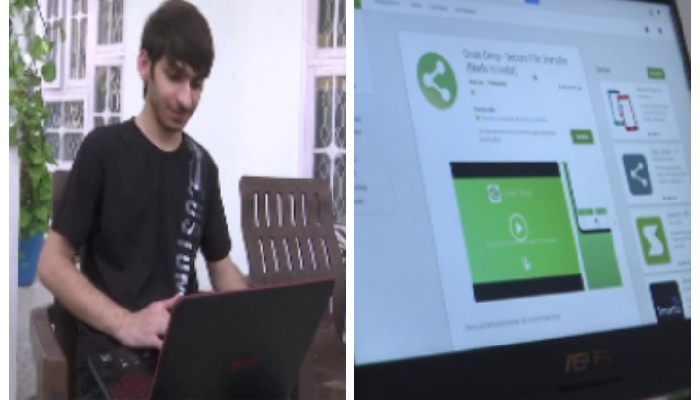
Rajouri, Aug 3: Ashfaq Mehmood Choudhary, a 17-year-old boy from Chattyear of Jammu and Kashmir's Rajouri district, has developed a file-sharing app 'Dodo Drop' which would enable users to share audios, videos, images, and texts between two devices without Internet access.

While speaking to media persons, Ashfaq Mehmood said that the 'Dodo Drop' application is an alternative to the Chinese 'SHAREit' app. "The Indian government has banned several Chinese apps due to data breaching, and among those apps was SHAREit which was used for sharing files.

Users faced a lot of problems due to the ban, and so I decided to make this file-sharing app. With 'Dodo Drop', users can share audios, videos, images, and even texts," he said.

Ashfaq said that it took him four weeks to develop the application, and it was launched on August 1 this year. The 'Dodo Drop' application has a transfer rate of up to 480 mbps, which is faster than the SHAREit app and is "quite easy" to use.

"Users can transfer data comprising photos, videos, audios, apps, texts, etc. between two devices with no Internet access. The transfers are fully encrypted and secure," he added.

"Our Prime Minister has always asserted the need for decreasing the dependency on foreign products and apps and to focus on the development of India-based apps. I tried to be part of the initiative of 'Aatmanirbhar Bharat' by developing an India-based file-sharing app. I want to develop global-standard apps for India," he added.

"We support and cooperate with him. He generates his own income by working on some projects and utilises it. We will continue to support him," said Parvez Ahmed Choudhary, Ashfaq's father.

In July, the Ministry of Electronics and Information Technology (MEITY) banned 47 apps, which were variants and cloned copies of the 59 apps banned earlier in June. These banned clones included SHAREit Lite, Tiktok Lite, Helo Lite, BIGO LIVE Lite, and VFY Lite.

The 59 apps had been banned by the Centre in June in view of the information available that they were engaged in activities which were "prejudicial to sovereignty and integrity and defence" of the country.

Almost all the apps banned had some preferential Chinese interest and the majority had parent Chinese companies.

The ban came amid border tensions with China in the Eastern Ladakh region.

Comments

Add new comment

  • Coastaldigest.com reserves the right to delete or block any comments.
  • Coastaldigset.com is not responsible for its readers’ comments.
  • Comments that are abusive, incendiary or irrelevant are strictly prohibited.
  • Please use a genuine email ID and provide your name to avoid reject.