'Faith is beyond attire': MP Nusrat Jahan refuses to toe the line of clerics

Agencies
June 30, 2019

Kolkata, Jun 30: Newly elected MP and actor Nusrat Jahan has said no one should comment on what she chooses to wear as "faith is beyond any attire", refusing to toe the line of hardline Muslim clerics who criticised her for wearing vermilion and mangalsutra.

A section of Deoband-based clerics reportedly also issued a 'fatwa' (diktat) against the Trinamool Congress lawmaker. The first-time MP from West Bengal's Basirhat came to Parliament on June 25 wearing vermilion and sporting a 'mangalsutra', and said 'Vande Matram' after taking oath.

Jahan, 29, married businessman Nikhil Jain at a ceremony in Turkey earlier in June and took oath a few days later.

The clerics claimed Jahan disrespected Islam by marrying into the Jain religion and called her attire "un-Islamic".

"Muslims can only marry Muslims and are only allowed to bend before Allah. Islam has no place for Vande Matram, mangalsutra and vermilion and they are against the religion," claimed Mufti Asad Kasami of Jamia Shaikh-ul Hind.

Responding to the criticism, Jahan on Saturday night tweeted, "Paying heed or reacting to comments made by hardliners of any religion only breeds hatred and violence, and history bears testimony to that."

Affirming that she represents an "inclusive India...Which is beyond the barriers of caste, Creed and religion," she said, ".....I still remain a Muslim....And none should comment on what I choose to wear.....Faith is beyond attire."

She commented on her tweet that faith "is more about believing and practicing the invaluable doctrines of religion."

Many people have come in Jahan's support, including women leaders of the ruling BJP at the Centre.

Comments

abdulla
 - 
Monday, 29 Jul 2019

She is digging her own grave by following parth of Iblees.  None can stop her if she does so coz there is no compulsion or force in Islam.   Islam or Muslims will not lose anything if she selects hell fire.  May Allah bless her with right way of thinking.   

Add new comment

  • Coastaldigest.com reserves the right to delete or block any comments.
  • Coastaldigset.com is not responsible for its readers’ comments.
  • Comments that are abusive, incendiary or irrelevant are strictly prohibited.
  • Please use a genuine email ID and provide your name to avoid reject.
Agencies
July 31,2020

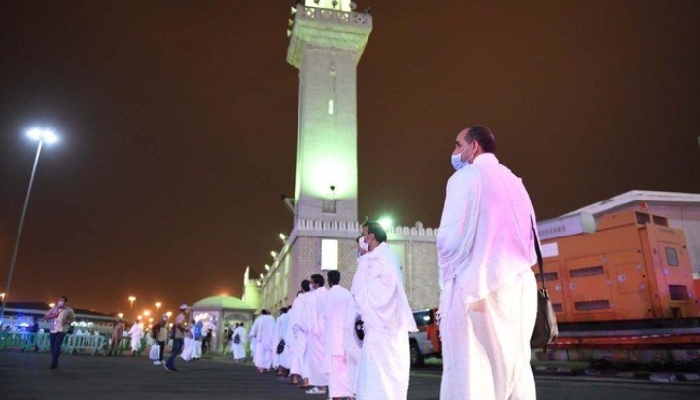
Jeddah, Jul 31: Hajj 2020 pilgrims arrived in Muzdalifah Thursday night to rest after spending the day in Arafat.

Earlier, the pilgrims scaled Mount Arafat to pray and repent, as a highly unusual Hajj approached its climax. They listened to a sermon delivered by Sheikh Abdullah Al-Manea and prayed Dhuhr and Asr prayers together at the Al-Namirah Mosque in Arafat.

This year’s pilgrimage is the smallest in modern times, after the number of participants was greatly restricted to prevent the spread of the coronavirus. 

Tight security was in place around the foot of the rocky hill outside Makkah, also known as Jabal Al-Rahma or Mount of Mercy, in preparation for the high point of the annual ritual.

Video footage shown on state television showed the pilgrims setting off on their climb to the summit. They wore face masks and observed strict social-distancing rules imposed by Saudi authorities.As sprinklers sprayed water on them to provide relief from the summer desert heat, the pilgrims raised their palms as they climbed the slopes of the hill — the site of Prophet Muhammad’s last sermon. When they reached the top they recited holy verses and prayed for forgiveness for their sins.

Earlier, the pilgrims were taken in buses from Mina to Mount Arafat. Strict precautionary measures were in place, with each group accompanied by security teams, ambulances and civil defense vehicles. 

When they arrived, their temperatures were checked before they entered Namirah Mosque to hear a sermon that was translated into 10 languages.

“The camps were set up for pilgrims in Arafat early on,” said Minister of Hajj and Umrah Muhammad Salih Bentin. The sermon at Namirah Mosque was delivered by Sheikh Abdullah Al-Manea, who led the pilgrims in noon and afternoon prayers.

“During Hajj this year, we reiterate that it is essential for pilgrims, as well as everyone assisting them, to adhere to the precautionary regulations that have been implemented,” Al-Manea, a member of the Council of Senior Scholars, said during his sermon. “This is to be done for their own safety.

“Precautions have been put in place to protect lives against the damage that the pandemic can cause, and also to actualize Islam’s teachings pertaining to safeguarding human life by Allah’s permission.”

The stay in Arafat is described as the pinnacle of Hajj and Muslims around the world reflect the actions of pilgrims by asking for forgiveness and praying for their deepest desires.
Pilgrims left Arafat in coaches for Muzdalifah after sunset and will pray the Maghrib and Isha prayers there.

After sunset prayers, the pilgrims made their way down Mount Arafat to Muzdalifah, where they will spend the night before the final Hajj ritual, the symbolic stoning of the devil. 

This year, each pilgrim received sanitized pebbles in advance of the event on Friday, which is the first day of Eid Al-Adha.
This year the Kingdom faced the unprecedented challenge of ensuring pilgrims attending Hajj were protected as much as possible from the risks of the coronavirus.

They will then sleep, pray the Fajr prayer there tomorrow and then leave for Mina.

Comments

Add new comment

  • Coastaldigest.com reserves the right to delete or block any comments.
  • Coastaldigset.com is not responsible for its readers’ comments.
  • Comments that are abusive, incendiary or irrelevant are strictly prohibited.
  • Please use a genuine email ID and provide your name to avoid reject.
Agencies
April 25,2020

From loudspeakers on the roof of a Minnesota mosque, the Islamic call to prayer echoed for the first time ever throughout a Minneapolis neighbourhood late on Thursday as the Muslim community there prepared to begin the holy month of Ramadan.

It echoed again on Friday morning and will continue five times a day during the holy month. 

The simple, short call - known as the adhan - marked an historical moment for Minneapolis and major cities across the United States, community members said. While the adhan is commonly broadcast throughout the Middle East, North Africa and other places, for many Muslims in the US, it is only heard inside mosques or community centres.

"There's definitely a lot of excitement," said Imam Abdisalam Adam, who is on the board of the Dar al-Hijrah mosque, from where the adhan will be broadcast.
"Some people see it as historic," Adam told Al Jazeera. "To the point ... that they're not doing it, able to see it in their lifetime." 

Recited by different representatives from mosques around the city, the call to prayer is expected to reach thousands in the Cedar-Riverside neighbourhood in Minneapolis, according to Jaylani Hussein, the executive director of Minnesota's Council on American-Islamic Relations (CAIR).

While Hussein says the community had discussed broadcasting the call for years, it became even more pressing this year when the coronavirus pandemic forced mosques to shut their doors and residents to stay inside. The coronavirus has infected more than 870,000 people nationwide and killed at least 50,000.
"We wanted to touch those individuals who frequent this mosque and this community," Hussein said. "If we cannot be physically together, at least this echo, this voice, this call to prayer can be an extension of us being together at this difficult time. To give some people some solace."
Ramadan - Minnesota.

The Dar al-Hijrah mosque in the Cedar-Riverside neighbourhood of Minneapolis, Minnesota [Courtesy of Abdisalem Adam] 
Ramadan is traditionally a time when Muslims worldwide regularly attend mosques for daily prayers and break their fasts together. But this year, most have been told to pray at home and forgo community iftars in favour of staying safe from the COVID-19 crisis.

Adam, the imam, said while the Muslim community is experience loss this Ramadan, they hope the call to prayer broadcast will create a "semblance of normalcy".

"With the loss of Friday prayers and the regular congregational prayers, we are hoping that this will give a sense of solace and connection to the spiritual needs of community members," he added. 

An avenue to greater investment?

The Cedar-Riverside neighbourhood is a densely populated area of Minneapolis that has historically been an entry point for many immigrants and today is home to large Somali and Oromo communities.

Ramla Bile, a Somali American who lives in a neighbourhood adjacent to Cedar-Riverside, has been active in the community for years. She welcomed the broadcast of the call to prayer, saying it will help people "feel the spirit of Ramadan in a way that is meaningful".

But she also hopes the city of Minneapolis, which provided the noise permit for the broadcast, will make bigger strides to invest in the community in even more tangible ways.

"There's been a lot of need and a lot hurt in the community in light of the COVID-19 pandemic. And then there's the ongoing conversation you've been having," she said, pointing to deep-seated Islamophobia, systemic racism and the need for infrastructure projects like sprinkler systems in high-rise buildings. 

"We need to see greater investments to support the most vulnerable members of our community," Bile said referring to the neighbourhood's elders, undocumented individuals, low-income families and others.

"Right now, we're waiting for a bailout for our micro-businesses who comprise our Somali malls, or a rent freeze for neighbourhood residents," she added.

For CAIR's Hussein and Imam Adam, they hope this Ramadan's call to prayer helps encourage other communities around the US to take similar steps.

"This will hopefully inspire others … to think about what could happen in future Ramadans and beyond," Hussein said.

Adam added that while the virus has devastated communities and upended daily life, it has also shown that "we're in this together".

"It just shows the significance of the global village and how interconnected and interdependent we are as a world community," he said. "I think that there will be a lot of change in our way of life for the better. I hope so."


 

Comments

Add new comment

  • Coastaldigest.com reserves the right to delete or block any comments.
  • Coastaldigset.com is not responsible for its readers’ comments.
  • Comments that are abusive, incendiary or irrelevant are strictly prohibited.
  • Please use a genuine email ID and provide your name to avoid reject.
News Network
May 27,2020

In a development which highlights the diversity in the United Kingdom’s legal system, a 40-year-old Muslim woman has become the first hijab-wearing judge in the country.

Raffia Arshad, a barrister, was appointed a deputy district judge on the Midlands circuit last week after 17-year career in law.  

She said her promotion was great news for diversity in the world’s most respected legal system. She hopes to be an inspiration to young Muslims.

Ms Arshad, who grew up in Yorkshire, north England, has wanted to work in law since she was 11.

Ms Arshad said the judicial office was looking to promote diversity, but when they appointed her they did not know that she wore the hijab.

‘It’s definitely bigger than me,” she told Metro newspaper. "I know this is not about me.

"It’s important for all women, not just Muslim women, but it is particularly important for Muslim women."

Ms Arshad, a mother of three, has been practising private law dealing with children, forced marriage, female genital mutilation and other cases involving Islamic law for the past 17 years.

She was the first in her family to go to university and has also written a leading text on Islamic family law.

Although the promotion by the Lord Chief Justice was welcome news for her, Ms Arshad said the happiness from other people sharing the news was “far greater”.

“I’ve had so many emails from people, men and women," she said.

"It’s the ones from women that stand out, saying that they wear a hijab and thought they wouldn’t even be able to become a barrister, let alone a judge."

Ms Arshad is regularly the subject of discrimination in the courtroom because of her choice to wear the hijab.

She is sometimes mistaken for a court worker or a client.

Ms Arshad said that recently she was asked by an usher whether she was a client, an interpreter, and even if she were on work experience.

“I have nothing against the usher who said that but it reflects that as a society, even for somebody who works in the courts, there is still this prejudicial view that professionals at the top end don’t look like me,” she said.

A family member once advised her to not wear a hijab at an interview for a scholarship at the Inns of Court School of Law in 2001, warning that it would affect her chances of landing the role.

“I decided that I was going to wear my headscarf because for me it’s so important to accept the person for who they are," Ms Arshad said.

"And if I had to become a different person to pursue my profession, it’s not something I wanted.”

The joint heads of St Mary’s Family Law Chambers said they were “delighted” to hear the news of her appointment.

“Raffia has led the way for Muslim women to succeed in the law and at the bar, and has worked tirelessly to promote equality and diversity in the profession,” Vickie Hodges and Judy Claxton said.

“It is an appointment richly deserved and entirely on merit, and all at St Mary’s are proud of her and wish her every success.”

Comments

Add new comment

  • Coastaldigest.com reserves the right to delete or block any comments.
  • Coastaldigset.com is not responsible for its readers’ comments.
  • Comments that are abusive, incendiary or irrelevant are strictly prohibited.
  • Please use a genuine email ID and provide your name to avoid reject.