IMF calls for 'urgent' action by India amid slowdown

News Network
December 24, 2019

Washington, Dec 24: India's government must take steps quickly to reverse the economic slowdown of an economy that has been one of the engines of global growth, the International Monetary Fund said Monday.

Declining consumption and investment, and falling tax revenue, have combined with other factors to put the brakes on one of the fastest growing economies in the world, the IMF said in its annual review.

After lifting millions out of poverty "India is now in the midst of a significant economic slowdown," Ranil Salgado, of the IMF Asia and Pacific Department, told reporters.

"Addressing the current downturn and returning India to a high growth path requires urgent policy actions."

However, the government has limited space to boost spending to support growth, especially given high debt levels and interest payments, the fund warned

IMF chief economist Gita Gopinath last week said India's slowdown had "surprised to the downside," and said the fund is set to significantly downgrade its growth estimates for the Indian economy in the World Economic Outlook which will be released next month.

The IMF in October slashed its forecast for 2019 by nearly a full point to 6.1 percent, while cutting the outlook for 2020 to 7.0 percent.

Salgado said India's central bank has "room to cut the policy rate further, especially if the economic slowdown continues."

The Reserve Bank of India (RBI) cut the key lending rate five times this year to a nine-year low, but at its last meeting earlier this month defied expectations by keeping policy unchanged.

The central bank slashed its annual growth forecast to 5 percent from 6.1 percent, as consumer demand and manufacturing activity contracts.

Salgado said "the government needs to reinvigorate the reform agenda," including restoring the health of the financial sector in order to "enhance its ability to provide credit to the economy."

Comments

Ahmed
 - 
Tuesday, 24 Dec 2019

Am Not point to all hindus but some hindus who think modi is leader for them....


please my dear brother think carefully...the person who lie time to time he is not good leader..

he is just using for his desire or some other desire..

when you dont have job, and empty pocket and your daughter ask for chocklet that time your relize what you have dont by supporting criminal and lier.


belive in RAM as leader bcoz he speak truth and thuthfull to his people...but not belive in Devil who say Lie for every second..


i hope our hindu brothers from mangalore will understand...


Suresh SS
 - 
Tuesday, 24 Dec 2019

Modi will bring India to the worst situation and people will starve to death all RSS Goondas to eat cowdung

Add new comment

  • Coastaldigest.com reserves the right to delete or block any comments.
  • Coastaldigset.com is not responsible for its readers’ comments.
  • Comments that are abusive, incendiary or irrelevant are strictly prohibited.
  • Please use a genuine email ID and provide your name to avoid reject.
Agencies
July 28,2020

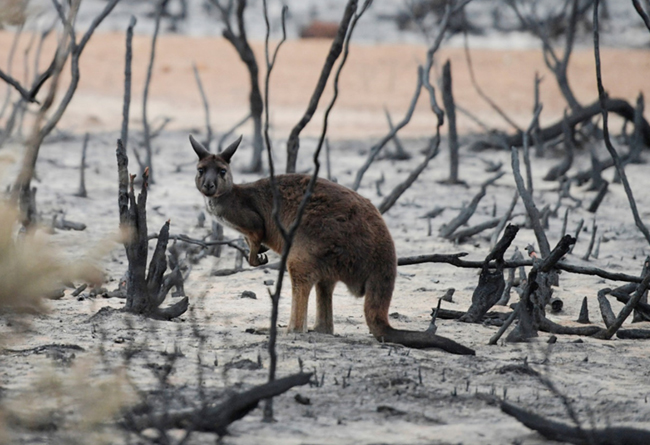
Sydney, Jul 28: Nearly 3 billion koalas, kangaroos and other native Australian animals were killed or displaced by bushfires in 2019 and 2020, a study by the World Wide Fund for Nature (WWF) said on Tuesday, triple the group's earlier estimates.

Some 143 million mammals, 2.46 billion reptiles, 180 million birds and 51 million frogs were impacted by the country's worst bushfires in decades, the WWF said.

When the fires were still blazing, the WWF estimated the number of affected animals at 1.25 billion. The fires destroyed more than 11 million hectares (37 million acres) across the Australian southeast, equal to about half the area of the United Kingdom.

"This ranks as one of the worst wildlife disasters in modern history," said WWF-Australia Chief Executive Officer Dermot O'Gorman in a statement.

The project leader Lily Van Eeden, from the University of Sydney, said the research was the first continent-wide analysis of animals impacted by the bushfires, and "other nations can build upon this research to improve understanding of bushfire impacts everywhere".

The total number included animals which were displaced because of destroyed habitats and now faced lack of food and shelter or the prospect of moving to habitat that was already occupied.

The main reason for raising the number of animal casualties was that researchers had now assessed the total affected area, rather than focusing on the most affected states, they said.

After years of drought made the Australian bush unusually dry, the country battled one of its worst bushfire seasons ever from September 2019 to March 2020, resulting in 34 human deaths and nearly 3,000 homes lost.

Comments

Add new comment

  • Coastaldigest.com reserves the right to delete or block any comments.
  • Coastaldigset.com is not responsible for its readers’ comments.
  • Comments that are abusive, incendiary or irrelevant are strictly prohibited.
  • Please use a genuine email ID and provide your name to avoid reject.
News Network
May 14,2020

May 14: The UN’s children agency has warned that an additional 6,000 children could die daily from preventable causes over the next six months as the COVID-19 pandemic weakens the health systems and disrupts routine services, the first time that the number of children dying before their fifth birthday could increase worldwide in decades.

As the coronavirus outbreak enters its fifth month, the UN Children’s Fund (UNICEF) requested USD 1.6 billion to support its humanitarian response for children impacted by the pandemic.

The health crisis is “quickly becoming a child rights crisis. And without urgent action, a further 6,000 under-fives could die each day,” it said.

With a dramatic increase in the costs of supplies, shipment and care, the agency appeal is up from a USD 651.6 million request made in late March – reflecting the devastating socioeconomic consequences of the disease and families’ rising needs.

"Schools are closed, parents are out of work and families are under strain," UNICEF Executive Director Henrietta Fore said on Tuesday.

 “As we reimagine what a post-COVID world would look like, these funds will help us respond to the crisis, recover from its aftermath, and protect children from its knock-on effects.”

The estimate of the 6,000 additional deaths from preventable causes over the next six months is based on an analysis by researchers from the Johns Hopkins Bloomberg School of Public Health, published on Wednesday in the Lancet Global Health Journal.

UNICEF said it was based on the worst of three scenarios analysing 118 low and middle-income countries, estimating that an additional 1.2 million deaths could occur in just the next six months, due to reductions in routine health coverage, and an increase in so-called child wasting.

Around 56,700 more maternal deaths could also occur in just six months, in addition to the 144,000 likely deaths across the same group of countries. The worst case scenario, of children dying before their fifth birthdays, would represent an increase "for the first time in decades,” Fore said.

"We must not let mothers and children become collateral damage in the fight against the virus. And we must not let decades of progress on reducing preventable child and maternal deaths, be lost,” she said.

Access to essential services, like routine immunisation, has already been compromised for hundreds of millions of children and threatens a significant increase in child mortality.

According to a UNICEF analysis, some 77 per cent of children under the age of 18 worldwide are living in one of 132 countries with COVID-19 movement restrictions.

The UN agency also spotlighted that the mental health and psychosocial impact of restricted movement, school closures and subsequent isolation are likely to intensify already high levels of stress, especially for vulnerable youth.

At the same time, they maintained that children living under restricted movement and socio-economic decline are in greater jeopardy of violence and neglect. Girls and women are at increased risk of sexual and gender-based violence.

The UNICEF pointed out that in many cases, refugee, migrant and internally displaced children are experiencing reduced access to protection and services while being increasingly exposed to xenophobia and discrimination.

“We have seen what the pandemic is doing to countries with developed health systems and we are concerned about what it would do to countries with weaker systems and fewer available resources,” Fore said.

In countries suffering from humanitarian crises, UNICEF is working to prevent transmission and mitigate the collateral impacts on children, women and vulnerable populations – with a special focus on access to health, nutrition, water and sanitation, education and protection.

To date, the UN agency said it has received USD 215 million to support its pandemic response, and additional funding will help build upon already-achieved results.

Within its response, UNICEF has reached more than 1.67 billion people with COVID-19 prevention messaging around hand washing and cough and sneeze hygiene; over 12 million with critical water, sanitation and hygiene supplies; and nearly 80 million children with distance or home-based learning.

The UN agency has also shipped to 52 countries, more than 6.6 million gloves, 1.3 million surgical masks, 428,000 N95 respirators and 34,500 COVID-19 diagnostic tests, among other items.


Comments

Add new comment

  • Coastaldigest.com reserves the right to delete or block any comments.
  • Coastaldigset.com is not responsible for its readers’ comments.
  • Comments that are abusive, incendiary or irrelevant are strictly prohibited.
  • Please use a genuine email ID and provide your name to avoid reject.
News Network
June 24,2020

Jun 24: The coronavirus tally in Pakistan reached 188,926 with the detection of 3,892 new cases in the last 24 hours, the health ministry said on Wednesday.

Sixty more people died due to the viral infection, taking the death toll to 3,755.

As many as 3,337 patients are in critical condition across the country, the ministry said.

With the detection of 3,892 new cases in the last 24 hours, the coronavirus tally in the country now stands at 188,926, it said.

Sindh reported the maximum number of 72,656 cases, followed by 69,536 in Punjab, 23,388 in Khyber-Pakhtunkhwa, 11,483 in Islamabad, 9,634 in Balochistan, 1,337 in Gilgit-Baltistan and 892 in Pakistan-occupied Kashmir (Pok).

Health authorities have so far conducted 1,150,141 coronavirus tests, including 23,380 in the last 24 hours.

A total of 77,754 patients have recovered so far from the disease.

Comments

Add new comment

  • Coastaldigest.com reserves the right to delete or block any comments.
  • Coastaldigset.com is not responsible for its readers’ comments.
  • Comments that are abusive, incendiary or irrelevant are strictly prohibited.
  • Please use a genuine email ID and provide your name to avoid reject.