


Communal hate crime: Family in shock after 16-yr-old Hafiz-ul-Quran murdered on train

coastaldigest.com web desk
June 24, 2017

New Delhi, Jun 24: In an apparent case of communal hate crime, five Muslim men on board a train from Delhi to Mathura were attacked by other passengers, resulting in the death of one.
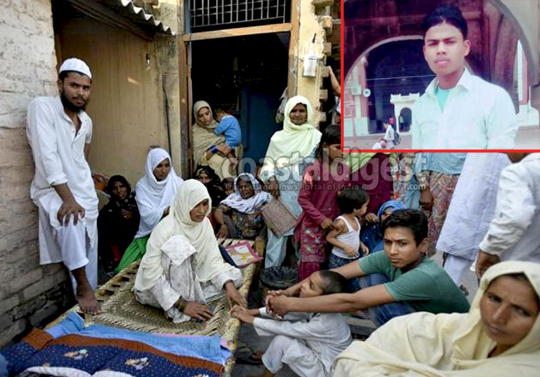
trainstabbed

The incident took place on Thursday evening between Okhla and Asoti in Haryana, a distance of about 60 km. The four injured said: At Khaddawli, a small village in Haryana’s Faridabad district, the attackers repeatedly called them “anti-nationals” and “beef eaters”, threw their skull caps on the floor, caught their beards and taunted them with terms such as “mulla”.

“Junaid (16) was stabbed to death, while his brothers Hashim (21) and Shaqir (23) were injured. Singh said the condition of Shaqir was “serious”. “One person has been arrested in this connection,” deputy superintendent of police, Faridabad Government Railway Police (GRP), Mohinder Singh said.

Mother’s gift

It was on Wednesday evening that Junaid and Hashim attained the title of a “Hafiz” after investing over three years to memorize the Quran by heart and got Rs 1500 as a reward from their mother.

It was their first Eid after becoming Huffaz and they wanted to look their best. To celebrate and shop, they planned a visit to Delhi’s Jama Masjid and promised to return before sundown. One of the two could not.

“Junaid was so happy that he will be formally felicitated for their achievement on Eid. Since Ramadan started, he and Hashim had been reciting the Quran everyday at the mosque. They wanted to look good, so they specially went to purchase a new set of clothes to Jama Masjid. Their mother asked them to fetch the best sewaiyan and sweets to be served on the festival. He promised to reach home early, but what reached home was his dead body. How could those men be so cruel to have pierced my son’s body like that,” Jallaluddin, Junaid’s father, said.

“He was a child. He was just 16. How could they hate us so much to have killed him so brutally? When I reached the spot, my son Hashim was sitting on the station with Junaid’s body soaked in blood in his lap,” he added, even as he was being consoled intermittently by fellow villagers in Khadwali, Haryana.

Jallaluddin had reached Ballabgarh station to pick up his sons so that they could go to open the fast together, but when he reached the train had already left.

“Sakir (Junaid’s elder brother who boarded the train at Ballabgarh after being informed about the attack) called me saying that he was going to the station to pick up the boys. He asked me to come to the station as well. He never told me that there was a problem. When I reached the station, the train had already left. When I could not locate the boys I called Sakir, he also did not take the call. Junaid and Hashim too did not pick. I thought the boys must have left. What did I know that they were fighting for their life,” he said.

Saira, Junaid’s mother, was oblivious to the news of her son’s death. Till Friday morning she was not informed about it. When the women from the village started visiting her to console her, she wondered why they were there.

“Women kept coming and asking me about Junaid. I wondered why they were referring to him in the past tense. No one ever told me that he was no more. How could they hide it from me,” she said, fighting back her tears.

“I got to know only when his body returned home this morning. When he did not reach home last night, I kept asking his father about his whereabouts but no one answered me,” she said.

Saira said she will never be able to celebrate the festival of Eid. “This time it was special. My sons became the Huffaz. The preservers. And a day later I lost him. How can this be justified. How am I to cope up with this loss?”

Comments

saleemkana
 - 
Saturday, 24 Jun 2017

Dear Modi Govt;
Please arrange a war between Indian Govt and Indian Muslims. I wont call it war between Hindus and Muslim, coz i saw many hindus who are peace lovers and they love us (Muslims). Its the Indian Govt to provoke some unemployed hindus to do so (Kill, assault) for such silly reasons. If the govt takes very strict action for any small crimes and these ppl will not have any guts to attempt even minor crimes

Let it be decided for 1 final time. Either you kill us or let us show our power. No need of killings of muslims each day.

Now the water level is crossing the neck.

Jai Hind

Ranjan shetty
 - 
Saturday, 24 Jun 2017

all fabricated stories and these fake victimisation is used to lure people for global and street jihad against govts . people are not fool to hack someone to death like this . there might be some genuine reason.

Arshi
 - 
Tuesday, 27 Jun 2017

Ranjan.. definitely people are not fooling but yes they are mad!! Have you learned about jihad? do you know what it is? Ok, leave it to their history, what about these mad people's action what you would like to call this heinous act? Over smart or crime? are you from India? you trust and respect law and order? If yes, then what is your opinion?? If no, you are anti-Indian citizen taking law in the hand! can you please imagine such incidents if it could happen with your, beloved brother, son, or any other close family members what will be the pain and reaction? If cannot feel the pain, then ask your mother if you hacked to death the way they did to him what will be her trauma and agony or ask your wife!

I don't think you are staying in Al Ain if yes, you will not write such comments because you know how much this Islamic country giving you the facilities, safety, peaceful life. Punishment for crime is equal to one and all.

so be matured and become good human at least. Muslims don't like to spoil peaceful environment it does not mean they are useless.

Add new comment

  • Coastaldigest.com reserves the right to delete or block any comments.
  • Coastaldigset.com is not responsible for its readers’ comments.
  • Comments that are abusive, incendiary or irrelevant are strictly prohibited.
  • Please use a genuine email ID and provide your name to avoid reject.
Ram Puniyani
February 10,2020

Noam Chomsky is one of the leading peace workers in the world. In the wake of America’s attack on Vietnam, he brought out his classic formulation, ‘manufacturing consent’. The phrase explains the state manipulating public opinion to have the public approve of it policies—in this case, the attack of the American state on Vietnam, which was then struggling to free itself from French colonial rule.

In India, we are witness to manufactured hate against religious minorities. This hatred serves to enhance polarisation in society, which undermines India’s democracy and Constitution and promotes support for a Hindu nation. Hate is being manufactured through multiple mechanisms. For example, it manifests in violence against religious minorities. Some recent ghastly expressions of this manufactured hate was the massive communal violence witnessed in Mumbai (1992-93), Gujarat (2002), Kandhamal (2008) and Muzaffarnagar (2013). Its other manifestation was in the form of lynching of those accused of having killed a cow or consumed beef. A parallel phenomenon is the brutal flogging, often to death, of Dalits who deal with animal carcasses or leather.

Yet another form of this was seen when Shambhulal Regar, indoctrinated by the propaganda of Hindu nationalists, burned alive Afrazul Khan and shot the video of the heinous act. For his brutality, he was praised by many. Regar was incited into the act by the propaganda around love jihad. Lately, we have the same phenomenon of manufactured hate taking on even more dastardly proportions as youth related to Hindu nationalist organisations have been caught using pistols, while police authorities look on.

Anurag Thakur, a BJP minster in the central government recently incited a crowd in Delhi to complete his chant of what should happen to ‘traitors of the country...” with a “they should be shot”. Just two days later, a youth brought a pistol to the site of a protest at Jamia Millia Islamia university and shouted “take Azaadi!” and fired it. One bullet hit a student of Jamia. This happened on 30 January, the day Nathuram Godse had shot Mahatma Gandhi in 1948. A few days later, another youth fired near the site of protests against the CAA and NRC at Shaheen Bagh. Soon after, he said that in India, “only Hindus will rule”.

What is very obvious is that the shootings by those associated with Hindu nationalist organisations are the culmination of a long campaign of spreading hate against religious minorities in India in general and against Muslims in particular. The present phase is the outcome of a long and sustained hate campaign, the beginning of which lies in nationalism in the name of religion; Muslim nationalism and Hindu nationalism. This sectarian nationalism picked up the communal view of history and the communal historiography which the British introduced in order to pursue their ‘divide and rule’ policy.

In India what became part of “social common sense” was that Muslim kings had destroyed Hindu temples, that Islam was spread by force, and that it is a foreign religion, and so on. Campaigns, such as the one for a temple dedicated to the Hindu god Rama to be built at the site where the Babri masjid once stood, further deepened the idea of a Muslim as a “temple-destroyer”. Aurangzeb, Tipu Sultan and other Muslim kings were tarnished as the ones who spread Islam by force in the subcontinent. The tragic Partition, which was primarily due to British policies, and was well-supported by communal streams also, was entirely attributed to Muslims. The Kashmir conflict, which is the outcome of regional, ethnic and other historical issues, coupled with the American policy of supporting Pakistan’s ambitions of regional hegemony, (which also fostered the birth of Al-Qaeda), was also attributed to the Muslims.

With recurring incidents of communal violence, these falsehoods went on going deeper into the social thinking. Violence itself led to ghettoisation of Muslims and further broke inter-community social bonds. On the one hand, a ghettoised community is cut off from others and on the other hand the victims come to be presented as culprits. The percolation of this hate through word-of-mouth propaganda, media and re-writing of school curricula, had a strong impact on social attitudes towards the minorities.

In the last couple of decades, the process of manufacturing hate has been intensified by the social media platforms which are being cleverly used by the communal forces. Swati Chaturvedi’s book, I Am a Troll: Inside the Secret World of the BJP’s Digital Army, tells us how the BJP used social media to spread hate. Whatapp University became the source of understanding for large sections of society and hate for the ‘Other’, went up by leaps and bounds. To add on to this process, the phenomenon of fake news was shrewdly deployed to intensify divisiveness.

Currently, the Shaheen Bagh movement is a big uniting force for the country; but it is being demonised as a gathering of ‘anti-nationals’. Another BJP leader has said that these protesters will indulge in crimes like rape. This has intensified the prevalent hate.

While there is a general dominance of hate, the likes of Shambhulal Regar and the Jamia shooter do get taken in by the incitement and act out the violence that is constantly hinted at. The deeper issue involved is the prevalence of hate, misconceptions and biases, which have become the part of social thinking.

These misconceptions are undoing the amity between different religious communities which was built during the freedom movement. They are undoing the fraternity which emerged with the process of India as a nation in the making. The processes which brought these communities together broadly drew from Gandhi, Bhagat Singh and Ambedkar. It is these values which need to be rooted again in the society. The communal forces have resorted to false propaganda against the minorities, and that needs to be undone with sincerity.

Combating those foundational misconceptions which create hatred is a massive task which needs to be taken up by the social organisations and political parties which have faith in the Indian Constitution and values of freedom movement. It needs to be done right away as a priority issue in with a focus on cultivating Indian fraternity yet again.

Comments

Add new comment

  • Coastaldigest.com reserves the right to delete or block any comments.
  • Coastaldigset.com is not responsible for its readers’ comments.
  • Comments that are abusive, incendiary or irrelevant are strictly prohibited.
  • Please use a genuine email ID and provide your name to avoid reject.
coastaldigest.com web desk
June 9,2020

With the steep hike in excise duty in the past couple of months, an average consumer of petrol now pays over 275% in taxes to centre and states on a litre of the fuel.  The base price of petrol is just about Rs 18. The taxes are close to Rs 50 and the pump price is over Rs 72.

India imports 85% of all its crude oil demand.  After a steep hike in excise duty in the past two months despite a hold on daily price revisions by the oil public sector undertakings (PSUs), Indian consumers now pay 275% collectively in excise duty to state and centre. 

The central government hiked excise on petrol and diesel by Rs 10 and Rs 13 respectively last month. The excise duty on petrol is taxed around Rs 33-a-litre while the same on diesel it is Rs 32.

The Value-Added Tax (VAT) on both petrol and diesel is Rs 16.44 and Rs 16.26 respectively. Both the taxes together are around Rs 49 while it is sold at petrol pumps at 73-per-litre.

These two taxes cumulatively account for 69% of tax which is higher than anywhere else in the world. The same is taxed at 19% in the US, 47% in Japan, UK 62% and 63% in France. The government does not pass on the benefit of lower crude oil prices to the customer.

It is to be noted that Indian consumers continued to pay Rs 70-a-litre even when crude oil prices hit a paltry US $ 20-a-barrel on April 12.

Former finance minister and Congress leader recently took a jab at the Centre over rising prices stating, “Fuel selling prices raised twice in two days, following tax hikes two weeks ago. This time to benefit oil companies. Government is poor, it needs more taxes. Oil companies are poor, they need better prices. Only the poor and middle class are not poor, so they will pay”.

Comments

Lovely indian
 - 
Wednesday, 10 Jun 2020

Acche din for modi bakth....lets enjoy


you need only ram mandir and NRC

Add new comment

  • Coastaldigest.com reserves the right to delete or block any comments.
  • Coastaldigset.com is not responsible for its readers’ comments.
  • Comments that are abusive, incendiary or irrelevant are strictly prohibited.
  • Please use a genuine email ID and provide your name to avoid reject.
coastaldigest.com news network
July 7,2020

Bengaluru, Jul 7: Vasudeva Maiya, former CEO of Sri Guru Raghavendra Co-operative Bank, was found dead in his car in Bengaluru on July 6.

The Subramanyapura police have begun an investigation into Vasudeva Maiya's death.  Source said that he committed suicide. He was a native of Kota in Udupi district.

The car was found parked a little away from Maiya's house at around 6.30 pm on July 6.

The Reserve Bank of India (RBI) had in January imposed restrictions on Sri Guru Raghavendra Co-operative Bank and limited withdrawals to Rs 35,000 by customers.

On June 18, Anti-Corruption Bureau (ACB) raided five offices of Sri Guru Raghavendra Co-operative Bank, in relation to alleged misappropriation of Rs 1,400 crore.

The RBI, Enforcement Directorate, Criminal Investigation Department, and Registrar of Cooperative Societies are looking into the financial irregularities at the lender.

The police also conducted searches at residences of Maiya and the bank's chairman K Ramakrishna in relation to the above mentioned case, sources said.

Comments

Add new comment

  • Coastaldigest.com reserves the right to delete or block any comments.
  • Coastaldigset.com is not responsible for its readers’ comments.
  • Comments that are abusive, incendiary or irrelevant are strictly prohibited.
  • Please use a genuine email ID and provide your name to avoid reject.