Communal tension in DK is creation of BJP; not failure of police: Param

coastaldigest.com news network
July 9, 2017

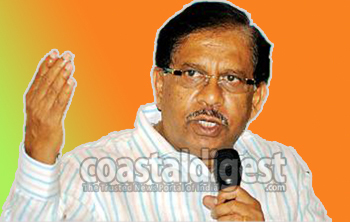
Udupi, Jul 9: Bharatiya Janata Party and its allies are fully responsible for communal tensions in Dakshina Kannada, and not the police, according to G Parameshwara, the president of Karnataka Pradesh Congress Committee.param4param3

Responding to presspersons on the situation in Kalladka and other parts of Dakshina Kannada, after visiting the Sri Krishna Mutt/Temple here, Mr Parameshwara said there was no failure on part of the police in Kalladka.

“I regret to say that the BJP leaders and workers are provoking communal passions in Dakshina Kannada. Owing to this, people are losing their lives. Even the Pejawar seer had held iftar to promote harmony and peace among communities. The BJP is doing this with an eye on elections,” he said.

To a query, he said some forces were trying to create confusion in the society over the iftar organised by the Pejawar seer. “We welcome the seer’s move; my party wants harmony and peace in the society,” he said. On the recent visits of former Chief Minister and BJP leader B.S. Yeddyurappa to Dalit colonies in the State, Mr. Parameshwara said that it was all a “drama”.

“If Mr Yeddyurappa was really bothered about the Dalits, he should have tried to do something for them when he was in power. Everyone knows that it being done for political gains,” he said.

Comments

SYED
 - 
Monday, 10 Jul 2017

Alhamdulillah. Good work done By team HIDAYA Foundation, and special thanks to Mr. ASIF Deals for his wonderful effort.

Naser
 - 
Monday, 10 Jul 2017

Its pathetic that those who never did any thing for the freedom struggle but supported British against Independence to our land are now ruling our country.

Add new comment

  • Coastaldigest.com reserves the right to delete or block any comments.
  • Coastaldigset.com is not responsible for its readers’ comments.
  • Comments that are abusive, incendiary or irrelevant are strictly prohibited.
  • Please use a genuine email ID and provide your name to avoid reject.
News Network
April 18,2020

Kochi, Apr 18: The Centre on Friday informed the Kerala High Court that there was no immediate plan to bring back the Indian citizens stranded in the Gulf countries due to the novel coronavirus outbreak and that the expatriates had been granted visa extension.

The counsel for the central government made the submission before a division bench comprising justices Rajavijayaraghavan and T R Ravi during the hearing of a plea seeking a direction to bring back Indians stranded in the UAE.

Permission of the Gulf countries was required to send medical teams there to carry out medical examination of the stranded Indians, the counsel said when the court sought to know the Centre's view on Kerala government sending medical teams to the Gulf countries to deal with the issue of COVID-19 disease among Malayalees there.

The court posted the plea for April 21 for consideration after the Central government informed that a similar petition is under consideration of the Supreme Court.

In its plea, Kerala Muslim Cultural Centre (KMCC) in Dubai, the organisation for non-resident Indians from Kerala, sought directions to the Ministries of External Affairs and Civil Aviation to provide exemptions in the international air travel ban to bring back Indians stranded in the UAE.

The petitioners noted that those who return could be kept in quarantine as per the protocol of the World Health Organisation (WHO).

Comments

Add new comment

  • Coastaldigest.com reserves the right to delete or block any comments.
  • Coastaldigset.com is not responsible for its readers’ comments.
  • Comments that are abusive, incendiary or irrelevant are strictly prohibited.
  • Please use a genuine email ID and provide your name to avoid reject.
Agencies
May 8,2020

Washington D.C., May 8: The prime time for brain development in a child's life is the first year, where the infant spends most of the time asleep. It is the time when neural connections form and sensory memories are encoded.

However, when sleep is disrupted, as occurs more often among children with autism, brain development may be affected, too.

New research led by the University of Washington finds that sleep problems in a baby's first 12 months may not only precede an autism diagnosis but also may be associated with altered growth trajectory in a key part of the brain, the hippocampus.

The study, which was published in the American Journal of Psychiatry, researchers report that in a sample of more than 400 taken of 6- to 12-month-old infants, those who were later diagnosed with autism were more likely to have had difficulty falling asleep.

It also states that this sleep difficulty was associated with altered growth trajectories in the hippocampus.

"The hippocampus is critical for learning and memory, and changes in the size of the hippocampus have been associated with poor sleep in adults and older children.

As many as 80 per cent of the children with autism spectrum disorder have sleep problems," said Annette Estes, director of the UW Autism Center and senior author of the study.

"In our clinical experience, parents have a lot of concerns about their children's sleep, and in our work on early autism intervention, we observed that sleep problems were holding children and families back," added Estes, who is also a UW professor of speech and hearing sciences.

"It could be that altered sleep is part-and-parcel of autism for some children. One clue is that behavioural interventions to improve sleep don't work for all children with autism, even when their parents are doing everything just right. This suggests that there may be a biological component to sleep problems for some children with autism," said Estes.

To consider links among sleep, brain development, and autism, researchers at the IBIS Network looked at MRI scans of 432 infants, surveyed parents about sleep patterns, and measured cognitive functioning using a standardized assessment.

At the outset of the study, infants were classified according to their risk for developing autism: Those who were at higher risk of developing autism -- about two-thirds of the study sample -- had an older sibling who had already been diagnosed.

Infant siblings of children with autism have a 20 per cent chance of developing autism spectrum disorder -- a much higher risk than children in the general population.

In the current study, 127 of the 432 infants were identified as "low risk" at the time the MRI scans were taken because they had no family history of autism.

They later evaluated all the participants at 24 months of age to determine whether they had developed autism. Of the roughly 300 children originally considered "high familial risk," 71 were diagnosed with autism spectrum disorder at that age.

Problems with sleep were more common among the infants later diagnosed with an autism spectrum disorder, as were larger hippocampi. No other subcortical brain structures were affected, including the amygdala, which is responsible for certain emotions and aspects of memory, or the thalamus, a signal transmitter from the spinal cord to the cerebral cortex.

The authors note that while parents reported more sleep difficulties among infants who developed autism compared to those who did not, the differences were very subtle and only observed when looking at group averages across hundreds of infants.

Sleep patterns in the first years of life change rapidly as infants transition from sleeping around the clock to a more adult-like sleep/wake cycle. Until further research is completed, Estes said, it is not possible to interpret challenges with sleep as an early sign of increased risk for autism.


Comments

Add new comment

  • Coastaldigest.com reserves the right to delete or block any comments.
  • Coastaldigset.com is not responsible for its readers’ comments.
  • Comments that are abusive, incendiary or irrelevant are strictly prohibited.
  • Please use a genuine email ID and provide your name to avoid reject.
News Network
March 2,2020

Bengaluru, Mar 2: BJP leader and Karnataka cabinet minister BS Sriramulu's daughter Rakshita's wedding will take place with Sanjeev Reddy here on March 5. The nine-day function will cost crores of rupees.

For the wedding, decorations and arrangements are being done at Sriramulu's home here.

The reception will take place in Bengaluru Palace Ground on March 5.

"I couldn't invite you all in person but I tried to welcome you all. Through the media, I am again inviting you all. We are not performing a pretentious wedding. I invite you all on March 5 at Palace Ground," Sriramulu said.

After BJP leader Janardhan Reddy's daughter's marriage in Bengaluru Palace Ground, the marriage of Sriramulu's daughter is being considered one of the costliest marriages in Karnataka's history.

Comments

Add new comment

  • Coastaldigest.com reserves the right to delete or block any comments.
  • Coastaldigset.com is not responsible for its readers’ comments.
  • Comments that are abusive, incendiary or irrelevant are strictly prohibited.
  • Please use a genuine email ID and provide your name to avoid reject.