Communal tension in DK is creation of BJP; not failure of police: Param

coastaldigest.com news network
July 9, 2017

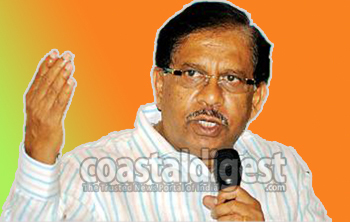
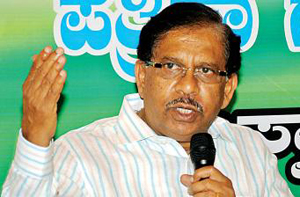
Udupi, Jul 9: Bharatiya Janata Party and its allies are fully responsible for communal tensions in Dakshina Kannada, and not the police, according to G Parameshwara, the president of Karnataka Pradesh Congress Committee.param4param3

Responding to presspersons on the situation in Kalladka and other parts of Dakshina Kannada, after visiting the Sri Krishna Mutt/Temple here, Mr Parameshwara said there was no failure on part of the police in Kalladka.

“I regret to say that the BJP leaders and workers are provoking communal passions in Dakshina Kannada. Owing to this, people are losing their lives. Even the Pejawar seer had held iftar to promote harmony and peace among communities. The BJP is doing this with an eye on elections,” he said.

To a query, he said some forces were trying to create confusion in the society over the iftar organised by the Pejawar seer. “We welcome the seer’s move; my party wants harmony and peace in the society,” he said. On the recent visits of former Chief Minister and BJP leader B.S. Yeddyurappa to Dalit colonies in the State, Mr. Parameshwara said that it was all a “drama”.

“If Mr Yeddyurappa was really bothered about the Dalits, he should have tried to do something for them when he was in power. Everyone knows that it being done for political gains,” he said.

Comments

SYED
 - 
Monday, 10 Jul 2017

Alhamdulillah. Good work done By team HIDAYA Foundation, and special thanks to Mr. ASIF Deals for his wonderful effort.

Naser
 - 
Monday, 10 Jul 2017

Its pathetic that those who never did any thing for the freedom struggle but supported British against Independence to our land are now ruling our country.

Add new comment

  • Coastaldigest.com reserves the right to delete or block any comments.
  • Coastaldigset.com is not responsible for its readers’ comments.
  • Comments that are abusive, incendiary or irrelevant are strictly prohibited.
  • Please use a genuine email ID and provide your name to avoid reject.
News Network
June 26,2020

Bengaluru, Jun 26: The National Restaurant Association of India (NRAI) on Thursday came up with a Standard Operating Procedure (SOP) for restaurants whereby among other physical distancing norms, it has suggested a 2-metre gap between tables.

Formulated in partnership with Releski, a Bengaluru based skill-tech company, the SoP suggests that in case of back-to-back seating, people sitting with their backs towards each other will have their seats divided by 'Plexiglass' divider raised up to 2 meters from the ground.

"In a typical restaurant, the improvised seating plan should have a minimum distance of 2 metres between tables. The distance of 2 metres (6 feet) between tables should measure from one edge of the table to the other table's edge," it said.

In case of loose or free seating such as in banquet style or food court style seating, a minimum 2 meters of distance should be maintained between tables.

The guidelines noted that, to encourage physical distancing, restaurants have to sacrifice their seating capacity, to promote health and safety, and also to gain trust from their patrons.

"In order to perform this, divide your restaurants under different sectors. Pull out your restaurant's floor plan and colour code different sections red and yellow. Red sections are potential areas where maximum footfall or traffic is observed. Yellow sections are areas where the footfalls are average," it said.

All the red sections are encircled or bordered by placing barricades or Q manager and will open at specific points to access the yellow section and all the opening points will have hand sanitisers and sprays, and every guest who walks from red zones to yellow zones will sanitise himself/herself to reduce the chances of contamination.

For air conditioning, the guidelines of CPWD shall be followed which inter alia emphasises that the temperature setting of all air conditioning devices should be in the range of 24-30 degree Celsius, relative humidity should be in the range of 40- 65 per cent, intake of fresh air should be as much as possible and cross ventilation should be adequate, the guidelines suggested.

The industry body has also suggested appointment of a COVID-free Ambassador who would operate as the Chief Health Officer within the restaurant team, preferably from the management team in each shift.

The ambassador's would put the new daily work routines into practice, to monitor compliance with good practice and to lead the preventative measures, adapt to health & safety recommendations and requirements of the restaurant and oversee the implementation of the norms.

Anurag Katriar, President of NRAI and CEO & Executive Director of deGustibus Hospitality, said: "Every restaurant cutting across formats is facing the harsh reality of subdued to shut business volumes in the present and the uncertainty of business environment in the future. One thing is certain that hygiene and safety will be a key differentiator in the post-pandemic restaurant operations."


Comments

Add new comment

  • Coastaldigest.com reserves the right to delete or block any comments.
  • Coastaldigset.com is not responsible for its readers’ comments.
  • Comments that are abusive, incendiary or irrelevant are strictly prohibited.
  • Please use a genuine email ID and provide your name to avoid reject.
News Network
May 15,2020

Marriages will have to shed decadence as the state government, in an advisory, has restricted the number of guests to 50 and barred consumption of liquor at such events. 

The advisory was issued in anticipation that the COVID-19 lockdown will be eased in a phased manner. 

The advisory, issued by the Department of Health & Family Welfare, states that events can be held in a “suitable public place with good natural ventilation (no air condition).”

For latest updates on coronavirus outbreak, click here
All guests must have the Arogya Setu app on their phones and the contact details all marriage attendees should be maintained. 

No person from a containment zone will be allowed to attend the event, and persons aged above 65 years, pregnant women and children below 10 years are not permitted. 

Sanitizers are to be provided at the entry and at “appropriate” places. Thermal screening is a must at the entry point of the venue. The scanner should be held 3-15 cm away from a person’s forehead. “Anyone found having a fever (37.5 degree centigrade or 99.5 farenheit), cold, cough, difficulty in breathing shall not be permitted to attend the event and immediately referred to seek medical advice,” the advisory said. 

Besides prohibition on consumption of alcohol, the advisory said paan, gutka and tobacco will not be allowed. 

Face masks are compulsory and all persons should maintain a physical distance of more than one metre. The venue shall be clean and hygienic, with a prohibition on spitting in public places.

A nodal person should be identified to oversee the arrangements, the advisory said.

Comments

Add new comment

  • Coastaldigest.com reserves the right to delete or block any comments.
  • Coastaldigset.com is not responsible for its readers’ comments.
  • Comments that are abusive, incendiary or irrelevant are strictly prohibited.
  • Please use a genuine email ID and provide your name to avoid reject.
coastaldigest.com news network
May 28,2020

Bengaluru, May 28: The Karnataka government has done away with previously mandatory COVID-19 testing for asymptomatic international travellers. 

The development comes a day after the government issued a circular, which allowed placing of international travellers into home quarantine if they had completed seven days of institutional quarantine.

A circular signed by Jawaid Akhtar, Additional Chief Secretary to the State Government, dated May 27, says that any “person who has completed seven days of institutional quarantine and is asymptomatic can be permitted for home quarantine with a COVID-19 test (RT-PCR), subject to undergoing a medical check-up.”

This check-up equates to thermal screening (with a required temperature of under 37.5C or 99.5F and pulse oximetry of under 94%). 

The circular added that all elderly people, over the age of 60, and those with comorbidities (such as Diabetes mellitus, hypertension, asthma, heart ailment, renal disease...etc) are “required to be clinically evaluated diligently prior to shifting them for quarantine.”

On Wednesday, Pankaj Pandey, Commissioner, the Department of Health and Family Welfare said that these new guidelines were based on recommendations from the COVID Task Force. A member of the COVID Task Force said that new strategies had been formulated based on the latest findings on how the SARS-Cov-2 virus affects people.

Comments

Add new comment

  • Coastaldigest.com reserves the right to delete or block any comments.
  • Coastaldigset.com is not responsible for its readers’ comments.
  • Comments that are abusive, incendiary or irrelevant are strictly prohibited.
  • Please use a genuine email ID and provide your name to avoid reject.