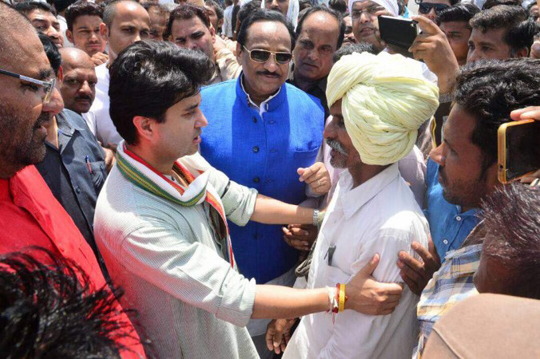
Cong leader Jyotiraditya Scindia arrested on way to meet farmers

Agencies
June 13, 2017

New Delhi, Jun 13: Congress leader Jyotiraditya Scindia on Tuesday was arrested before he reached Mandsaur in Madhya Pradesh, the epicentre of farmers’ agitation after state police imposed section 144 in the region which prohibits more than four people from gathering.

scindia

Scindia was arrested under section 151. Talking to media, before his arrest, Scindia has said he would go alone in Mandsaur as section 144 doesn’t prohibit a single person’s movement. “144 laga hai to maine police ko kaha hai mai akele jaunga. Kaun rok sakta hai agar ek insaan akele jana chahta hai ? (Section 144 has been imposed and, therefore, I told police that I would go alone. Let’s see who stops if someone plans to go alone?), Scindia was quoted as saying by ANI.

Scindia, the Congress’ chief whip in Lok Sabha, was stopped from entering into Mandsaur along with his supporters at Dhodar. He had said that he wanted to meet the family members of the five persons who were killed in police firing during farmers’ agitation last week.

Earlier, a party spokesman had said that the Congress leader would sit on a 72-hour-long ‘satyagraha’ from June 14 in Bhopal to protest against the “anti-farmer policies” of the BJP government in MP.

Madhya Pradesh farmers have been protesting since June 1, demanding loan waiver and better prices for their produce. The situation spiralled out of control as agitating protesters looted and set ablaze properties in several districts.

In the wake of protests, Chief Minister Shivraj Singh Chouhan had observed an indefinite fast in an attempt to calm down the rising tempers. However, he ended his fast on Sunday claiming that peace has returned to the state.

Comments

Add new comment

  • Coastaldigest.com reserves the right to delete or block any comments.
  • Coastaldigset.com is not responsible for its readers’ comments.
  • Comments that are abusive, incendiary or irrelevant are strictly prohibited.
  • Please use a genuine email ID and provide your name to avoid reject.
News Network
January 31,2020

New Delhi, Jan 31: Substantial competition and low tariff rates by telecom operators since 2016 have led to a financial stress in the sector, the Economic Survey said on Friday.

The data price in the country came down by over 99 per cent during 2016-2019, making it among the lowest tariff in the world, according to the survey.

"Since 2016, the sector has witnessed substantial competition and price cutting by the telecom service providers (TSPs), creating financial stress in the sector. As a result, the sector is experiencing consolidation. While some operators have filed for bankruptcy, others have merged, in their quest to improve viability," the survey report said.

In April-June 2019, the price of data was Rs 7.7 per gigabyte (GB) as compared to Rs 200 per GB in June 2016, it added.

"The Average Revenue Per User (ARPU) for GSM based mobile services has also gone down substantially from Rs 126 in June 2016 to Rs 74.30 in June 2019," the survey said.

The tariff war started in the market with entry of new telecom operator Reliance Jio in September 2016.

"BSNL and MTNL are also affected by the tariff war that has impacted their cash flow resulting in mounting losses," the survey said.

The financial health of the public sector telecom firms plummeted to a level where they have been finding hard to pay employees salaries in time.

The government has drawn up a plan to revive these PSUs which is still in works.

The revival plan consists of several measures, including reduction of staff cost through voluntary retirement scheme, allotment of spectrum for 4G services, monetisation of land and building, tower and fibre assets of BSNL and MTNL, debt restructuring through sovereign guarantee bonds and ''in-principle'' approval for merger of BSNL and MTNL.

The survey said that the wireless telephony now constitutes 98.27 per cent of all subscriptions whereas share of landline telephones now stands at only 1.73 per cent where market share is dominated by private sector players.

"The overall tele-density in India stands at 90.45 per cent, the rural tele-density being 57.35 per cent and urban teledensity being 160.71 per cent at the end of September 2019. The private sector dominates with a share of 88.81 per cent (106.06 crore connections) at the end of September, 2019 while the share of public sector was 11.19 per cent (13.36 crore connections)," the survey said.

The lower price of data has also lead in surge of broadband connections and average consumption of the internet.

Total broadband connections increased by about ten times, from 6.1 crore in 2014 to 59.46 crore in June 2019, the survey said.

The number of internet subscribers (both broadband and narrowband put together) stood at 66.53 crore at the end of June 2019 as compared to 25.16 crore in 2014.

The number of mobile internet subscribers was 64.36 lakh at the end of June 2019 while the number of wireline internet subscribers was 2.17 crore.

"India is now the global leader in monthly data consumption, with average consumption per subscriber per month increasing 157 times from 62 MB in 2014 to 9.8 GB in June 2019. The cost of data has also reduced substantially, enabling affordable internet access for millions of citizens," the survey said.

Comments

Add new comment

  • Coastaldigest.com reserves the right to delete or block any comments.
  • Coastaldigset.com is not responsible for its readers’ comments.
  • Comments that are abusive, incendiary or irrelevant are strictly prohibited.
  • Please use a genuine email ID and provide your name to avoid reject.
News Network
July 10,2020

London, Jul 10: India's Reliance will load its first cargo of Venezuelan crude in three months this week in exchange for diesel under a swap deal the parties say is permitted under the US sanctions regime on the Latin American country, according to a Reliance source and a shipping document from state oil firm PDVSA.

Washington has exempted some Venezuelan oil trade from sanctions when transactions are in exchange for fuel and food or to repay debts rather than for cash. But that trade slowed as the US tightened restrictions and refiners, shippers and insurers have been steering clear of Venezuela to avoid any risk they may fall foul of sanctions.

Washington aims to deprive Venezuelan socialist President Nicolas Maduro of his main source of revenue with the sanctions, which have driven Venezuelan oil exports to their lowest level since the 1940s.

Reliance gave the US State Department and the Office of Foreign Assets Control (OFAC) notice of the diesel swap and received word back that the policies that allowed the transaction were still in place, the Reliance source told Reuters.

Reliance has previously said that its supplies of fuel to PDVSA in exchange for crude were permitted under sanctions.

An oil tanker named Commodore would load the cargo of crude in Venezuela and ship it to India, the tanker's manager NGM Energy said.

"All details of the transaction and transportation were shared with US authorities, who confirmed that the U.S. policy authorizing such transactions remained in place," NGM Energy said in a statement to Reuters.

"The shipment is made in connection with the humanitarian exchange of oil for diesel fuel."

The Commodore is loading a 1.9-million barrel cargo of crude for Reliance at Venezuela's main oil port of Jose, according to an internal PDVSA cargo schedule seen by Reuters.

The Liberian-flagged Commodore was at the Jose Terminal on Thursday, ship tracking data on Refinitiv Eikon showed.

The US State Department, Treasury's enforcement arm OFAC, and PDVSA did not immediately respond to a request for comment.

Reliance has a swap deal to provide diesel to Venezuela in exchange for fuel but has not received a cargo of crude since April. Sources at Indian refiners told Reuters earlier this year they planned to wind down their purchases of Venezuelan oil to avoid any problems with supply due to sanctions.

Other long-time customers of PDVSA, including Italy's Eni and Spain's Repsol, have continued taking cargoes of Venezuelan crude this year under permission granted by the US Treasury Department to exchange the oil for diesel supply as part of debt repayment deals, according to sources from the companies.

NGM Energy also manages the Voyager I tanker, which the United States removed from its list of sanctioned vessels last week after NGM and the ship's owner Sanibel Shiptrade said they would increase measures to ensure vessels complied with international sanctions.

"Last month, NGM Energy SA adopted a firm policy of not allowing vessels under its commercial management to trade to Venezuela, or to carry Venezuelan petroleum cargoes, absent US government authorization," NGM said.

"NGM continues to stand by that pledge."

Comments

Add new comment

  • Coastaldigest.com reserves the right to delete or block any comments.
  • Coastaldigset.com is not responsible for its readers’ comments.
  • Comments that are abusive, incendiary or irrelevant are strictly prohibited.
  • Please use a genuine email ID and provide your name to avoid reject.
News Network
January 24,2020

Jan 24: India’s economy appears to be shaking off a slump, as activity in the services and manufacturing sectors expanded for a second straight month in December.

The needle on a gauge measuring so-called animal spirits signaled the economy may be taking a turn for the better, as five of the eight high-frequency indicators tracked by Bloomberg News came in stronger last month. The dial was last at the current position in August.

“Animal spirits” is a term coined by British economist John Maynard Keynes to refer to investors’ confidence in taking action, and the gauge uses the three-month weighted average to smooth out volatility in the single-month numbers.

The nascent recovery would need a helping hand, with expectations building that Finance Minister Nirmala Sitharaman will provide some stimulus when she presents the budget Feb. 1. Official forecasts show the economy is set to expand at 5% in the year ending March 2020 -- the weakest pace in more than a decade.

Here are the details of the dashboard:

Business Activity

The dominant services index rose to the highest level in five months in December as improving new work orders helped boost activity. The seasonally adjusted Markit India Services PMI index climbed to 53.3 from 52.7 in November, helping post a strong end to the calendar year.

India’s manufacturing PMI also rose -- to 52.7 from 51.2 a month ago -- boosted by the fastest increase in new orders since July. A reading above 50 means expansion while anything below that signals contraction.

The uptick in business confidence was accompanied by a rise in inflationary pressures, the survey showed. That trend may keep monetary policy makers from resuming interest-rate cuts anytime soon, leaving most of the heavy-lifting to boost growth with the government.

“The relative stability in macro indicators over the past two months suggests that the worst is behind, but the recovery is likely to be prolonged,” said Teresa John, an economist at Nirmal Bang Equities Pvt. in Mumbai. “Still, sluggish growth and rising inflation indicate that India may well remain in stagflation for most of 2020.”

Exports

Exports remained a laggard, falling 1.8% in December from a year ago. The drag was mainly because of a fall in export of engineering goods, which constitute a third of India’s non-oil exports.

Capital goods imports continued to contract and was lower by 16.5% year-on-year in December after a 22% drop in November. This was the seventh consecutive month of continuous decline, underscoring the weakness in the capex cycle, according to IDFC First Bank.

Consumer Activity

Weakness in demand for passenger vehicles persisted, with local sales falling 1.2% in December from a year ago, according to the Society of Indian Automobile Manufacturers. That capped the worst yearly passenger vehicle sales on record. A Nielsen study on demand for fast-moving consumer goods showed volume growth dropped to 3.5% in the last quarter of 2019 from 3.9% in the same period of 2018.

Funding conditions held out hope, showing considerable improvement in December, according to the Citi India Financial Conditions Index. Credit growth remained tardy though, with demand for loans rising at a slower 7.1% pace from a year ago compared with a nearly 8% growth in November.

Industrial Activity

Industrial output rose for the first time in four months in November. The pick up was broad-based, led by mining, manufacturing and electricity. Mining and manufacturing, in particular, posted a second month of sequential growth. Production of consumer goods also rose after a few months of contraction.

The index of eight core infrastructure industries, which feeds into the index of industrial production, however, declined 1.5% in November from a year ago -- the fourth straight month of contraction. That was on account of shrinking production of electricity, steel, coal, natural gas and crude oil. Both the core sector and industrial output numbers are reported with a one-month lag.


Comments

Add new comment

  • Coastaldigest.com reserves the right to delete or block any comments.
  • Coastaldigset.com is not responsible for its readers’ comments.
  • Comments that are abusive, incendiary or irrelevant are strictly prohibited.
  • Please use a genuine email ID and provide your name to avoid reject.