Congress concentrated only on work, no marketing; BJP doing only marketing'

[email protected] (CD Network)
July 16, 2016

Mangaluru, Jul 16: Senior Congress leader Mallikarjun Kharge said the party has failed completely in marketing the achievements of the UPA government.

congress 11

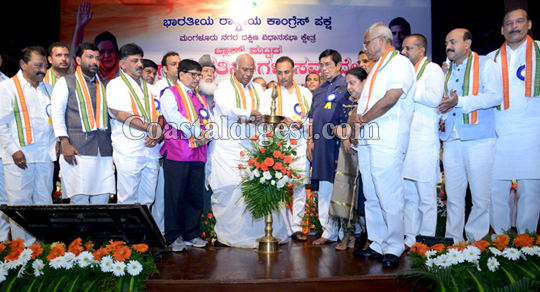
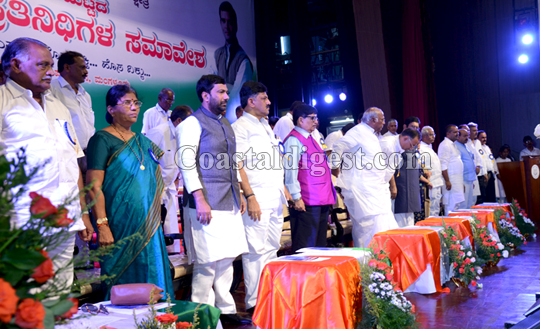
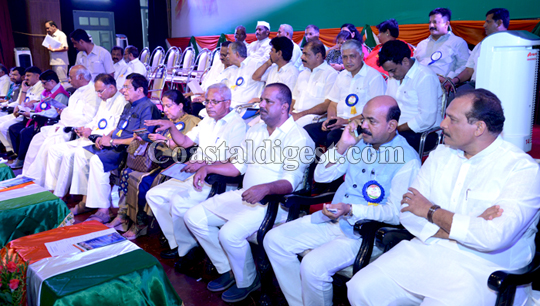
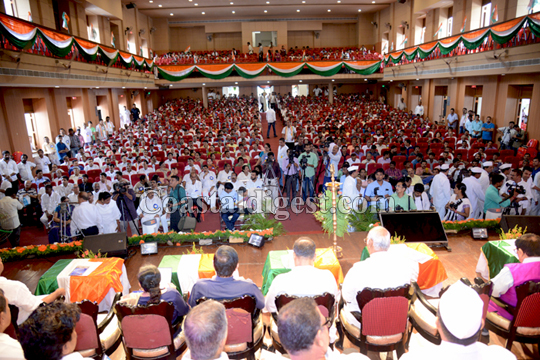
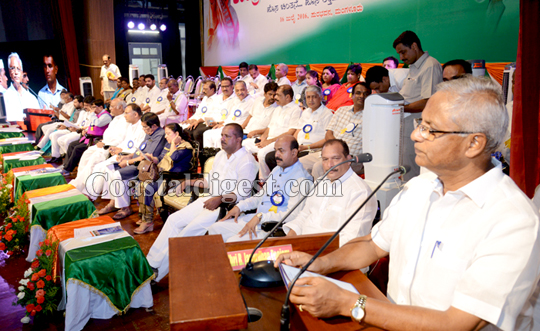
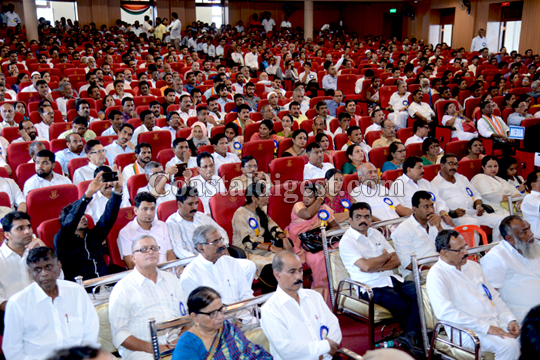
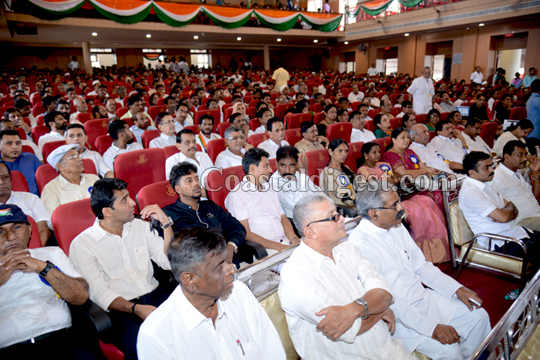
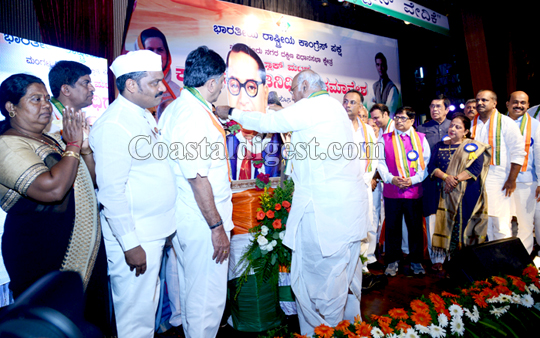
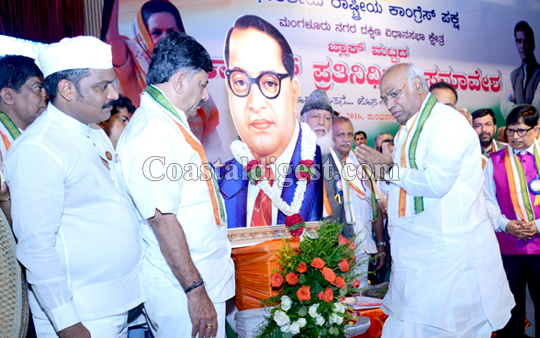
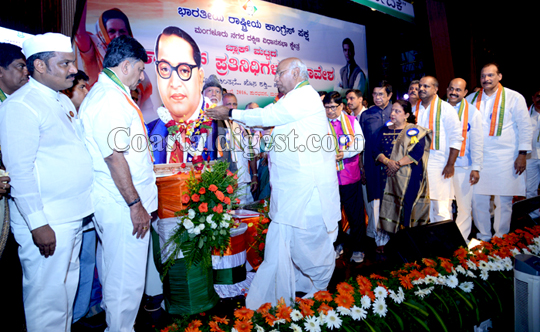
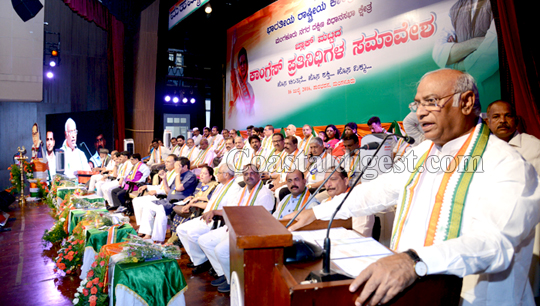
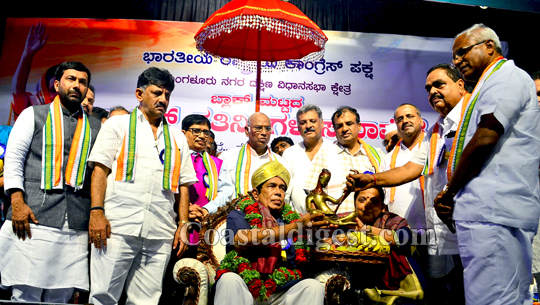
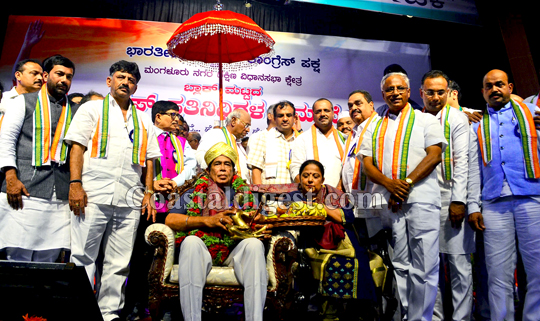
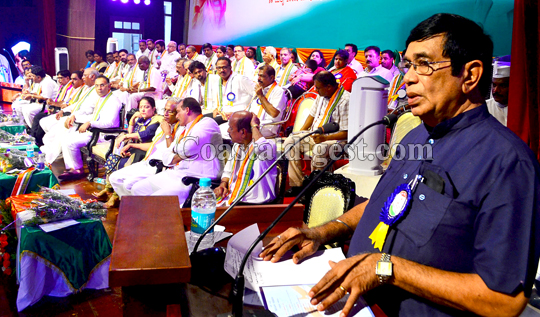
Inaugurating the party convention and Ambedkar Jayanthyutsava organized by Mangaluru South Block Congress Committee here on Saturday, Kharge said that Congress concentrated only on work and silently fulfilling promises whereas BJP concentrated only on marketing.

"We are lagging behind in marketing our party's achievements,” he lamented.

“The Congress has made several noteworthy contributions and led the nation towards development. It is the Congress that is instrumental in development of ports, airports, highways, bridges in the nation. The Congress government introduced several pro-people rules like Food Security Act, MGNREG Act, RTE Act and several other similar initiatives like Mangalyaan, but we have failed to market our achievements in a proper way. Ironically, the BJP does more marketing than the actual progress they record," Kharge said and called upon party workers to join hands in the process of building party at grass root levels.

"RSS, BJP and Sangh Parivar leaders, who never lit lamp during Ambedkar Jayanti and those who do not hoist tricolor, are teaching patriotism to Congress. Modi and the BJP leaders make a loud clamour that Congress destroyed the nation in the past. However, they are shamelessly claiming the credit of development works initiated by the UPA government by just cutting ribbon tapes now," Kharge charged.

Taking a dig at the BJP's pre-election promises, Kharge said, neither black money stashed in Swiss banks has been brought back, nor employment has been provided to unemployed youth.

Hitting at the Prime Minister's frequent foreign tours, Kharge said, "Modi visits foreign countries even without invitation even though we have an external affairs minister. Prime Minister of a nation should visit foreign countries only in case of very important conclaves. Investors will come to India if our foreign policy is attractive," he added.

Kharge said the Karnataka Prevention and Eradication of Human Sacrifice and Other Inhuman Evil and Aghori Practices and Black Magic Bill, 2016 should be passed as a dedication to B R Ambedkar on the occasion of his 125th birth anniversary. "Passing Anti-superstition Bill will be a true tribute to the architect of Indian Constitution. I am sure that BJP leader Jagadish Shettar and JD(S) leader HD Kumaraswamy, who believe in Basavanna's ideology, will not oppose the passage of the bill," Kharge said.

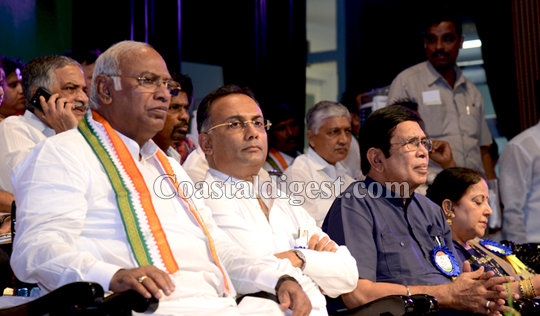
Senior Congress leader Oscar Fernandes, AICC in-charge secretary Shantharam Naik, energy minister DK Shivakumar, food and civil supplies minister UT Khader, KPCC working president Dinesh Gundu Rao and other leaders were present. Mangaluru City South MLA JR Lobo presided.

congress 1

congress 2

congress 3

congress 4

congress 5

congress 6

congress 7

congress 8

congress 9

congress 10

congress 12

cong 1

cong 2

cong 3

Comments

Zahoor Ahmed
 - 
Sunday, 17 Jul 2016

Where are BJP and RR. Oscar birth or wedding anniversary ?

Add new comment

  • Coastaldigest.com reserves the right to delete or block any comments.
  • Coastaldigset.com is not responsible for its readers’ comments.
  • Comments that are abusive, incendiary or irrelevant are strictly prohibited.
  • Please use a genuine email ID and provide your name to avoid reject.
Agencies
January 1,2020

For many Indian tycoons, 2019 turned woeful as lenders -- empowered by the nation’s recent bankruptcy law and desperate to clean up soured debt from their books -- started seizing assets of delinquent firms or dragged them into insolvency.

Indian banks wrote off a record $39 billion of loans in the 18 months through September in a bid to repair their balance sheets as they battled the world’s worst bad debt pile. Making matters worse, a shadow banking crisis led to a funding squeeze, crushing debt-laden businesses that were critically dependent on rollover financing.

“Life has come a full circle for tycoons that had enjoyed debt-fueled growth,” said Nirmal Gangwal, founder of distress and debt restructuring advisory firm Brescon & Allied Partners LLP. “Many firms collapsed like a house of cards. The downfall was rather unprecedented.”
The government has also been cracking down on economic crime to assuage public anger over absconding businessmen. It’s even barred some from traveling overseas if they were deemed a flight risk.

Here are some of the country’s biggest and most-storied businessmen who saw their fortunes fade. Spokespersons for none of these tycoons, except Essar, immediately replied to emails and text messages seeking comments.

Anil Ambani

The chairman of Reliance Group, which makes movies to metro lines, had a close shave with jail time in March before his elder brother and Asia’s richest man, Mukesh Ambani, bailed him out at the last minute. The woes of the ex-billionaire came to the fore when India’s top court asked him to pay Ericsson AB’s India unit about $77 million of past dues or go to jail since Anil Ambani, 60, had given a personal guarantee. His telecom carrier slipped into insolvency this year, while unprofitable Reliance Naval & Engineering Ltd. faced a cash crunch. Reliance Capital Ltd. is selling assets to pare debt. Ambani is also fending off Chinese lenders in a London court.

Malvinder & Shivinder Singh

Karma caught up with ex-billionaires and brothers Malvinder Singh, 47, and Shivinder Singh, 44, and how. Scions of a prominent business family, they once helmed India’s top drug maker and second-largest hospital chain. In October, the two were arrested on charges of fraudulently diverting nearly $337 million from a lender they controlled. India’s market regulator found in 2018 that the brothers had defrauded their hospital company of about $56 million. The collapse of the $2 billion empire turned brother against brother, prompting their mother to broker a peace deal that was short-lived. In February, Malvinder accused Shivinder and their spiritual guru of fraud.

Shashikant & Ravikant Ruia

After a hard-fought battle to keep their flagship steel mill, the first-generation entrepreneurs finally saw the bankrupt Essar Steel India Ltd. pass on to ArcelorMittal last month. The $5.9 billion takeover was almost two years in the making with multiple legal wrangles. The group, controlled by Shashikant Ruia, 76, and Ravikant Ruia, 70, were also reprimanded by a U.K. judge in March this year for concealing documents. Started in 1969 as a construction firm, Essar Group diversified, investing about $18 billion between 2008 and 2012, and piled on debt. In 2017, the group had sold another prized asset, Essar Oil.

Selling an asset to pare a liability shouldn’t be seen as a “lost asset,” an Essar spokesman said, adding that the group remains a diversified conglomerate.

VG Siddhartha

Before jumping off a bridge into a river in July in an apparent suicide, the founder of India’s biggest coffee chain Cafe Coffee Day had penned a letter that spoke of pressure from lenders, a private equity firm and harassment by tax officials. He had spent much of the last two years pledging ever more of Coffee Day Enterprises Ltd. shares to refinance loans for ever shorter periods, at ever higher interest rates. “I would like to say I gave it my all,” V.G. Siddhartha, 60, wrote in the letter. “I fought for a long time but today I gave up.”

Naresh Goyal

The former ticketing agent who built India’s largest airline by value, stepped down as chairman of Jet Airways India Ltd. in March, caving in to pressure from banks who took over the company. Cut-throat price wars and surging costs pushed Jet deeper into loss. The airline stopped flying in April and went into bankruptcy two months later as lenders failed to find a buyer. In July, an Indian court barred Naresh Goyal from flying overseas after the government said it was investigating an alleged $2.6 billion fraud involving Jet Airways.

Rana Kapoor

The founder of Yes Bank Ltd., which became India’s fourth-largest non-state lender, tweeted in September 2018 that his shares were invaluable and requested his children never to sell them upon inheritance. But trouble was brewing. The nation’s banking regulator, which found the lender had repeatedly under-reported its bad loans, refused to extend his tenure as chief executive officer. This forced Rana Kapoor, 62, to step down by end-January. Kapoor, who has pledged some of his Yes Bank shares in July, sold almost his entire stake in the lender by October.

Subhash Chandra

The rice trader-turned-media mogul, 69, who brought cable television into Indian homes in the early 1990s with his ZEE TV, resigned as chairman of Zee Entertainment Enterprises Ltd. in November and lost control of his crown jewel. Subhash Chandra has been selling stake in Zee Entertainment in the past few months to repay group’s debt.

Gautam Thapar

A default by Gautam Thapar, founder of the paper mill-to-power transmission Avantha Group, on pledged shares made Yes Bank Ltd. the biggest shareholder in CG Power and Industrial Solutions Ltd. In August, the firm was hit by an accounting scandal forcing the board to remove Thapar, 59, from the chairman’s post. A month later, the market regulator ordered a forensic audit of the firm and barred Thapar from accessing securities market.


Comments

Add new comment

  • Coastaldigest.com reserves the right to delete or block any comments.
  • Coastaldigset.com is not responsible for its readers’ comments.
  • Comments that are abusive, incendiary or irrelevant are strictly prohibited.
  • Please use a genuine email ID and provide your name to avoid reject.
News Network
June 22,2020

Bengaluru, Jun 22: Senior Congress leader BK Hariprasad and BJP’s MTB Nagaraj, one of the defectors who helped the saffron party come to power in Karnataka, were unanimously elected to the Legislative Council along with five others on Monday. 

All seven were declared as “duly elected” by Legislative Assembly Secretary MK Vishalakshi, the returning officer for the biennial election to the Legislative Council. 

Hariprasad and Naseer Ahmed of the Congress, Nagaraj, R Shankar, Prathap Simha Nayak and Sunil Vallyapur of the BJP and Govinda Raju of the JD(S) are now MLCs. 

While Ahmed was an incumbent who will get another term, the six others will replace Jayamma, MC Venugopal, NS Bore Raju, HM Revanna and TA Sharavana and DU Mallikarjuna whose term ends June 30. 

While an election was scheduled June 29, it was not necessary as only seven candidates were in the fray for the seven seats on Monday, which was the last date for withdrawal of nominations. The nominations of A Yadavanahalli PC Krishnegowda and Mandikkal Nagaraja were rejected. 

With their rejection as MLCs, Nagaraj and Shankar - who jumped ship to the BJP last year - will now look to become ministers in Chief Minister BS Yediyurappa’s Cabinet. Both Nagaraj and Shankar were ministers when they resigned and defected from the Congress-JD(S) coalition. While Nagaraj lost the December 2019 bypolls, Shankar did not contest. 

Nagaraj, Shankar and Vallyapure were Yediyurappa’s picks for the Council, whereas Nayak is said to have been backed by BJP state president Nalin Kumar Kateel. 

There were many aspirants in the Congress for the Council berths, but Hariprasad and Ahmed were picked, given their experience. Hariprasad is widely believed to counter Siddaramaiah, who leads the party in the Assembly. 

Raju of the JD(S) runs a poultry business in Kolar and the choice of a fresh face is seen as the party leadership steering clear of any trouble as there were many asking for the ticket. 

Comments

Add new comment

  • Coastaldigest.com reserves the right to delete or block any comments.
  • Coastaldigset.com is not responsible for its readers’ comments.
  • Comments that are abusive, incendiary or irrelevant are strictly prohibited.
  • Please use a genuine email ID and provide your name to avoid reject.
Media Release
February 14,2020

Veteran journalist P. Sainath has said that the nation is in a crisis. And this crisis is not limited to just the rural area. It has become a national crisis at various areas such as agriculture, education, economy, job creation etc.

He was delivering the endowment lecture on the topic ‘Indian democracy at the post-liberalization and post-truth era’ at Media Manthan 2020 organized by the PG department of journalism and mass communication at St Aloysius College (Autonomous). 

Mr Sainath said that the many policies adopted in the 90s led to India becoming unusually unequal. Referring to the speech Ambedkar had made at the Constituent Assembly while handing over the draft of the Constitution, Mr Sainath said, “Ambedkar had warned about the weakness of Indian democracy that liberty without equality allows the supremacy of a few over the multitude. Liberty, equality and fraternity must be kept together as we cannot have one without the other.” 

Mr Sainath stated that the agrarian crisis was no longer about the loss of productivity, employment or about farmer suicide; it was a societal, civilizational crisis. Commenting on the lopsided policies such as cow-slaughter ban, he explained how cow slaughter ban had adversely affected many industries due to their interdependency. While Muslims who slaughtered cows were rendered helpless, the cattle traders who were mostly OBCs lost their earnings as the cattle prices crashed. An important industry like Kolhapur sandals industry in Maharashtra went bankrupt as a result of the cow slaughter ban in Maharashtra. He said the policymakers had no idea how the rural industries were interconnected. Demonetisation too devastated the rural economy as 98 percent of rural transactions happen through cash. 

Mr Sainath also spoke about the crisis of inequality which affects the Dalits and the Adivasis far more than anyone else as 90 percent of the rural households take home less than Rs 10,000/- per month. “Women are yet another group whose labour is never counted in the gross domestic product. Women and girls globally do unpaid work which amounts to about 12.5 billion working hours per year. Monetarily speaking, this is worth 10.8 trillion dollars,” Mr Sainath added. 

Speaking about the crisis of jobs Mr Sainath said that major companies were laying off employees just to create more profits for the investors and the adoption of artificial intelligence in the industry would further destroy millions of jobs.

Rector of St Aloysius College Institutions Fr Dionysius Vaz SJ, Principal Dr (Fr) Praveen Martis SJ, HOD of Journalism and Mass Communication department Dr (Fr) Melwyn Pinto SJ were present.

‘Veerappan and Vijay Mallya’s business models are interesting!’

Addressing the gathering during his endowment lecture on Friday, Mr Sainath made an interesting comment on the so called ‘revenue model’. “Whenever I visit IIMs and IITs for lectures on my PARI project, the students there ask me what my revenue model for my project is. I tell them that I do not have a revenue model. In fact, journalism does not begin with a revenue model. Gandhiji, Ambedkar, Bhagat Singh were all great journalists. But they did not have a revenue model,” Mr Sainath said.

On a lighter note, he said that the best revenue model that he liked was that of forest brigand Veerappan and liquor baron Vijay Mallya. “Veerappan ruled the forest for forty years and from the top ministers to the villagers he could dictate terms and liver royally. Similarly, Mallya’s revenue model was to steal the banks and run away abroad and live like a king,” Mr Sainath added.

Journalism is not and can never be a business. It is a calling, he opined. While newspaper can be a business, television can be a business, journalism per se cannot be reduced to a business. “Unfortunately today, journalists are recruited on a contract basis and they have no bargaining power; and there are no unions to fight for their cause. Hence, they are at the mercy of the corporate media houses for their survival and are made to write stories that cannot be called journalism,” Mr Sainath said.

Answering a question as to the pressures he faced as a journalist, he said that external pressures from the government or others could be very well handled. It is the internal pressures from once own media house that journalists find it difficult to manage.


Comments

Add new comment

  • Coastaldigest.com reserves the right to delete or block any comments.
  • Coastaldigset.com is not responsible for its readers’ comments.
  • Comments that are abusive, incendiary or irrelevant are strictly prohibited.
  • Please use a genuine email ID and provide your name to avoid reject.