Cops force Muslim woman to remove burqa at Yogi Adityanath's rally

Agencies
November 22, 2017

Ballia, Nov 22: The district administration here has ordered a magisterial probe into the incident of a woman being forced to take off her burqa in public at Uttar Pradesh Chief Minister Yogi Adityanath's rally, officials said today.   

A video showing the woman being made to take off her black burqa minutes before the chief minister makes an appearance at the rally yesterday has gone viral.

"The city magistrate has been asked to conduct an inquiry into it and action will be taken against those found guilty," District Magistrate Surendra Vikram said.

The chief minister was here yesterday to address an election meeting ahead of the local body elections.   

The woman, who identified herself as Saira, later said the women constables on duty asked her to remove the black burqa, the outer robe worn by women in some Islamic traditions, which she did.   

She said she was a BJP worker and had come to the rally from her village wearing her "traditional dress".

The police has also ordered an inquiry.   

Superintendent of Police Anil Kumar said the video footage has been received and a departmental inquiry ordered in this connection.   

"The Deputy SP (City) has been asked to conduct an inquiry in this connection," the SP said.  

"We had instructions that there should be no black flags shown at the rally. I will get this looked into," he said.   

Three days ago, black flags were shown to the chief minister in Meerut, where he had gone to address an election rally. In the scuffle that followed, BJP supporters thrashed a man.

Comments

shaji
 - 
Thursday, 23 Nov 2017

This muslim lady is lucky that Police only asked her to remove burqa and did not force her to wear bhagwa color saree and put tilak on her forehead as per bjp manifesto.   She is also lucky that bjp backed police did not label her to be from Bangladesh.   Shame on you sister for joining anti muslim and anti national Bjp.   They will never accept you as Indian.   Tomorrow they will say that the house you are staying was a mandir and will drag you out of it.

Abu Safwan
 - 
Thursday, 23 Nov 2017

why she removed her burqa?  it is better for her to leave the program instead of  removing burqa.   


She is BJP worker then she can complaint this with her party chiefs to take action on police, otherwise will leave the party.


It is not compulsory for her to attend that meeting.   

sami
 - 
Wednesday, 22 Nov 2017

What a shame, disastrous. so this is what the new India(___ Rashtriya) will be? What do the people want to do with mahatma Gandhi’s version of India? You want to change it to savatkers version? the guy who wrote mercy potions to British , who was against freedom and was aggressively against Indian flag.


Its shame. so book of thoughts (RSS book) is right leave as per yogi’s disturbed mentality’s requirement or give your neck to his sword?


Shame. People have fallen pray to the conspiracy making them feel they are insecure by handful 18% population.


“she is a BJP party worker” 


Add new comment

  • Coastaldigest.com reserves the right to delete or block any comments.
  • Coastaldigset.com is not responsible for its readers’ comments.
  • Comments that are abusive, incendiary or irrelevant are strictly prohibited.
  • Please use a genuine email ID and provide your name to avoid reject.
News Network
January 20,2020

New Delhi, Jan 20: Union Finance Minister Nirmala Sitharaman on Sunday said the kind of cleaning in the system that the BJP-led government had to carry out after coming to power in 2014 was "unbelievable" and it undertook the exercise without any grudge or worry.

Between 2014-16, there were a lot of questions as to why reforms did not come fast and there were comments that the government was incapable of bringing them, she said delivering the Nani Palkhivala Memorial lecture on "Road Map to $5 Trillion Economy" here.

Pointing out that there were allegations and criticism that the government wants to do something but it did not, Sitharaman said, "I am fully willing to buy that." She recalled that Prime Minister Narendra Modi often said he did not believe in incremental changes and the country needed good transformational change. The stage in which India is today, it cannot have little marginal increments, but good transformational change.

"But still one might say in the last five years the government never did. That can be a critical analysis and I am fully willing to buy that. Because post-2014 the kind of cleaning up the government had to do was unbelievable and we undertook that exercise without a grudge without a worry.. we had to do it and it is part of the game," she said. Elaborating, Sitharaman said states have their own views on Land Acquisition Bill and the government could not have done anything because land, after all, is with them.

Commenting on the topic 'Road Map to $5 trillion economy,' she said quoting Prime Minister Narendra Modi's comments, the government would take the route "Sarkar ka abhaav nahi hona chahiye, prabhaav hona chahiye aur dabaav nahi hona chahiye."

"Abhaav and dabaav both of which are not desirable, abhaav is the inadequacy or lack of adequate presence or shortfall. You do not need a shortfall. You need a government where it should be present, where it is expected to function.", she said.

"So there should not be abhaav. Dabaav (meaning pressure) is not something you want from the government. So, you want Prabhaav. It is broadly an influence, facilitation, broadly the philosophy with which it is mandated, she said.

Noting that the government has got the mandate through the election, she said, "The mandate was spelt out in so many different ways in its manifesto. So the route towards $5 trillion is this."

"We have to be there to facilitate. We have to be there to make it easy. We have to be where you need us, where there is no policy (reforms from the government)," she said.

On the Insolvency and Bankruptcy Code (IBC) implemented by the government, the union minister said the approach of the IBC was not to shut business. "IBC takes on the approach in having some kind of resolution where all people who exploited the company do not come back through the "back door," she said.

IBC was done through better management so that the institution is alive and kicking. It is something which she wanted to carry forward from Modi 1.0 to 2.0. "The point I am trying to make on this road to $5 trillion economy is that it is not just an abstraction, this is not how I want India to be. But in micro-level too, we are coming in response to every stakeholder," she said.

Comments

Well Wisher
 - 
Tuesday, 21 Jan 2020

LOL. Do not say anything, else she will get angry.

Add new comment

  • Coastaldigest.com reserves the right to delete or block any comments.
  • Coastaldigset.com is not responsible for its readers’ comments.
  • Comments that are abusive, incendiary or irrelevant are strictly prohibited.
  • Please use a genuine email ID and provide your name to avoid reject.
Agencies
July 29,2020

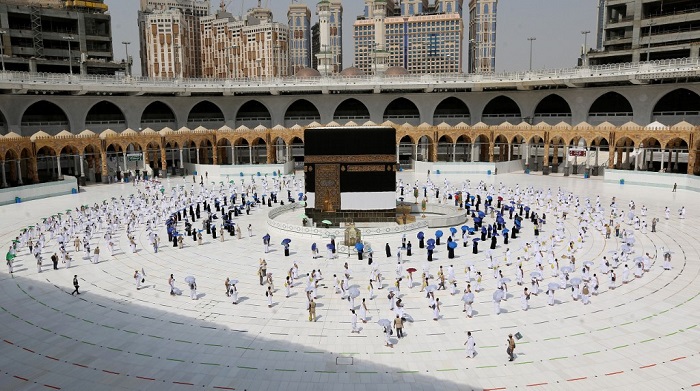
Dubai, Jul 29: Muslim pilgrims on Wednesday begin the annual Haj, downsized this year as the Saudi hosts strive to prevent a coronavirus outbreak during the five-day pilgrimage.

The Haj, one of the five pillars of Islam and a must for able-bodied Muslims at least once in their lifetime, is usually one of the world's largest religious gatherings.

But this year only up to 10,000 people already residing in the Kingdom will participate in the ritual, a tiny fraction of the 2.5 million pilgrims from around the world that attended last year.

"There are no security-related concerns in this pilgrimage, but (downsizing) is to protect pilgrims from the danger of the pandemic," said Khalid bin Qarar Al Harbi, Saudi Arabia's director of public security.

Pilgrims will be required to wear masks and observe social distancing during a series of religious rites that are completed over five days in the holy city of Makkah and its surroundings in western Saudi Arabia.

Those selected to take part in the Haj were subject to temperature checks and placed in quarantine as they began trickling into Makkah at the weekend.

State media showed health workers sanitising their luggage, and some pilgrims reported being given electronic wristbands to allow authorities to monitor their whereabouts.

Workers, clutching brooms and disinfectant, were seen cleaning the area around the Kaaba, the structure at the centre of the Grand Mosque draped in gold-embroidered cloth towards which Muslims around the world pray.

Haj authorities have cordoned off the Holy Kaaba this year, saying pilgrims will not be allowed to touch it, to limit the chances of infection.

They also reported setting up multiple health facilities, mobile clinics and ambulances to cater to the pilgrims.

Saudi authorities said only around 1,000 pilgrims residing in the Kingdom would be permitted for the Haj. Some 70 per cent of the pilgrims are foreigners residing in the Kingdom, while the rest will be Saudi citizens, authorities said.

All worshippers were required to be tested for coronavirus before arriving in the holy city of Makkah and will also have to quarantine after the pilgrimage as the number of cases in the Kingdom nears 270,000.

They were given elaborate amenity kits that include sterilised pebbles for a stoning ritual, disinfectants, masks, a prayer rug and the Ihram, a seamless white garment worn by pilgrims, according to a Haj ministry programme document.

"I did not expect, among millions of Muslims, to be blessed with approval," Emirati pilgrim Abdullah Al Kathiri said in a video released by the Saudi media ministry.

"It is an indescribable feeling... especially since it is my first pilgrimage."

The Haj ministry said non-Saudi residents of the Kingdom from around 160 countries competed in the online selection process but it did not say how many people applied.

Despite the pandemic, many pilgrims consider it safer to participate in this year's ritual without the usual colossal crowds cramming into tiny religious sites, which make it a logistical nightmare and a health hazard.

Comments

Add new comment

  • Coastaldigest.com reserves the right to delete or block any comments.
  • Coastaldigset.com is not responsible for its readers’ comments.
  • Comments that are abusive, incendiary or irrelevant are strictly prohibited.
  • Please use a genuine email ID and provide your name to avoid reject.
News Network
February 2,2020

Feb 2: Prime Minister Narendra Modi’s second budget in seven months disappointed investors who were hoping for big-bang stimulus to revive growth in Asia’s third-largest economy.

The fiscal plan -- delivered by Finance Minister Nirmala Sitharaman on Saturday -- proposed tax cuts for individuals and wider deficit targets but failed to provide specific steps to fix a struggling financial sector, improve infrastructure and create jobs. Stocks slumped as a proposal to scrap the dividend distribution tax for companies failed to impress investors.

"Far from being a game changer, the budget provides little in terms of short-term growth stimulus,” said Priyanka Kishore, head of India and South East Asia economics at Oxford Economics Ltd. in Singapore. “While income tax cuts will provide some relief on the consumption front, the multiplier effect is low and the overall stance of the budget is not expansionary."

India has gone from being the world’s fastest-growing major economy three years ago, expanding at 8%, to posting its weakest performance in more than a decade this fiscal year, estimated at 5%.

While the government has taken a number of steps in recent months to spur growth, they’ve fallen short of spurring demand in the consumption-driven economy. Saturday’s budget just added to the glum sentiment.

Okay Budget

“It’s an okay budget but not firing on all cylinders that the market was hoping for,” said Andrew Holland, chief executive officer at Avendus Capital Alternate Strategies in Mumbai.

The government had limited scope for a large stimulus given a huge shortfall in revenues in the current year. The slippage induced Sitharaman to invoke a never-used provision in fiscal laws, allowing the government to exceed the budget gap by 0.5 percentage points. The result: the deficit for the year ending March was widened to 3.8% of gross domestic product from a planned 3.3%.

On Friday, India’s chief economic adviser Krishnamurthy Subramanian said reviving economic growth was an “urgent priority” and deficit goals could be relaxed to achieve that. The adviser’s Economic Survey estimated growth will rebound to 6%-6.5% in the year starting April.

The fiscal gap will narrow to 3.5% next year, as the government budgeted for gross market borrowing to rise marginally to 7.8 trillion rupees from 7.1 trillion rupees in the current year. A plan to earn 2.1 trillion rupees by selling state-owned assets in the year starting April will also help plug the deficit.

Total spending in the coming fiscal year will increase to 30.4 trillion rupees, representing a 13% increase from the current year’s budget, according to latest data.

Key highlights from the budget:

* Tax on annual income up to 1.25 million rupees pared, with riders

* Dividend distribution tax to be levied on investors, instead of companies

* Farm sector budget raised 28%, transport infrastructure gets 7% more

* Spending on education raised 5%

* Fertilizer subsidy cut 10%

Analysts said the muted spending plan to keep the deficit in check will lead to more downside risks to growth in the coming months.

“It is very doubtful that the increase in expenditure will push demand much,” Chakravarthy Rangarajan, former governor at the Reserve Bank of India told BloombergQuint, adding that achieving next year’s budget deficit goal of 3.5% of GDP was doubtful.

With the government sticking to a conservative fiscal path, the focus will now turn to central bank, which is set to review monetary policy on Feb. 6. Given inflation has surged to a five-year high of 7.35%, the RBI is unlikely to lower interest rates.

What Bloomberg’s Economists Say:

The burden of recovery now falls solely on the Reserve Bank of India. With inflation breaching RBI’s target at present, any rate cuts by the central bank are likely to be delayed and contingent upon inflation falling below the upper end of its 2%-6% target range.

-- Abhishek Gupta, India economist

Governor Shaktikanta Das may instead focus on unconventional policy tools such as the Federal Reserve-style Operation Twist -- buying long-end debt while selling short-tenor bonds -- to keep borrowing costs down.


Comments

Add new comment

  • Coastaldigest.com reserves the right to delete or block any comments.
  • Coastaldigset.com is not responsible for its readers’ comments.
  • Comments that are abusive, incendiary or irrelevant are strictly prohibited.
  • Please use a genuine email ID and provide your name to avoid reject.