


COVID-19 cases surges to 26,917 in India

News Network
April 26, 2020

New Delhi, Apr 26: The total count of coronavirus cases in the country surged to 26,917 on Sunday.

The total COVID-19 cases in the country are inclusive of 5,913 cured and discharged patients, one migrated, and 826 deaths. At present, there are 20,177 active COVID-19 cases in the country.

The Federation of Resident Doctors' Association (FORDA) wrote to the Union Health Minister, Dr Harsh Vardhan, seeking assistance regarding accommodation facilities for resident doctors advised for home quarantine.

In a letter to the Health Minister, the association stated that recently there have been reports of resident doctors from various hospitals who tested positive for COVID-19. As a consequence, their primary contacts who are mostly their colleagues and resident doctors, have been advised to be on home quarantine, the association added.

On the other hand, Maharashtra continues to have the largest number of COVID-19 positive cases at 7,628 . 1,076 persons have been cured in the state while 323 persons have died.

Fresh cases have been reported several states including West Bengal, Maharashtra, Rajasthan and Uttar Pradesh.

The total number of cases in Indore has risen to 1,176, including 57 deaths.

While 133 deaths have been reported from Gujarat where the total number of cases spiked up to 3,071.

Kerala has seen a recovery rate of around 74 per cent as 338 out of the total 457 COVID-19 positive patients recovered in the state with only 4 fatalities.

Delhi has seen 2,625 COVID-19 positive cases and 54 deaths due to the pandemic.

Here's a quick read on the COVID-19 related updates:

1. A five-member Central team visited Telangana Director General of Police (DGP) office here on Sunday, to review the law and order situation in the state and oversee how the state police are ensuring the implementation of the lockdown.

2. Post Graduate Institute of Medical Education and Research (PGIMER) Chandigarh and AIIMS Delhi and Bhopal will study the effectiveness of Mycobacterium w in critical COVID-19 patients.

3. Chandigarh-based Post- Graduate Institute of Medical Education and Research (PGIMER) said that it has assessed the safety of mycobacterial w (Mw), an immunomodulator for leprosy, in four hospitalised patients of COVID-19, and has found no short-term adverse effect.

4. As many as 2,189 cases were lodged and 10,062 people have been arrested so far, for the breach of lockdown norms in Uttarakhand.

5. The Delhi High Court has directed that COVID-19 related tests should be made available to the general public at the lowest cost possible as the country is going through an unprecedented medical crisis affecting public order.

6. Bihar government has ordered two automatic RNA extraction machines, said the Principal Secretary of Health, Sanjay Kumar today.

7. Medical services at Babu Jagjivan Ram Hospital in the Jahangirpuri area have been closed and the hospital is being sanitised after 44 staff members including doctors were tested positive for COVID-19, Delhi Health Department said.

8. In order to support the frontline workers in the fight against COVID-19, Samsung and Google will be offering free phone repairs to health care workers and first responders.

9. Bhopal Division of Indian Railways has converted 74 railways coaches into isolation wards, said Sunil Dhingra, Senior Section Engineer of Bhopal Division.

10. Indian High Commission here on Sunday said two Air India and one Blue Dart flights will send about 78 tonnes of cargo to India as part of the 1 million PPE kits being sourced from Singapore-based company.

Comments

Add new comment

  • Coastaldigest.com reserves the right to delete or block any comments.
  • Coastaldigset.com is not responsible for its readers’ comments.
  • Comments that are abusive, incendiary or irrelevant are strictly prohibited.
  • Please use a genuine email ID and provide your name to avoid reject.
Agencies
August 4,2020

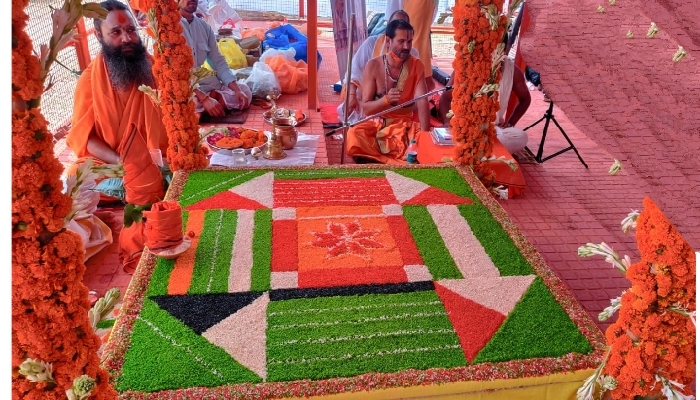
Ayodhya, Aug 4: Ramarchan puja begins at Ram Janmabhoomi site ahead of the foundation laying ceremony of Ram Temple in Ayodhya.
Ramarchan Puja is a prayer to invite all major gods and goddesses ahead of Lord Ram's arrival.

Mahesh Bhagchandka, one of the trustees of Ashok Singhal foundation as Yajman in the puja said, "This is being conducted at the temporary seat of Ramlalla. The pooja will be conducted in four phases."

Speaking about the third and fourth phases, he said: "In the third phase, Dashrath, father of Lord Ram with his wives will be worshipped and then all three brothers of Lord Ram - Laxman, Bharat and Shatrughan with their wives. Lord Hanuman ji will too be worshipped. Whereas in the fourth phase, Lord Ram will be worshipped."
Meanwhile, security has been heightened in Ayodhya ahead of the foundation laying ceremony.

Temples across the city is decorated with lights, diyas and flowers ahead of the grand event. Patna's Mahavir Mandir Trust is preparing over 1.25 lakh 'Raghupati Laddoos' for the occasion. Thes laddoos will be distributed as 'prasad' to devotees.

Uttar Pradesh Chief Minister Yogi Adityanath on Monday offered prayers at the Hanuman Garhi temple during his visit to Ayodhya to take stock of the preparations for the 'bhoomi pujan'.
He along with officials also visited 'Ram ki Paudi' to inspect the arrangements ahead of the foundation stone laying ceremony.

Prime Minister Narendra Modi is scheduled to lay the foundation stone of the Ram Temple in Ayodhya on August 5. 

Comments

Add new comment

  • Coastaldigest.com reserves the right to delete or block any comments.
  • Coastaldigset.com is not responsible for its readers’ comments.
  • Comments that are abusive, incendiary or irrelevant are strictly prohibited.
  • Please use a genuine email ID and provide your name to avoid reject.
Agencies
May 27,2020

New Delhi, May 27: India’s fourth recession since Independence, first since liberalisation, and perhaps the worst to date is here, according to rating agency, Crisil.

CRISIL sees the Indian economy shrinking 5 per cent in fiscal 2021 (on-year), because of the Covid-19 pandemic. The first quarter will suffer a staggering 25 per cent contraction.

About 10 per cent of gross domestic product (GDP) in real terms could be permanently lost. "So going back to the growth rates seen before the pandemic is unlikely in the next three fiscals", Crisil said.

Crisil has revised its earlier forecast downwards. "Earlier, on April 28, we had slashed our prediction to 1.8 per cent growth from 3.5 per cent growth. Things have only gone downhill since", it said.

While we expect non-agricultural GDP to contract 6 per cent, agriculture could cushion the blow by growing at 2.5 per cent.

In the past 69 years, India has seen a recession only thrice as per available data in fiscals 1958, 1966 and 1980. The reason was the same each time a monsoon shock that hit agriculture, then a sizeable part of the economy.

"The recession staring at us today is different," it added. For one, agriculture could soften the blow this time by growing near its trend rate, assuming a normal monsoon. Two, the pandemic-induced lockdowns have affected most non-agriculture sectors. And three, the global disruption has upended whatever opportunities India had on the exports front.

Economic conditions have slid precipitously since the April-end forecast of 1.8 per cent GDP growth for fiscal 2021 (baseline), Crisil said.

On the lockdown extension, it said that the government has extended the lockdown four times to deal with the rising number of cases, curtailing economic activity severely (lockdown 4.0 is ending on May 31).

The first quarter of this fiscal will be the worst affected. June is unlikely to see major relaxations as the Covid-19 affliction curve is yet to flatten in India.

"Not only will the first quarter be a washout for the non-agricultural economy, services such as education, and travel and tourism among others, could continue to see a big hit in the quarters to come. Jobs and incomes will see extended losses as these sectors are large employers," Crisil said.

CRISIL also foresees economic activity in states with high Covid-19 cases to suffer prolonged disruption as restrictions could continue longer.

A rough estimate based on a sample of eight states, which contribute over half of India's GDP, shows that their 'red zones' (as per lockdown 3.0) contributed 42 per cent to the state GDP on average regardless of the share of such red zones.

On average, the orange zones contribute 46 per cent, while the green zones where activity is allowed to be close to normal contribute only 12 per cent to state GDP.

The economic costs are higher than earlier expectations, according to Crisil. The economic costs now beginning to show up in the hard numbers are far worse than initial expectations.

Industrial production for March fell by over 16%. The purchasing managers indices for the manufacturing and services sectors were at 27.4 and 5.4, respectively, in April, implying extraordinary contraction. That compares with 51.8 and 49.3, respectively, in March.

Exports contracted 60.3 per cent in April, and new telecom subscribers declined 35 per cent, while railway freight movement plunged 35 per cent on-year.

"Indeed, given one of the most stringent lockdowns in the world, April could well be the worst performing month for India this fiscal," it said.

Added to that is the economic package without enough muscle. The government recently announced a Rs 20.9 lakh crore economic relief package to support the economy. The package has some short-term measures to cushion the economy, but sets its sights majorly on reforms, most of which will have payoffs only over the medium term.

"We estimate the fiscal cost of this package at 1.2 per cent of GDP, which is lower than what we had assumed in our earlier estimate (when we foresaw a growth in GDP)," it said.

"We believe a catch-up to the pre-crisis trend level of GDP growth will not be possible in the next three fiscals despite policy support. Under the base case, we estimate a 10 per cent permanent loss to real GDP (from the decadal-trend level), assuming average growth of about 7 per cent between fiscals 2022 and 2024," Crisil said.

Interestingly, after the Global Financial Crisis (GFC), a sharp growth spurt helped catch up with the trend within two years. GDP grew 8.2 per cent on average in the two fiscals following the GFC. Massive fiscal spending, monetary easing and swift global recovery played a role in a V-shaped recovery.

To catch-up would require average GDP growth to surge to 11 per cent over the next three fiscals, something that has never happened before.

The research said that successive lockdowns have a non-linear and multiplicative effect on the economy a two-month lockdown will be more than twice as debilitating as a one-month imposition, as buffers keep eroding.

Partial relaxations continue to be a hindrance to supply chains, transportation and logistics. Hence, unless the entire supply chain is unlocked, the impact of improved economic activity will be subdued.

Therefore, despite the stringency of lockdown easing a tad in the third and the fourth phases, their negative impact on GDP is expected to massively outweigh the benefits from mild fiscal support and low crude oil prices, especially in the April-June quarter. "Consequently, we expect the current quarter's GDP to shrink 25 per cent on-year," it said.

Counting lockdown 4.0, Indians have had 68 days of confinement. S&P Global estimates that one month of lockdown shaves 3 per cent off annual GDP on average across Asia-Pacific.

Since India's lockdown has been the most stringent in Asia, the impact on economic growth will be correspondingly larger.

Google's Community Mobility Reports show a sharp fall in movement of people to places of recreation, retail shops, public transport and workplace travel. While data for May shows some improvement in India, mobility trends are much below the average or baseline, and lower compared with countries such as the US, South Korea, Brazil and Indonesia.

Comments

Add new comment

  • Coastaldigest.com reserves the right to delete or block any comments.
  • Coastaldigset.com is not responsible for its readers’ comments.
  • Comments that are abusive, incendiary or irrelevant are strictly prohibited.
  • Please use a genuine email ID and provide your name to avoid reject.
News Network
February 9,2020

New Delhi, Feb 8: Arvind Kejriwal is set to return as Delhi chief minister and his Aam Aadmi Party (AAP) will virtually sweep the assembly elections, exit polls predicted Saturday.

As polling came to a close at 6 pm, with the Election Commission of India (ECI) projecting a voter turnout at 60.24% (as of 9:50 pm), a poll of polls covering 10 exit polls gave 52 seats to AAP, 17 to the Bharatiya Janata Party and one to the Indian National Congress.

The polls, which are sample surveys conducted among voters exiting polling booths, signalled that the Delhi voter responded to AAP’s campaign that focused on “kaam”, or getting work done.

Kejriwal, a former civil servant and activist who stormed into electoral politics with an anti-corruption campaign in 2013, led a campaign focusing on the development work his government did in Delhi, especially in education and healthcare, as well as sops such as lower electricity bills and free bus rides for women.

The exit polls gave AAP between 47 and 68 seats in the 70-member Assembly.

They predicted an absolute rout for Congress, which ruled Delhi for three terms between 1998 and 2013. The maximum seats to AAP were given by India Today TV-Axis exit poll, which predicted 59-68 seats for the party, while giving 2-11 for the BJP and none to the Congress.

If these figures hold, the results will come as a disappointment for the BJP, which had hoped its sweep in the Lok Sabha elections in 2019 would reflect in the assembly polls.

Delhi’s voter turnout saw a sharp fall over the 2015 elections. According to the Election Commission of India, voter turnout till 9 pm was projected at 60.24% — lower than 67.12% in 2015.

Traditionally, a lower voter turnout is read as a vote for the incumbent.

The voter turnout in Delhi has been similar during the Congress regime under Sheila Dikshit, when she won consecutive terms. In 2003, when Delhi voted a second time for the Dikshit government, the voter turnout was 53.42%, and a comparable 57.58% was the turnout in 2008.

Later, in two consecutive elections — 2013 and 2015 — voters turned out in big numbers to vote Dikshit out of power. In 2013, 65.63% of Delhi turned out and the percentage increased further to 67.12% in 2015.

Across constituencies, Matia Mahal in Central Delhi registered the highest voter turnout of 68.36%, whereas Bawana assembly constituency in North district saw the lowest turnout at 41.95%. Among districts, North East district registered the highest (62.75%) voter turnout, while the lowest turnout was recorded in South East district (54.15%), according to the ECI app.

Comments

Add new comment

  • Coastaldigest.com reserves the right to delete or block any comments.
  • Coastaldigset.com is not responsible for its readers’ comments.
  • Comments that are abusive, incendiary or irrelevant are strictly prohibited.
  • Please use a genuine email ID and provide your name to avoid reject.