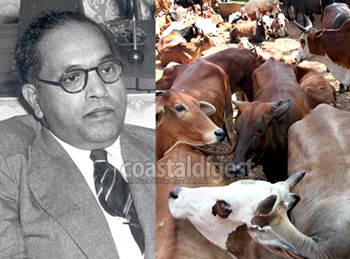
Cow protection mooted by Ambedkar, not BJP, claims Jaitley

News Network
July 21, 2017

New Delhi, Jul 21: Finance Minister Arun Jaitley on Thursday asked the Opposition parties in the Rajya Sabha to stop giving a political colour to cow-related violence, saying it could never be a partisan issue.ambacow

Replying to a debate on the issue of beef-related violence and lynching, Jaitley said, “Violence can never be a partisan issue and oppression in the name of cow will not be tolerated.”

He held that the protection of cows was not introduced by the BJP. He quoted Article 48 of the Constitution, which calls upon the state to protect cows from slaughter, saying it was written by Dr B R Ambedkar.

“Then, there was not a state where the BJP was in power. It was during (Jawaharlal) Nehru’s rule,” he said. Senior Congress leader Ghulam Nabi Azad said his party was not seeking to support the slaughter of cows.

Jaitley said, “Wherever acts of violence and lynching have erupted, legal proceedings and charge sheets have been filed in a systematic way. Sensitivity to the cow could not justify violence.”

Comments

shamon
 - 
Sunday, 23 Jul 2017

What can we expect from this unhuman shoba. I think she forgot to include names of various BJP leaders in the list of people kiilled in karnataka. Did she inlude her name also (may be yes). what a shame?

Add new comment

  • Coastaldigest.com reserves the right to delete or block any comments.
  • Coastaldigset.com is not responsible for its readers’ comments.
  • Comments that are abusive, incendiary or irrelevant are strictly prohibited.
  • Please use a genuine email ID and provide your name to avoid reject.
News Network
February 29,2020

Bengaluru, Feb 29: A Lingayat seer on Friday threatened to get 10 BJP MLAs to quit if Karnataka Chief Minister BS Yediyurappa does not make MLA Dattatreya Patil Revoor a minister soon.

"If Yediyurappa does not make BJP's Gulbarga South MLA Dattatreya Patil Revoor a minister, I will get 10 ruling party legislators resign and reduce the government to a minority, forcing the Chief Minister to resign," said Srishaila Saranga mutt seer Deshikendra Swami at a meeting in Kalaburagi on Friday.

Addressing a gathering of the Lingayat community, to which Revoor belongs, the seer said although he wanted Yediyurappa to complete the remaining 3-year term in office and the BJP to return to power after the next elections, it would be difficult for Yediyurappa to continue if Revoor is not made a minister.

"Yediyurappa will be in office for the next three years if he makes Revoor minister. If not, I will ask him (latter) also to resign, as does not need to be in politics anymore because he has a house, many acres of agricultural land and is very rich," the seer told the gathering in Kannada.

In his nomination to contest in the May 2018 assembly elections, Revoor (37) declared in an affidavit Rs 17-crore assets, including immovable properties.

Wishing Yediyurappa to remain in office for the next three years and return as Chief Minister, the seer said if Yediyurappa is forced to quit, then the Lingayat community would not get an opportunity to have its leader as Chief Minister again for at least 30 years.

Yediyurappa, whose constituency is Shikaripura in Shivamogga district, is considered the tallest Lingayat leader of the politically powerful community, which accounts for 18% of the 6.5-crore state's population.

Though a dozen BJP legislators won from the erstwhile Hyderabad-Karnataka region in the May 2018 Assembly elections, only Prabhu Chauhan from the adjacent Bidar district was made minister for animal husbandry.

The Saranga mutt seer’s threat comes a month after Veerashaiva Lingayat Panchamasali seer Swami Vachananda, dared Yediyurappa to make 3 of the community legislators ministers ahead of the second cabinet expansion on February 6.

At a Lingayat gathering in the state's Davengere district on January 15, Vachananda told Yediyurappa to make party's Bilgi legislator Murgesh Nirani Minister, failing which the community would withdraw its support to the ruling party.

Hiryur is about 300km northwest of the southern state's capital Bengaluru.

Ticking off the young seer, a defiant Yediyurappa, however, threatened to walk out of the meeting if he was blackmailed for making Lingayat MLAs ministers.

"You cannot threaten me saying your sub-sect (Veera Shaiva) community would not support the BJP in the next assembly or Lok Saba elections, due in 2023 and 2024," retorted Yediyurappa, reasserting his status as the community's strongman in the state.

In the second cabinet expansion, only 10 newly elected legislators who defected from the Congress and the Janata Dal-Secular (JD-S) were made ministers, leaving 6 posts vacant in the 34-member ministry.

In the first cabinet expansion on August 20, 2019, 17 party legislators were made ministers. Nirani and others, who were present on the dais, pacified Yediyurappa to take his seat and requested the seer to avoid making political speech on such occasions.

"The chief minister threatened to resign than succumb to pressures from religious or community followers," a party official told media.


Comments

Add new comment

  • Coastaldigest.com reserves the right to delete or block any comments.
  • Coastaldigset.com is not responsible for its readers’ comments.
  • Comments that are abusive, incendiary or irrelevant are strictly prohibited.
  • Please use a genuine email ID and provide your name to avoid reject.
News Network
March 15,2020

Mysuru, Mar 15: The renowned Mysore Palace will remain closed for tourists for a week from March 15 to 22, in the wake of the coronavirus outbreak, Mysore Palace committee said on Saturday.

The Karnataka government has ordered shutting down for a week all places and activities where people gather in large number including swimming pools, shopping malls, schools, colleges and cinema halls, state Health Minister B Sriramulu said amid the coronavirus threat.

This comes after Chief Minister BS Yediyurappa chaired an emergency meeting with ministers and senior officials on Friday to discuss the situation.

Earlier, schools in the state had announced early summer vacation for their students this academic year as a precautionary measure. Other public places have been shut down in the state amid the coronavirus scare.

The central government had on Thursday said that the death of the 76-year-old man from Kalaburagi in Karnataka was confirmed to be caused due to co-morbidity while he was also tested positive for COVID-19. The man visited Saudi Arabia on January 29 and returned to India a month later on February 29.

Till date, India has reported two deaths and 84 confirmed cases of the deadly coronavirus.

The World Health Organisation (WHO) has declared the coronavirus outbreak a pandemic. The virus, which originated in the Chinese city of Wuhan last year has spread to more than 100 countries worldwide, infecting over 1,30,000 people.

Comments

Add new comment

  • Coastaldigest.com reserves the right to delete or block any comments.
  • Coastaldigset.com is not responsible for its readers’ comments.
  • Comments that are abusive, incendiary or irrelevant are strictly prohibited.
  • Please use a genuine email ID and provide your name to avoid reject.
Ram Puniyani
January 14,2020

In the beginning of January 2020 two very disturbing events were reported from Pakistan. One was the attack on Nankana Sahib, the holy shrine where Sant Guru Nanak was born. While one report said that the place has been desecrated, the other stated that it was a fight between two Muslim groups. Prime Minister of Pakistan Imran Khan condemned the incident and the main accused Imran Chisti was arrested. The matter related to abduction and conversion of a Sikh girl Jagjit Kaur, daughter of Pathi (One who reads Holy Guru Granth Sahib in Gurudwara) of the Gurudwara. In another incident one Sikh youth Ravinder Singh, who was out on shopping for his marriage, was shot dead in Peshawar.

While these condemnable attacks took place on the Sikh minority in Pakistan, BJP was quick enough to jump to state that it is events like this which justify the Citizenship Amendment Act (CAA). Incidentally CAA is the Act which is discriminatory and relates to citizenship with Religion, which is not as per the norms of Indian constitution. There are constant debates and propaganda that population of Hindus has come down drastically in Pakistan and Bangla Desh. Amit Shah, the Home minister stated that in Pakistan the population of Hindus has come down from 23% at the time of partition to 3.7% at present. And in Bangla Desh it has come down from 22% to present 8%.

While not denying the fact that the religious minorities are getting a rough deal in both these countries, the figures which are presented are totally off the mark. These figures don’t take into consideration the painful migrations, which took place at the time of partition and formation of Bangla Desh later. Pakistan census figures tell a different tale. Their first census was held in 1951. As per this census the overall percentage of Non Muslim in Pakistan (East and West together) was 14.2%, of this in West Pakistan (Now Pakistan) it was 3.44 and in Eat Pakistan it was 23.2. In the census held in Pakistan 1998 it became 3.72%. As far as Bangla Desh is concerned the share of Non Muslims has gone down from 23.2 (1951) to 9.6% in 2011.

The largest minority of Pakistan is Ahmadis, (https://minorityrights.org/country/pakistan/) who are close to 4 Million and are not recognised as Muslims in Pakistan. In Bangla Desh the major migrations of Hindus from Bangla Desh took place in the backdrop of Pakistan army’s atrocities in the then East Pakistan.

As far as UN data on refugees in India it went up by 17% between 2016-2019 and largest numbers were from Tibet and Sri Lanka.  (https://www.un.org/en/development/desa/population/migration/publication…)

The state of minorities is in a way the index of strength of democracy. Most South Asian Countries have not been able to sustain democratic values properly. In Pakistan, the Republic began with Jinnah’s classic speech where secularism was to be central credo of Pakistan. This 11th August speech was in a way what the state policy should be, as per which people of all faiths are free to practice their religion. Soon enough the logic of ‘Two Nation theory” and formation of Pakistan, a separate state for Muslim took over. Army stepped in and dictatorship was to reign there intermittently. Democratic elements were suppressed and the worst came when Zia Ul Haq Islamized the state in collusion with Maulanas. The army was already a strong presence in Pakistan. The popular formulation for Pakistan was that it is ruled by three A’s, Army, America and Allah (Mullah).

Bangla Desh had a different trajectory. Its very formation was a nail in the coffin of ‘two nation theory’; that religion can be the basis of a state. Bangla Desh did begin as a secular republic but communal forces and secular forces kept struggling for their dominance and in 1988 it also became Islamic republic. At another level Myanmar, in the grip of military dictatorship, with democratic elements trying to retain their presence is also seeing a hard battle. Democracy or not, the army and Sanghas (Buddhist Sang has) are strong, in Myanmar as well. The most visible result is persecution of Rohingya Muslims.

Similar phenomenon is dominating in Sri Lanka also where Budhhist Sanghas and army have strong say in the political affairs, irrespective of which Government is ruling. Muslim and Christian minorities are a big victim there, while Tamils (Hindus, Christians etc.) suffered the biggest damage as ethnic and religious minorities. India had the best prospect of democracy, pluralism and secularism flourishing here. The secular constitution, the outcome of India’s freedom struggle, the leadership of Gandhi and Nehru did ensure the rooting of democracy and secularism in a strong way.

India so far had best democratic credentials amongst all the south Asian countries. Despite that though the population of minorities rose mainly due to poverty and illiteracy, their overall marginalisation was order of the day, it went on worsening with the rise of communal forces, with communal forces resorting to identity issues, and indulging in propaganda against minorities.

While other South Asian countries should had followed India to focus more on infrastructure and political culture of liberalism, today India is following the footsteps of Pakistan. The retrograde march of India is most visible in the issues which have dominated the political space during last few years. Issues like Ram Temple, Ghar Wapasi, Love Jihad, Beef-Cow are now finding their peak in CAA.

India’s reversal towards a polity with religion’s identity dominating the political scene was nicely presented by the late Pakistani poetess Fahmida Riaz in her poem, Tum bhi Hum Jaise Nikle (You also turned out to be like us). While trying to resist communal forces has been an arduous task, it is becoming more difficult by the day. This phenomenon has been variously called, Fundamentalism, Communalism or religious nationalism among others. Surely it has nothing to do with the religion as practiced by the great Saint and Sufi traditions of India; it resorts mainly to political mobilization by using religion as a tool.

Comments

Ashi
 - 
Tuesday, 14 Jan 2020

If Malaysia implement similar NRC/CAA, India and China are the loser.

Add new comment

  • Coastaldigest.com reserves the right to delete or block any comments.
  • Coastaldigset.com is not responsible for its readers’ comments.
  • Comments that are abusive, incendiary or irrelevant are strictly prohibited.
  • Please use a genuine email ID and provide your name to avoid reject.