


Cow slaughter ban: Cattle dying of thirst and hunger in Maharashtra

April 9, 2016

Osmanabad: Over the last six months, Laxman Ritapure lost ten of his cattle. Four cows, four bullocks and two calves. As Marathwada's searing drought lengthened into a second year, he ran out of water and fodder to feed them.cow-cattle
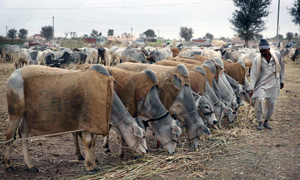
In this parched eight-district region where the drought has affected every single village, the beef ban which was enacted a year ago has come as a double whammy for farmers like Ritapure.

The new law extended Maharashtra's ban on cow slaughter to include bullocks. This cut off demand from abattoirs and paralysed trade at cattle markets. Soon, there was a steep price crash. "I took them to the cattle market last year but prices had halved. I tried to sell them again in January but there were no takers," says Ritapure.

He still 26 cattle left to feed. With just one acre to his name, Ritapure had bought ten animals seven years ago. The brood grew over the years. Ritapure now spends Rs 2,000 a week on fodder. The money he earns from selling milk just about covers this.

"If the government banned beef to save cows, it should look after them too," he says bitterly. Having raised the animals himself, losing them is particularly painful. "They are like my children. I would rather go without food myself than see them die," he says.

His neighbours have also lost their cattle in the last few months. Melon farmer Kiran Kale has lost one of his seven cattle. Suryakant Konde has lost a cow and a calf. "During the day, I just release my buffalo and calves. They graze on what they can find," says Konde, who has a three-acre field. The government is helping to fund 333 cattle camps set up in the region by private groups and NGOs, where water and fodder is given free.

As many as 3.2 lakh cattle in Marathwada are housed in the camps located in the worst-affected districts of Beed, Latur and Osmanabad.

For farmers desperate to save their livestock, the cattle camps are a life-line. But Mangrul's villagers say the nearest camp is five km away and difficult for them to access.

Farmers have to stay at the camp to look after their animals. But most camps don't provide bathing facilities or food for these care-takers. "I will have to travel home every day. Who can afford to spend Rs 50 a day on transport?" asks Ritapure.

"We do not run the camps," says Osmanabad collector Prashant Narnaware. "We approve applications from individuals or NGOs. We give them Rs 70 per animal per day from the National Disaster Relief Fund."

The majority of cattle camps are run by local politicians, including many who plan to stand for the zilla parishad elections next year.

The BJP's Santosh Hange, a member of the Beed zilla parishad and an aide of rural development minister Pankaja Munde runs a cattle camp at Nandurghat in Kaij Taluka. Hange plans to stand for the zilla parishad polls and is acutely aware that the camp will endear him to his electorate. "I am helping them during a crisis. They will remember me," he points out.

In camps that provide food and water for the farmers tending to cattle, entire families have moved in.

"There is more water for us here than in our own village," says dairy farmer Bharat Baglani who has been living at Shiv Sangram politician Rajendra Mhaske's cattle camp in Beed for the last eight months.

Comments

Sameer Kandak
 - 
Sunday, 10 Apr 2016

Better to trade all these cow to baba pathanjali , he can utilize for his low standard items like milk , butter & ghee etc etc

A message
 - 
Saturday, 9 Apr 2016

Dear Anthony,
U wrote everything right... But the last sentence on God...
ISLAM says ALLAH is the creator of all that exists.. & He knows whatever happening in this earth.. He is the most MERCIFUL.. cos of his mercy, Some of his creation do the evil and get away... But there is DAY it will accounted. That is the day, We will have to answer everything for the DEEDS done in this world which is the creation of ALLAH.
Suffering will exists in this world and those who oppressor people with their evil power will have permanent punishment unless they REPENT sincerely.. ALLAH forgives every sin except associating partners with HIM in WORSHIP.
God will SAve this COUNTRY for sure from the EVIL which we people CREATED cos people just believe what is said to them in the media....and elect leaders who doenst make sense...
When we look into who is ALLAH the true God, ALLAH's help comes even if you are in the deepest of the ocean calling him to help.
First Know who is ALLAH. When U know who is ALLAH surely U will depend on ALLAH and then the fear of such pity evil leaders will VAnish ... from your Fearful hearts that has been oppressed by these evil leaders.

Satyameva jayate
 - 
Saturday, 9 Apr 2016

Prakash..there are lot of genuine problems where wordings can bec twisted leave it...how can you save your Mata or how gods could die of thirst and hunger chodh yaar....ask you Hindu god saviors to stop this bulshit and stop seeing beef eaters.....as said in pk movie...sabh wrong number hai. just to screw minorities..
Sue your bjp rulers who can't save your God.

Rikaz
 - 
Saturday, 9 Apr 2016

RSS and Bajrangies should provide proper basic water and food supplies to these innocent animals.....it is solely those cow protectors responsibility to take care of them....they talk too much about cow now let they solve this problems too...

Add new comment

  • Coastaldigest.com reserves the right to delete or block any comments.
  • Coastaldigset.com is not responsible for its readers’ comments.
  • Comments that are abusive, incendiary or irrelevant are strictly prohibited.
  • Please use a genuine email ID and provide your name to avoid reject.
News Network
February 7,2020

Mangaluru, Feb 7: In an attempt to promote menstrual hygiene among women, the Karnataka State Road Transport Corporation (KSRTC) has installed vending machines and incinerators to dispense and dispose off sanitary napkins at 10 bus stands of the state including Mangaluru.

The machines have been installed inside the women's washroom and women can purchase sanitary napkins from the vending machines by inserting five rupee coins.

Nearly 100 napkins can be stored in the vending machines at a time and housekeeping personnel have been instructed to replenish the stock, as and when required.

While directions on how to use the machine have been displayed near the machines, people can get seek assistance from housekeeping staff if needed.

Initially, the machines were installed at two depots in Bengaluru on a pilot basis and in the second phase it has been extended to 10 KSRTC bus depots.

Comments

Add new comment

  • Coastaldigest.com reserves the right to delete or block any comments.
  • Coastaldigset.com is not responsible for its readers’ comments.
  • Comments that are abusive, incendiary or irrelevant are strictly prohibited.
  • Please use a genuine email ID and provide your name to avoid reject.
News Network
July 22,2020

Bengaluru, Jul 22: Karnataka's Covid-19 task force on Tuesday decided that the state government will regulate the supply of Remdesivir, the drug used in the treatment of coronavirus infected patients, to private hospitals to check black marketing and hoarding.

"Remdesivir which is currently available in the government hospitals will be supplied to private hospitals through the government.

This will help curb black marketing of this drug," Medical Education Minister K Sudhakar's office said in a release.

Along with Sudhakar, other task force members, including Health Minister Sriramulu, Deputy Chief Minister C N Ashwath Narayan and Chief Secretary T M Vijay Bhaskar attended the meeting. However, Home Minister Basavaraj Bommai was not part of it as he was out of Bengaluru.

At the meeting, the government has also fixed the rate for Covid-19 tests in private labs- Rs 2,000 for government referred cases and 3,000 for self-reporting cases.

It was also decided to purchase 4 lakh antigen test kits and 5 lakh swab test kits to ramp up testing, the release said, adding that approvals have also been given for additional drugs for the treatment of Covid-19 patients.

The decisions also included increasing monthly salary for Ayush doctors to 48,000, MBBS doctors to 80,000 and nurses to get 30,000 for next 6 months.

The task force also made it clear that private hospitals have to reserve 50 percent beds for the government for Covid-19 treatment. The remaining 50 percent can be used by the private hospitals for Covid-19 and non-Covid-19 treatment.

Private hospitals provide treatment under Ayushman Bharat scheme (ABARK) for Covid-19 patients.

Those cases in which treatment does not cover under the scheme can be charged as per the user charges, the release said.

A committee will be formed to supervise and recommend the purchase of equipment and medicines for Covid-19 treatment, which will be headed by ACS, ITBT Department.

Approval has been given for the procurement of N-95 masks and lakh PPE kits for the safety of healthcare workers. The decision also has been taken to connect oxygen pipeline to 4,736 beds in 17 government medical colleges, which will enable high flow oxygen for these beds besides being beneficial for future use as well.

According to the release, 16 RTPCR and 15 Automated RNA extraction units will be established to ramp up testing and this will help achieve the target of 50,000 tests per day. "On the whole approvals given for purchase of equipment and upgradation of existing facilities at government hospitals is estimated to be about Rs 500 Crore," it added.

Comments

Add new comment

  • Coastaldigest.com reserves the right to delete or block any comments.
  • Coastaldigset.com is not responsible for its readers’ comments.
  • Comments that are abusive, incendiary or irrelevant are strictly prohibited.
  • Please use a genuine email ID and provide your name to avoid reject.
News Network
February 14,2020

Bhuj, Feb 14: In a horrifying incident, as many as 68 undergraduate girls were paraded through their college into the restroom and forced to individually remove their undergarments to prove that they were not menstruating. 

This shameful exercise was conducted at Shri Sahjanand Girls’ Institute (SSGI) in Gujarat’s Bhuj under the supervision of principal and other teachers. 

It all began after the hostel rector complained to the principal that some of the inmates had been violating the Hindu religious norms specifically for menstruating females.

According to the sect’s norms, menstruating females are barred from entering the temple and kitchen. They are even forbidden from touching other students. However, the hostel administration reportedly complained to principal Rita Raninga that some girls who were having their periods not just mingled with other hostel inmates, but also entered the kitchen and ventured near the temple on the premises. 

“It was sheer mental torture and we don’t have words to describe it,” a student who underwent the traumatic experience said, adding that there were total 68 girls who were forced to pass through the test.

“The hostel administration levelled this allegation and insulted us on Wednesday. On Thursday, when we were attending lectures, rector Anjaliben called the principal and complained about this. We were forced to leave our classrooms and queue up outside in the passage. The principal abused and insulted us, asking which of us were having our periods. Two of us who were menstruating stepped aside,” said another victim.

“Despite this, we were all taken to the washroom. There, female teachers asked us to individually remove our undergarments so they could check if we were menstruating,” she added.

Another teenage undergraduate said, “We come from farflung villages. The college campus houses a school that runs classes from Class 1to 12. They provide hostel facilities to the school students. The college does not have its own hostel. We live with the school-kids in their hostel.”

She added, “The principal, hostel rector and the trustees harass us regularly over the issue of menstruation. We are punished for having periods. This happens even if we follow their religious rules. They made us remove our undergarments because they thought some of us were lying about not having periods, and mingling with the others against rules. But the humiliation meted out to us on Thursday was the last straw. When we protested against this, trustee Pravin Pindoria told us that we could take legal action if we wanted but we would have to first leave the hostel. He also forced the students to sign a letter saying nothing happened in college. But enough is enough.”

Kutch University authorities have, meanwhile, swung into action and a five-member team including in-charge vice-chancellor, Darshna Dholakia, and two other senior female professors visited the college on Thursday. “We will speak to the students and the college authority and later initiate appropriate action based on the findings,” Dholakia said.

Run by followers of Swaminarayan Mandir, the college was set up in 2012 but moved into a new building on the premises of Shree Swaminarayan Kanya Mandir in 2014. The college which offers BCom, BA and BSc courses has about 1,500 students of which 68, who come from remote villages, stay in the hostel on campus. The college is known for its pro-Hindutva stance.

Comments

Add new comment

  • Coastaldigest.com reserves the right to delete or block any comments.
  • Coastaldigset.com is not responsible for its readers’ comments.
  • Comments that are abusive, incendiary or irrelevant are strictly prohibited.
  • Please use a genuine email ID and provide your name to avoid reject.