



CPEC should not be politicised, says Sharif

May 14, 2017

Beijing, May 14: Pakistan Prime Minister Nawaz Sharif today said that the multi-billion dollar CPEC was an economic project open to all nations in the region and it "must not be politicised", taking pot-shots at India for boycotting China's high-profile Belt and Road Forum.
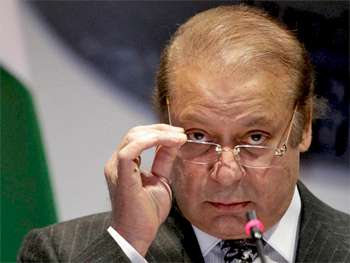
nawazIndia skipped the meeting due to its concerns over the China-Pakistan Economic Corridor (CPEC), which goes through Pakistan-occupied Kashmir (PoK). However, few Indian scholars attended the opening session of the two-day "Belt and Road" conference here that brought together leaders from 29 nations.

"Let me make it very clear that CPEC is an economic undertaking open to all countries in the region. It has no geographical boundaries. It must not be politicised," Sharif said in his speech at the inaugural session of the forum, defending the project over which India has raised objections.

Stating that CPEC has emerged as core and flagship project of China's One Belt and One Road (OBOR), he said, "OBOR signifies that geo-economics must take precedence over geo-politics and that the centre of gravity should shift from conflict to cooperation. We see it as a path for overcoming terrorism and extremism."

In implementing CPEC "we are not striving to merely leverage geography for economic prosperity, we are also trying to build peaceful, connected and caring neighbourhood," he told the gathering.

"It is time we transcend our differences, resolve conflicts through diplomacy and leave legacy of peace for future generations," Sharif said without directly referring to India.

Sharif, who is leading a large delegation and clinched more Chinese finance for six more projects of the CPEC, said "the fact is that OBOR belongs to all of us, those who are participating in it and those who are not as yet. OBOR has truly become a global community."

"As OBOR unfolds across continents we see it fostering inclusion, creating tolerance and promoting acceptance of cultural diversity," he said.

He said Pakistan believes that the most powerful impact of OBOR will be on the lives of poor and marginalised people who would have higher incomes, better education and health facilities. It would help eradicating poverty, he added.

"The CPEC is core project of OBOR. In fact it has been rightly called its flagship because it aims to connect neighbourhoods of East and West Asia. CPEC makes Pakistan both a conduit, destination for cross regional investment and trade," he said.

Terming China as Pakistan's "close friend and trusted ally", he said his participation at the forum was to celebrate the remarkable success of the seminal initiative of OBOR.

He also said that infrastructure, energy and industrial projects under CPEC are moving as envisaged.

Many of them would be completed before their timelines. Unprecedented economic social and cultural benefits will accrue from the CPEC not just for people of Pakistan but also the people of the entire region, he said.

"Through a resolute will and sound planning as well as steadfast support of our Chinese friends, we shaped an enabling environment for CPEC to take off," he said.

He said CPEC is also producing new entrepreneurs and creating new jobs and attracting international investment.

Playing down differences over the project among different provinces in his country, Sharif said, "the CPEC is owned and nurtured by all citizens of Pakistan. It is also fully compatible with our own vision 2025 which invests our own resources in multiple corridors of regional cooperation including energy, industry trade and transportation."

Comments

Add new comment

  • Coastaldigest.com reserves the right to delete or block any comments.
  • Coastaldigset.com is not responsible for its readers’ comments.
  • Comments that are abusive, incendiary or irrelevant are strictly prohibited.
  • Please use a genuine email ID and provide your name to avoid reject.
News Network
January 25,2020

Beijing, Jan 25: The death toll due to the novel coronavirus (2019-nCoV) outbreak in China has soared to 41, while the number of infected persons were 1,287, the National Health Commission said on Saturday.

The Commission said that 444 fresh cases were reported since Friday, with 237 patients in serious conditions, while 38 had been cured and discharged from hospitals, reports Efe news.

Health authorities have carried out check-ups on 15,197 people who have come into close contact with the infected persons. Nearly 14,000 of them continue to be monitored for symptoms.

The others cases outside of China were reported in France (two), Australia (one), Thailand (four including two cured), Japan (two including one cured), South Korea (two), the US (two), Vietnam (two), Singapore (three), Nepal (one), Hong Kong (five), Macao (two) and Taiwan (three).

The symptoms of the new coronavirus, provisionally designated by the World Health Organization as 2019-nCoV, are similar to those of cold but may be accompanied by fever and fatigue, dry cough and dyspnea (shortness of breath).

The WHO has so far to declared the outbreak as an international health emergency.

Strict measures were being carried out in China, which include complete suspension of transport in around a dozen cities in Hubei province and also cancelling Chinese New Year celebrations.

Traditional events at Lama Temple and Ditan Park in Beijing were cancelled due to the risk of spreading the virus, authorities reported Friday, while the famous Forbidden City has also been closed indefinitely.

Wuhan, the capital of Hubei, where the virus was first reported, has been on lockdown since Thursday to prevent further spread of the virus and the city's authorities have begun to build a "special hospital" with 1,000 beds for infected patients.

"Construction of the special hospital with a capacity of 1,000 beds for patients with #nCoV2019 has begun in Wuhan," official China Daily said on Twitter.

The hospital in Wuhan will be based on the model of a similar facility that was built in just seven days in Beijing to deal with SARS in 2003.

Comments

Add new comment

  • Coastaldigest.com reserves the right to delete or block any comments.
  • Coastaldigset.com is not responsible for its readers’ comments.
  • Comments that are abusive, incendiary or irrelevant are strictly prohibited.
  • Please use a genuine email ID and provide your name to avoid reject.
Agencies
January 20,2020

For the first time in the 15 years of the Global Risks Report, the climate change and environment risk has occupied all the top five slots.

According to the 15th edition of the World Economic Forum's (WEF) Global Risks Report, the top five risks in terms of likelihood are extreme weather, climate action failure, natural disasters, biodiversity loss and human-made environmental disasters. They all fall in the one category of climate change and related environmental disasters.

WEF President Borge Brende said the world was feeling long-mounting and interconnected risks.

The report also points to how citizens are protesting across the world as discontent rises with failed systems that are creating inequality. The citizens' discontent had hardened with systems that had failed to promote advancement, it said.

"Disapproval of how governments are addressing profound economic and social issues has sparked protests throughout the world, potentially weakening the ability of governments to take decisive action should a downturn occur. Without economic and social stability, countries could lack the financial resources, fiscal margin, political capital or social support needed to confront key global risks," it said.

Listing the grim scenario, Borge said the global economy was faced with "synchronised slowdown", the past five years had been the warmest on record and cyber attacks were expected to increase this year.

The report warns that while the myriad risks were rising, time was running out on how to prevent them.

Borge said the growing palpability of shared economic, environmental and societal risks indicated that the horizon had shortened for preventing "or even mitigating" some of the direst consequences of global risks.

"It's sobering that in the face of this development, when the challenges before us demand immediate collective action, fractures within the global community appear to only be widening," he said.

The report points to grave concern about the consequences of continued environmental degradation, including the record pace of species decline.

Pointing to an unsettled geopolitical environment, the report said today's risk landscape was one in which new centres of power and influence were forming and old alliance structures and global institutions were being tested.

"While these changes can create openings for new partnership structures in the immediate term, they are putting stress on systems of coordination and challenging norms around shared responsibility. Unless stakeholders adapt multilateral mechanisms for this turbulent period, the risks that were once on the horizon will continue to arrive," it said.

Calling it a "an unsettled world", the WEF report notes that powerful economic, demographic and technological forces were shaping a new balance of power. "The result is an unsettled geopolitical landscape in which states are increasingly viewing opportunities and challenges through unilateral lenses," it said.

"What were once givens regarding alliance structures and multilateral systems no longer hold as states question the value of long-standing frameworks, adopt more nationalist postures in pursuit of individual agendas and weigh the potential geopolitical consequences of economic decoupling. Beyond the risk of conflict, if stakeholders concentrate on immediate geo-strategic advantage and fail to re-imagine or adapt mechanisms for coordination during this unsettled period, opportunities for action on key priorities may slip away," the WEF said.

In a chapter on risks to economic stability and social cohesion, it said a challenging economic climate might persist this year and members of the multi-stakeholder community saw "economic confrontations" and "domestic political polarisation" as the top risks in 2020.

The report also warned of downward pressure on the global economy from macroeconomic fragilities and financial inequality. These pressures continued to intensify in 2019, increasing the risk of economic stagnation.

Low trade barriers, fiscal prudence and strong global investment, once seen as fundamentals for economic growth, are fraying as leaders advance nationalist policies. The margins for monetary and fiscal stimuli are also narrower than before the 2008-2009 financial crisis, creating uncertainty about how well countercyclical policies will work.

The strategic partners for the WEF report included Marsh & McLennan and Zurich Insurance Group. The academic advisers were National University of Singapore, Oxford Martin School, University of Oxford and Wharton Risk Management and Decision Processes Center, University of Pennsylvania.

Comments

Add new comment

  • Coastaldigest.com reserves the right to delete or block any comments.
  • Coastaldigset.com is not responsible for its readers’ comments.
  • Comments that are abusive, incendiary or irrelevant are strictly prohibited.
  • Please use a genuine email ID and provide your name to avoid reject.
News Network
January 22,2020

Davos, Jan 22: President Donald Trump has said that the US is watching the developments between India and Pakistan over Kashmir "very closely" and repeated his offer to "help" resolve the longstanding dispute between the two neighbours as he met Prime Minister Imran Khan on the sidelines of the World Economic Forum here in the Swiss ski resort.

Addressing the media with the Pakistan Prime Minister prior to their private meeting on Tuesday, President Trump asserted that trade and borders were both critical points for discussion, while Khan said that for him, Afghanistan was the top priority.

Trump told Khan, whom he referred to as "my friend", that he would speak to Prime Minister Narendra Modi about the ongoing Kashmir issue. The US president is expected to visit India in the coming weeks, marking his first visit after taking up his post in the White House.

"What's going on between Pakistan and India … if we can help, we certainly will be willing to. We have been watching it very closely and it's an honour to be here with my friend," he said.

"The Pakistan-India conflict is a very big issue for us in Pakistan and we expect the US to always play its part in deescalating the tensions, because no other country can," Khan said.

President Trump has repeatedly offered to mediate following India's August 5 decision to revoke the special status to Jammu and Kashmir and bifurcate the state into two Union Territories, evoking strong reaction from Pakistan which has been trying to internationalise the Kashmir issue.

New Delhi has defended the move, saying Jammu and Kashmir is an integral part of India and the issue was strictly internal to the country, and the special status provisions only gave rise to terrorism in Jammu and Kashmir.

"The country took the decision of abrogation of Article 370, which had only given separatism and terrorism to that state," Prime Minister Narendra Modi said at a function in October last year.

This is the third meeting between Trump and Khan since Pakistan premier assumed office in 2018 and it came against the backdrop of Pakistan Foreign Minister Shah Mehmood Qureshi's recent trip to the US, amid reports that the US and Afghan Taliban were close to striking a peace deal.

"There are issues we want to talk about. The main issue is Afghanistan because it concerns the US and Pakistan. Fortunately, we are on the same page. Both of us are interested in peace there and an orderly transition in Afghanistan with talks with Taliban and the government," Khan said.

When a reporter asked Trump if he would visit Pakistan considering he was already set to visit India, the US president said he was meeting the Pakistan premier in Davos.

"Well, we're visiting right now. So we don't really have to. I wanted to say that from a relationship standpoint, we got a great relationship. From the standpoint our two countries, we're getting along very well. I would say we've never been closer with Pakistan the way we're right now. And this is a big statement," Trump said.

Khan left for Switzerland to attend the World Economic Forum and meet the world leaders, including President Trump, on the sidelines of the annual event which kicked off at the ski resort town of Davos on Tuesday.

The four-day summit marks the 50th anniversary of the forum.

A total of 53 heads of State are on the guest list. Nearly 3,000 participants from 118 countries are expected to attend the event during which political leaders, business executives, heads of international organisations and civil society representatives are set to deliberate on contemporary economic, geopolitical, social and environmental issues.

Comments

Add new comment

  • Coastaldigest.com reserves the right to delete or block any comments.
  • Coastaldigset.com is not responsible for its readers’ comments.
  • Comments that are abusive, incendiary or irrelevant are strictly prohibited.
  • Please use a genuine email ID and provide your name to avoid reject.