Cracker injuries darkenfestival of lights'; many hospitalised in Karnataka

[email protected] (CD Network)
October 31, 2016

Bengaluru, Oct 31: Despite awareness drives regarding precautions to be taken while bursting crackers, the eye hospitals in major cities of Karnataka witnessed a steady stream of patients, mostly minors, with some sustaining serious injuries.
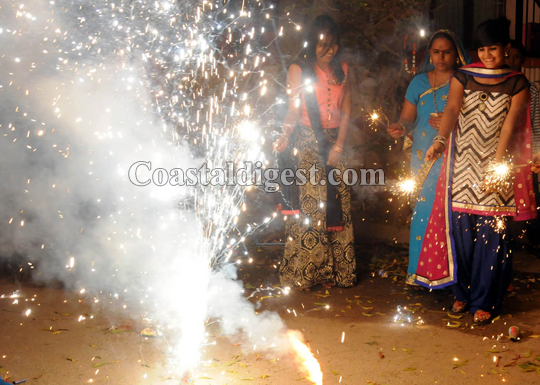
diwali 6

For the family of ten-year-old Varun from Chikkaballapur Chintamani, this Diwali turned out to be a nightmare. Varun was rushed to Minto hospital on Sunday afternoon, after he sustained injuries on both eyes.

He got injured while bursting crackers outside his house, after cracker particles entered both the eyes. According to Minto hospital authorities his condition was serious and has been hospitalised.

A ten-year-old girl Dharini too was admitted at Minto Hospital for a major eye injury. For 39-year-old Kavitha, her decision to take a stroll near her house in Kallahalli proved costly, as she was admitted to Minto hospital with a major eye injury.

There were at least 28 cases of firecracker-related injuries, ranging from minor burns to potentially permanent eye injuries, during Diwali celebrations in Bengaluru city alone.

Minto Eye Hospital saw four cracker-related injuries; three of those were children, one as young as 3. All were minor cases, with patients receiving out-patient care.

Twenty persons were treated for minor burns at Narayana Nethralaya in Ra jajinagar. Two kids were brought to MC Modi Charitable Eye Hospital in Mahalakshmipuram. Samprathi Eye Hospital and Squint Centre treated a five-year-old boy who injured his eyelid.

A majority of those injured were bystanders, indicating that firecrackers were burst on the streets, and not in demarcated safe areas.

Humans were not the only ones affected by crackers. Animals too suffered burns and hearing loss, stray dogs in particular. The Happy Paws Foundation rescued six crows from across the city, who had been burnt by crackers. While five are out of danger, one is critical. The foundation will travel around the city, locating and treating injured animals.
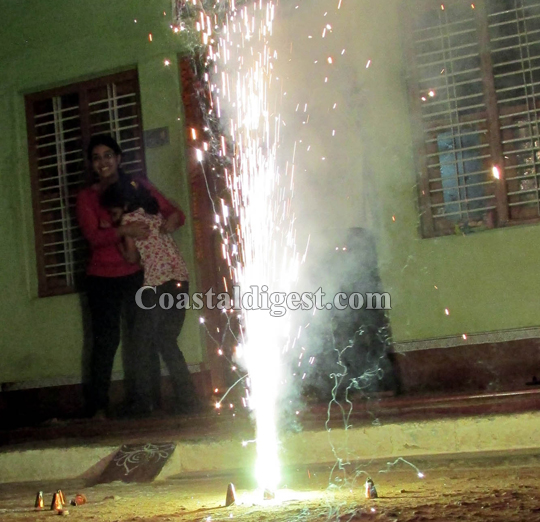

diwali 1

diwali 2

diwali 3

diwali 4

diwali 5

diwali 7

diwali 8

diwali 9

diwali 10

Comments

PK
 - 
Tuesday, 1 Nov 2016

Wen diwali comes we should expect some losses of money and life... thats for sure... Wasting money and life.

When people are far from God.. they tend believe in every superstitious rituals..

Skazi
 - 
Monday, 31 Oct 2016

All those, who play with the fire crackers and cause pollution deserve punishment.

Add new comment

  • Coastaldigest.com reserves the right to delete or block any comments.
  • Coastaldigset.com is not responsible for its readers’ comments.
  • Comments that are abusive, incendiary or irrelevant are strictly prohibited.
  • Please use a genuine email ID and provide your name to avoid reject.
News Network
April 2,2020

The current physical distancing guidelines provided by the World Health Organisation (WHO) and by the US Centers for Disease Control and Prevention (CDC) may not be adequate to curb the coronavirus spread, according to a research which says the gas cloud from a cough or sneeze may help virus particles travel up to 8 metres. The research, published in the Journal of the American Medical Association, noted that the the current guidelines issued by the WHO and CDC are based on outdated models from the 1930s of how gas clouds from a cough, sneeze, or exhalation spread.

Study author, MIT associate professor Lydia Bourouiba, warned that droplets of all sizes can travel 23 to 27 feet, or 7-8 metres, carrying the pathogen.

According to Bourouiba, the current guidelines are based on "arbitrary" assumptions of droplet size, "overly simplified", and "may limit the effectiveness of the proposed interventions" against the deadly pandemic.

 She explained that the old guidelines assume droplets to be one of two categories, small or large, taking short-range semi-ballistic trajectories when a person exhales, coughs, or sneezes.

However based on more recent discoveries, the MIT scientist said, sneezes and coughs are made of a puff cloud that carries ambient air, transporting within it clusters of droplets of a wide range of sizes.

Bourouiba warned that this puff cloud, with ambient air entrapped in it, can offer the droplets moisture and warmth that can prevent it from evaporation in the outer environment.

"The locally moist and warm atmosphere within the turbulent gas cloud allows the contained droplets to evade evaporation for much longer than occurs with isolated droplets," she said.

"Under these conditions, the lifetime of a droplet could be considerably extended by a factor of up to 1000, from a fraction of a second to minutes," the researcher explained in the study.

The MIT scientist, who has researched the dynamics of coughs and sneezes for years, added that these droplets settle along the trajectory of a cough or sneeze contaminating surfaces, with their residues staying suspended in the air for hours.

"Even when maximum containment policies were enforced, the rapid international spread of COVID-19 suggests that using arbitrary droplet size cutoffs may not accurately reflect what actually occurs with respiratory emissions, possibly contributing to the ineffectiveness of some procedures used to limit the spread of respiratory disease," Bourouiba wrote in the study

Comments

Add new comment

  • Coastaldigest.com reserves the right to delete or block any comments.
  • Coastaldigset.com is not responsible for its readers’ comments.
  • Comments that are abusive, incendiary or irrelevant are strictly prohibited.
  • Please use a genuine email ID and provide your name to avoid reject.
News Network
January 22,2020

Mangaluru, Jan 22: Mangaluru Commissioner of Police PS Harsha said that Aditya Rao, who surrendered before Bengaluru Police after planting an improvised explosive device (IED) at the Mangaluru International Airport, is now in their custody.

"Our Investigation team arrested Aditya Rao in Bengaluru in connection with planting of an explosive device at Mangaluru Airport on January 20. We produced the accused before Bengaluru first JMFC court and court issued transit warrant," said Harsha.

"We have brought him to Mangaluru from Bengaluru, now the accused is in our custody, our investigation team will interrogate him. We will investigate all aspects. He will be produced before Mangaluru 6th JMFC Court," he added.

Rao hails from Udupi and has engineering and MBA degrees.

According to the police, the IED was recovered from a bag at Mangaluru airport on January 20. It was later defused in an open field by the personnel of the bomb disposal squad.

Comments

Add new comment

  • Coastaldigest.com reserves the right to delete or block any comments.
  • Coastaldigset.com is not responsible for its readers’ comments.
  • Comments that are abusive, incendiary or irrelevant are strictly prohibited.
  • Please use a genuine email ID and provide your name to avoid reject.
News Network
January 29,2020

Newsroom, Jan 29: Karnataka’s capital has earned the unwelcome distinction of global capital of traffic congestion. According to a report by TomTom, the Netherlands-based global provider of navigation, traffic and map products, Bengaluru beat 415 other cities across 57 countries to earn the title of world's most traffic congested city in 2019.

“Bengaluru takes the top spot this year with drivers in the southern Indian city expecting to spend an average of 71% extra travel time stuck in traffic," TomTom said in the ninth edition of its annual Traffic Index.

Three other Indian cities, namely, Mumbai, Pune and New Delhi are also ranked in the 2019 edition of TomTom’s Traffic Index of the world’s most traffic-congested cities. 

The report released on Tuesday ranks cities by the average time added to a trip. TomTom index also includes details on when congestion is heaviest and lightest, how highways compare with surface streets, and how much time drivers wasted waiting for other drivers to get out of their way.

Following closely on the heels of Bengaluru is Manila, Philippines, with the similar 71% traffic congestion. Among the top five worst traffic affected cities are Mumbai and Pune from India at the fourth and fifth place respectively, while Bogota, Colombia is on third spot.

Delhi, the national capital of India is on the 8th spot, while Moscow (Russia), Lima (Peru), Istanbul (Turkey) and Jakarta (Indonesia) are on 6th, 7th, 9th and 10th spot respectively.

Mumbai recorded a 65% traffic congestion with 9th September, 2019 being the worst day. On an average, a Mumbaikar lost 209 hours in traffic congestion. Pune has 59% traffic congestion with 2nd August, 2019 being the worst day. 193 hours are lost due to congestion. Delhi, on the other hand, has 56% traffic congestion. 23rd October, 2019 was the worst day, while 190 hours are lost in traffic congestion.

Interestingly, among all the four Indian cities, Delhi has the most number of cars. Previous studies have concluded that Delhi has the best road conditions among the Metro cities of India.

If you are wondering what exactly the percentages mean, a 53% congestion level in Bangkok, for example, means that a trip will take 53% more time than it would during Bangkok’s baseline uncongested conditions.

TomTom calculates the baseline per city by analyzing free-flow travel times of all vehicles on the entire road network – recorded 24/7, 365 days a year. The report by Dutch navigation and mapping company ranks cities by the average time added to a trip. It also includes details on when congestion is heaviest and lightest, and how much time drivers wasted waiting for other drivers to get out of their way.

Comments

Add new comment

  • Coastaldigest.com reserves the right to delete or block any comments.
  • Coastaldigset.com is not responsible for its readers’ comments.
  • Comments that are abusive, incendiary or irrelevant are strictly prohibited.
  • Please use a genuine email ID and provide your name to avoid reject.