


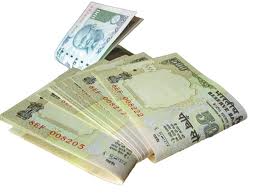
Currency notes issued before to 2005 to be withdrawn

January 22, 2014

New Delhi, Jan 22: The Reserve Bank of India (RBI) on Wednesday decided to withdraw all currency notes issued prior to 2005, including Rs 500 and Rs 1,000 denominations, after March 31 in a move apparently aimed at curbing black money and fake currencies.

currency

"After March 31, 2014, it (RBI) will completely withdraw from circulation all bank notes issued prior to 2005. From April 1, 2014, the public will be required to approach banks for exchanging these notes," the RBI said in a statement.

The public can easily distinguish the currency notes issued before 2005 as they do not have the year of printing on reverse side. The year of printing in a small font is visible at the middle of the bottom row in notes issued after 2005.

Asking people not to panic and cooperate in the withdrawal process, the RBI said old notes will continue to be legal and can be exchanged in any bank after April 1.

"From April 1, 2014, the public will be required to approach banks for exchanging these notes. Banks will provide exchange facility for these notes until further communication," the RBI said.

From July 1, 2014, persons seeking exchange of more than 10 pieces of Rs 500 and Rs 1,000 notes will have to furnish proof of identity and residence to the bank.

Although the RBI did not give any reason for withdrawal of pre-2005 currency notes, the move is expected to unearth black money held in cash.

As the new currency notes have added security features, they would help in curbing the menace of fake currency.

At present, currency notes in denominations of Rs 5, Rs 10, Rs 20, Rs 50, Rs 100, Rs 500 and Rs 1,000 are issued.

Comments

Add new comment

  • Coastaldigest.com reserves the right to delete or block any comments.
  • Coastaldigset.com is not responsible for its readers’ comments.
  • Comments that are abusive, incendiary or irrelevant are strictly prohibited.
  • Please use a genuine email ID and provide your name to avoid reject.
News Network
February 28,2020

Bengaluru, Feb 28: Historian S. Shettar, 85, breathed his last early on February 28 in Bengaluru. He was suffering from respiratory problems and was hospitalised for over a week.

Shettar was known for his multi-disciplinary work, encompassing linguistics, epigraphy, anthropology, the study of religions and art history. He had extensively worked on the Jain practice of ritual death in Karnataka and Asoka edicts. He had studied and compiled early edicts in Kannada and worked extensively on the growth of Kannada language down the ages.

Born in 1935 at Hampasagara, Ballari district, he went on to study at Cambridge University and started his career as a Professor of History at Karnatak University, Dharwad, his alma mater. He later headed the National Museum Institute of the History of Art, Conservation and Museology in 1978 and Indian Council for Historical Research in 1996. He was also a visiting professor at the National Institute of Advanced Studies, Bengaluru.

He was a bilingual historian who wrote in English for most of his career, but started writing in Kannada in later years. In the last two decades, he developed a keen interest in linguistics and wrote multiple books on classical Kannada and Prakrit. His 2007 book “Shangam Tamilagam” is considered a seminal work in the study of the early period of Dravidian languages. It won him Bhasha Samman from Central Sahitya Akademi. He later wrote two works on Halegannada, classical Kannada. His most recent work was “Prakrita Jagadvalaya” in 2018.

Comments

Add new comment

  • Coastaldigest.com reserves the right to delete or block any comments.
  • Coastaldigset.com is not responsible for its readers’ comments.
  • Comments that are abusive, incendiary or irrelevant are strictly prohibited.
  • Please use a genuine email ID and provide your name to avoid reject.
coastaldigest.com news network
June 2,2020

Kasaragod, June 2: As Kerala commenced fresh academic year with online classes from Monday, a ninth-standard student at Malappuram district in North Kerala ended life allegedly owing to lack of online study facilities like television connection and a smartphone at her house.

Devika, daughter of Balakrishnan, hailing from a Dalit community at Valancherry, about 25 kilometres from Malappuram town, ended her life.

Balakrishnan told the media that he could not recharge the television connection owing to financial crunches. He was working as a daily wage worker and owing to COVID-19 and lockdown, he was not having much work these days. 

The family also did not have a smartphone or computer. The family members alleged that Devika was quite upset as she could not attend the virtual class that began on Monday. She was a student of a nearby government school.

Local police said that Devika, who was the eldest among four children of Balakrishnan, was suspected to have self-immolated using kerosene at a premise close to her house on Monday evening. The cause and provocations were still being probed only. No suicide notes were recovered yet.

Comments

Add new comment

  • Coastaldigest.com reserves the right to delete or block any comments.
  • Coastaldigset.com is not responsible for its readers’ comments.
  • Comments that are abusive, incendiary or irrelevant are strictly prohibited.
  • Please use a genuine email ID and provide your name to avoid reject.
coastaldigest.com news network
January 11,2020

Mangaluru, Jan 11: U Haroon bin Aboobakar Mukri, a businessman from Uppinangady passed away at a private hospital in the city today. He was 74.

He was undergoing treatment for multiple ailments including age-related diseases. He breathed his last at 12:40 a.m. on Saturday.

Son of Late Aboobakar Mukri, who was an Islamic activist and leader of Jamaat-e-Islami Hind in Uppinangady, Haroon was known for his generosity, kind-heartedness and simplicity.

An alumnus of St Aloysius College, Mangaluru, he was also a passionate traveller and life enthusiast, who always loved to meet people and spread positive vibes.

He is survived by his wife, four sons, a daughter and a large number of relatives, friends and well-wishers.

The funeral prayers were held at Masjid al-Huda, Uppinangady on Saturday afternoon. He was buried on premises of the same mosque.

Comments

Add new comment

  • Coastaldigest.com reserves the right to delete or block any comments.
  • Coastaldigset.com is not responsible for its readers’ comments.
  • Comments that are abusive, incendiary or irrelevant are strictly prohibited.
  • Please use a genuine email ID and provide your name to avoid reject.