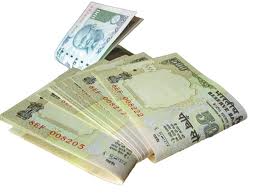
Currency notes issued before to 2005 to be withdrawn

January 22, 2014

New Delhi, Jan 22: The Reserve Bank of India (RBI) on Wednesday decided to withdraw all currency notes issued prior to 2005, including Rs 500 and Rs 1,000 denominations, after March 31 in a move apparently aimed at curbing black money and fake currencies.

currency

"After March 31, 2014, it (RBI) will completely withdraw from circulation all bank notes issued prior to 2005. From April 1, 2014, the public will be required to approach banks for exchanging these notes," the RBI said in a statement.

The public can easily distinguish the currency notes issued before 2005 as they do not have the year of printing on reverse side. The year of printing in a small font is visible at the middle of the bottom row in notes issued after 2005.

Asking people not to panic and cooperate in the withdrawal process, the RBI said old notes will continue to be legal and can be exchanged in any bank after April 1.

"From April 1, 2014, the public will be required to approach banks for exchanging these notes. Banks will provide exchange facility for these notes until further communication," the RBI said.

From July 1, 2014, persons seeking exchange of more than 10 pieces of Rs 500 and Rs 1,000 notes will have to furnish proof of identity and residence to the bank.

Although the RBI did not give any reason for withdrawal of pre-2005 currency notes, the move is expected to unearth black money held in cash.

As the new currency notes have added security features, they would help in curbing the menace of fake currency.

At present, currency notes in denominations of Rs 5, Rs 10, Rs 20, Rs 50, Rs 100, Rs 500 and Rs 1,000 are issued.

Comments

Add new comment

  • Coastaldigest.com reserves the right to delete or block any comments.
  • Coastaldigset.com is not responsible for its readers’ comments.
  • Comments that are abusive, incendiary or irrelevant are strictly prohibited.
  • Please use a genuine email ID and provide your name to avoid reject.
News Network
April 18,2020

Bengaluru, Apr 18: The Karnataka government has fixed the cost of test for COVID-19 in private laboratories at Rs 2,250, an official said on Friday.

"Based on the discussions and negotiations, the cost per test has been fixed at Rs 2,250. This includes the screening test and a confirmatory test," said order by Health and Family Welfare Department's Additional Chief Secretary Jawaid Akhtar.

A total of 16 laboratories (11 government and 5 private) have been approved by the Indian Council of Medical Research (ICMR) for testing samples of possible COVID-19 cases in the state.

Realising that early detection of coronavirus cases and timely treatment was the need of the hour, meetings were held to rope in more private laboratories to conduct COVID-19 sample tests.

As per the protocol by the Centre, testing the samples of suspected COVID-19 cases can be taken up in private laboratories subject to conditions which include sharing the lab data pertaining to the diagnosis of COV1D-19 with the state government and with the ICMR on a timely basis.

As per the Union Health Ministry, 353 people have infected from coronavirus in the state of which 83 are cured and discharged and 13 succumbed to the virus.

Comments

Add new comment

  • Coastaldigest.com reserves the right to delete or block any comments.
  • Coastaldigset.com is not responsible for its readers’ comments.
  • Comments that are abusive, incendiary or irrelevant are strictly prohibited.
  • Please use a genuine email ID and provide your name to avoid reject.
News Network
May 6,2020

Dubai, May 6: The Indian nationals cleared by the UAE health authorities and found to be asymptomatic will only be allowed to fly back home in one of India's biggest ever repatriation exercises, the Indian Embassy in Abu Dhabi has said ahead of the first set of flights on Thursday.

On Monday, the Indian government announced plans to begin a phased repatriation of its citizens stranded abroad from May 7. Air India will operate 64 flights from May 7 to May 13 to bring back around 15,000 Indian nationals stranded abroad amid the COVID-19-induced lockdown, India's Civil Aviation Minister Hardeep Singh Puri said on Tuesday.

The first two special flights that will operate from Thursday to evacuate Indians stranded in the UAE due to the coronavirus pandemic will begin with applicants from Kerala, who formed the majority of the expatriates who have registered to be repatriated from here, Indian Ambassador to the UAE Pavan Kapoor has said.

"All departing passengers will have to undergo medical screening and IGM/IGG test at the departure airport and only those cleared by the UAE health authorities and found to be asymptomatic will be allowed to board the plane,” the Indian Embassy in Abu Dhabi said on Tuesday.

According to the embassy, all passengers will be required to sign an undertaking to undergo compulsory quarantine at the destination of arrival and bear the cost of the same.

“Each passenger, at the time of boarding would be handed over a safety kit containing 2 three-layered face masks, 2 pairs of gloves and pouches/small bottles of hand sanitizers. While on board the flight, the health protocol of the Ministry of Civil Aviation of India will be strictly followed,” said the embassy.

The passenger lists for the two flights on May 7 have been finalised by the Embassy / Consulate and sent to Air India Express for issue of tickets.

The Embassy / Consulate will continue conveying the details of further special flights as and when they are announced by the Government of India, over the next few days.

Less than 2,000 Indians wishing to return home from the UAE will be flown to six Indian states in the first week of India’s biggest ever repatriation exercise named Vande Bharat Mission—sans social distancing and COVID-19 tests, the Gulf News reported.

Only those cleared by the UAE health authorities and found to be asymptomatic will be allowed to board the plane.

The short-listed applicants, who were contacted by the Indian missions on Tuesday to purchase tickets for the first two flights to Kerala on Thursday, told the Gulf News that the tickets are priced around Dh 725 to Dh 750 (over Rs 15,000).

Sharjah resident Rasheed Thayyil said his 70-year-old mother Nepheeza Thottungal, who came on a visit to the UAE in February, received an email from the Indian Consulate in Dubai which quoted an airfare of around Dh725 (approx Rs 15,000), the report said.

Another applicant from Abu Dhabi Ambily Babu said she purchased a ticket at Dh 750 from Air India Express for her Abu Dhabi-Kochi flight scheduled to fly on Thursday evening, it said.

Air India Express which is set to operate the first two flights to Kerala on Thursday will operate its Boeing 737-800 aircraft, with a seating capacity of 186 economy class seats, the report added.

With nine seats reserved for isolation, only 177 passengers would be flown, it said.

The Indian expatriate community of approximately 3.42 million is reportedly the largest ethnic community in the UAE constituting roughly about 30 per cent of the country's population, according to information available on the Indian Embassy website.


Comments

Add new comment

  • Coastaldigest.com reserves the right to delete or block any comments.
  • Coastaldigset.com is not responsible for its readers’ comments.
  • Comments that are abusive, incendiary or irrelevant are strictly prohibited.
  • Please use a genuine email ID and provide your name to avoid reject.
News Network
April 28,2020

Bengaluru, Apr 28: Providing respite, Karnataka has decided to ‘conditionally’ allow economic activities to restart in green zones.

The green zones of Chamarajanagar, Koppal, Chikkamagaluru, Raichur, Chitradurga, Ramanagara, Hassan, Shivamogga, Haveri, Yadgir, Kolar, Davangere, Udupi and Kodagu will now see shops and industrial activities starting operations, according to an order issued by Chief Secretary TM Vijay Bhaskar on Tuesday.

Lockdown restrictions in the wake of COVID-19 will continue in Bengaluru Urban, Belagavi, Mysuru, Vijayapura, Bagalkot, Kalaburagi, Bidar and Dakshina Kannada. Here, only essential services and supplies will be allowed.

In green zones, all shops that include neighbourhood shops, standalone shops, shops in residential complexes within the limits of municipal corporations and municipalities can open with 50 per cent manpower but with masks and social distancing mandatory.

Shops in residential and marketing complexes are allowed to open in areas located outside municipal limits, the order states.

Multi-brand and single-brand malls will remain shut across Karnataka.

Industries operating in rural areas of these green zones (except Ramanagara) have been allowed to start. Also, manufacturing and other industrial establishments with access control in special economic zones and export-oriented units, industrial estates and industrial townships will be allowed to operate.

“These establishments shall make arrangements for stay of workers within their premises as far as possible and/ or adjacent buildings. The transportation of workers to workplace shall be arranged by the employers in dedicated transport by ensuring social distancing (sic),” Bhaskar said in the order.

This order comes a day after Chief Minister BS Yediyurappa participated in a video conference with Prime Minister Narendra Modi, and with all deputy commissioners.

No decision on relaxing lockdown restrictions has been taken for Ballari, Mandya, Bengaluru Rural, Gadag, Tumakuru, Chikkaballapur, Uttara Kannada and Dharwad. “The decision regarding opening of shops and industries in taluks where there are no active COVID-19 cases will be taken by the concerned district in-charge minister,” Bhaskar said.

Comments

Add new comment

  • Coastaldigest.com reserves the right to delete or block any comments.
  • Coastaldigset.com is not responsible for its readers’ comments.
  • Comments that are abusive, incendiary or irrelevant are strictly prohibited.
  • Please use a genuine email ID and provide your name to avoid reject.