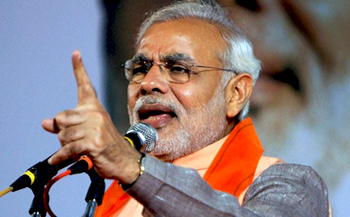
Dadri lynching and banning Pak singer regrettable; but don’t blame us: Modi

October 14, 2015

New Delhi, Oct 14: Prime Minister Narendra Modi, in an interview to Kolkata-based Bangla language newspaper Anand Bazaar Patrika, termed the Dadri incident ‘dukhad’ (unfortunate) and questioned the logic behind blaming the Central government for the incident.

modiHe said the Dadri incident and the banning of Pakistani singer Ghulam Ali's concerts were regrettable, but asked if it “is it fair to blame the Centre?”

Mohammad Akhlaq was beaten to death by a mob which suspected him of having stored and consumed beef. Several members of the BJP are among the suspects in the case.

‘Always practiced secularism’

The Prime Minister said that the "BJP had always practiced secularism in any situation where there have been differences; the party has never supported anyone involved in such incidents."

He took on the Opposition too, saying that by accusing the BJP of communalism and polarising communities, "isn’t the Opposition itself guilty of polarising the atmosphere?"

Comments

Steven
 - 
Tuesday, 12 Apr 2016

You specified, \Material products offer us a short-term happiness sugar high\"We must remember that if one continues to take pleasure in the brief sugar highs,
one will end up with DiaBETes.If you re-arrange the letters
a little you wind up in financial obligation (time
debt, monetary debt and relationship financial obligation).
LikeLike

My homepage law group: http://www.google.com"

Florene
 - 
Monday, 28 Mar 2016

Hi my friend! I wish to say that this post is amazing, great written and come with approximately all significant
infos. I would like to see extra posts like this .

Feel free to visit my web blog; century 21 real estate: http://www.google.com

Add new comment

  • Coastaldigest.com reserves the right to delete or block any comments.
  • Coastaldigset.com is not responsible for its readers’ comments.
  • Comments that are abusive, incendiary or irrelevant are strictly prohibited.
  • Please use a genuine email ID and provide your name to avoid reject.
News Network
February 19,2020

New Delhi, Feb 19: India will switch to the world's cleanest petrol and diesel from April 1 as it leapfrogs straight to Euro-VI emission compliant fuels from Euro-IV grades now - a feat achieved in just three years and not seen in any of the large economies around the globe.

India will join the select league of nations using petrol and diesel containing just 10 parts per million of sulphur as it looks to cut vehicular emissions that are said to be one of the reasons for the choking pollution in major cities.

Sanjiv Singh, Chairman of Indian Oil Corp (IOC) - the firm that controls roughly half of the country's fuel market, said almost all refineries began producing ultra-low sulphur BS-VI (equivalent to Euro-VI grade) petrol and diesel by the end of 2019 and oil companies have now undertaken the tedious task of replacing every drop of fuel in the country with the new one.

"We are absolutely on track for supplying BS-VI fuel from April 1. Almost all refineries have begun supplying BS-VI fuel and the same has reached storage depots across the country," he said.

From storage depots, the fuel has started travelling to petrol pumps and in the next few weeks all of them will only have BS-VI grade petrol and diesel, he said. "We are 100 per cent confident that fuel that will flow from nozzles at all the petrol pumps in the country on April 1 will be BS-VI emission compliant fuel."

India adopted Euro-III equivalent (or Bharat Stage-III) fuel with a sulphur content of 350 ppm in 2010 and then took seven years to move to BS-IV that had a sulphur content of 50 ppm. From BS-IV to BS-VI it took just three years.

"It was a conscious decision to leapfrog to BS-VI as first upgrading to BS-V and then shifting to BS-VI would have prolonged the journey to 4 to 6 years. Besides, oil refineries, as well as automobile manufacturers, would have had to make investments twice - first to producing BS-V grade fuel and engines and then BS-VI ones," he said.

State-owned oil refineries spent about Rs 35,000 crore to upgrade plants that could produce ultra-low sulphur fuel. This investment is on top of Rs 60,000 crore they spent on refinery upgrades in the previous switchovers.

BS-VI has a sulphur content of just 10 ppm and emission standards are as good as CNG.

Originally, Delhi and its adjoining towns were to have BS-VI fuel supplies by April 2019 and the rest of the country was to get same supplies from April 2020.

But oil marketing companies switched over to supply of BS-VI grade fuels in the national capital territory of Delhi on April 1, 2018.

The supply of BS-VI fuels was further extended to four contiguous districts of Rajasthan and eight of Uttar Pradesh in the National Capital Region (NCR) on April 1, 2019, together with the city of Agra.

BS-VI grade fuels were made available in 7 districts of Haryana from October 1, 2019.

Singh said the new fuel will result in a reduction in NOx in BS-VI compliant vehicles by 25 per cent in petrol cars and by 70 per cent in diesel cars.

The switchover, he said, is a tedious task as every drop of old, higher-sulphur content fuel has to be flushed out in depots, pipelines and tanks before being replaced by BS-VI.

"We are confident of disruption-free switchover to BS-VI supplies across the country," he said. "What we will be supplying is the best quality available anywhere in the world. You don't have any better fuel that is supplied in any part of the world. Perhaps our BS-VI fuel will be better than equivalent fuel in some parts of the US and Europe."

India adopted a fuel upgradation programme in the early 1990s. Low lead gasoline (petrol) was introduced in 1994 in Delhi, Mumbai, Kolkata and Chennai. On February 1, 2000, unleaded gasoline was mandated nationwide.

Similarly, BS-2000 (Euro-I equivalent, BS-1) vehicle emission norms were introduced for new vehicles from April 2000. BS-II (Euro-II equivalent) emission norms for new cars were introduced in Delhi from 2000 and extended to the other metro cities in 2001.

Benzene limits have been reduced progressively from 5 per cent in 2000 to 1 per cent nationwide. Lead content in gasoline was removed in phases and only unleaded gasoline is being produced and sold from February 1, 2000.

The octane number of gasoline signifies the improved performance of the engine. Loss in octane number due to phasing out of lead was made up by installing new facilities in the refinery and changes in refinery operation. RON (Research Octane Number) of gasoline for BS-2000 spec was increased to 88. This has over time been increased to 91.

Singh said sulphur reduction will reduce Particulate Matter (PM) emissions even in the in-use older generation diesel vehicles.


Comments

Add new comment

  • Coastaldigest.com reserves the right to delete or block any comments.
  • Coastaldigset.com is not responsible for its readers’ comments.
  • Comments that are abusive, incendiary or irrelevant are strictly prohibited.
  • Please use a genuine email ID and provide your name to avoid reject.
News Network
January 2,2020

Kolkata, Jan 2: In what could spark fresh tensions between West Bengal Chief Minister Mamata Banerjee and the BJP-led centre, the Union Ministry of Defence on Wednesday rejected her state's tableau proposal for the Republic Day parade on January 26.

"The tableau proposal of West Bengal government was examined by the expert committee in two rounds of meetings. The tableau proposal of the West Bengal government was not taken forward for further consideration by the committee after deliberations in the second meeting," the ministry said in its statement.

Twenty two proposals comprising 16 states and union territories and six ministries and departments have been shortlisted for the parade. The shortlist was compiled from as many as 56 tableau proposals - 32 from states and union territories and 24 from various ministries and departments - received by the central government.

"The expert committee examines the proposals on the basis of theme, concept, design and visual impact before making its recommendations. Due to time constraints arising out of the overall duration of the parade, only a limited number of tableaux can be shortlisted for participation in the parade," the statement read, adding that West Bengal was shortlisted for the 2019 Republic Day parade through a similar process.

"The rejection of the West Bengal tableau for the Republic Day parade is discriminatory. It has been done because West Bengal has been opposing the centre's CAA (Citizenship Amendment Act) and the NRC (National Register of Citizens) plans," Trinamool Congress MP Saugata Roy told news agency.

"West Bengal is known to be living state as far as culture, including arts, music and other things are concerned. So obviously, this is a discriminatory step taken by the central government against West Bengal," Mr Roy added.

The Trinamool Congress-led Bengal government is at loggerheads with the central government over several issues, and the expanding presence of the BJP in the eastern state ahead of the 2021 assembly elections has further intensified their rivalry.

Mamata Banerjee has repeatedly said that she will not allow Bengal to be a part of the proposed nationwide National Register of Citizens, an assertion that the BJP claims is proof of her minority appeasement strategy. Last month, a four-member delegation of Trinamool Congress politicians that visited BJP-ruled Uttar Pradesh to meet families of those killed in violent protests against the Citizenship Amendment Act were stopped by police personnel at the Lucknow airport.

The BJP leadership has now decided to launch a campaign blitzkrieg in West Bengal to counter what it claims is the Trinamool's "misinformation programmes" against the amended citizenship law and reach out to refugees. Protests across the country have currently put the party on the backfoot.

The Citizenship Amendment Act, for the first time, makes religion the test of citizenship in India. The government says it will help minorities from three Muslim-dominated countries get citizenship if they fled to India because of religious persecution before 2015. Critics say it is designed to discriminate against Muslims and violates the secular principals of the Constitution.

Brazilian President Jair Bolsonaro will be the chief guest at the Republic Day celebrations.

Comments

Add new comment

  • Coastaldigest.com reserves the right to delete or block any comments.
  • Coastaldigset.com is not responsible for its readers’ comments.
  • Comments that are abusive, incendiary or irrelevant are strictly prohibited.
  • Please use a genuine email ID and provide your name to avoid reject.
News Network
June 19,2020

Jun 19: Ten Indian Army soldiers including four officers were released by the China’s People’s Liberation Army (PLA) on Friday capping three days of hard negotiations that followed the bloody battle at the eastern Ladakh’s Galwan valley on Monday.

The 10 jawans returned around 5.30 PM on Friday to Patrol Point 14 (PP-14) after Indian team leader Major Gen. Abhijit Bapat, the commanding officer of the Third Div made it clear to the Chinese that there couldn’t be any progress in the disengagement talks unless the soldiers were returned safely.

Asked to comment on the release of Indian soldiers, the Indian Army maintained silence. The force released a brief statement on Thursday stating that all its men were accounted for.

However, the extent of the brutal clash can be gauged from the fact that 76 Indian Army soldiers are still in the hospital out of which 58 soldiers have “minor injuries” and “should be back on duty within a week”, according to Army sources.

Return of the Indian soldiers has been the main point of negotiations for the last two days. The situation is now calmer at areas near PP-14 in the Galwan valley after the return of Indian soldiers even though large numbers of troops from both sides are still present in the area.

Meanwhile analysis of satellite images has revealed a large presence of Chinese troops in the northern banks of Pangong Tso, a disputed territory for years.

“In the past month, Chinese forces have become an overwhelming majority in the disputed areas (on the north bank of the 135 km long lake). Significant positions have been constructed between Fingers 4 and 5, including around 500 structures, fortified trenches and a new boat shed over 20 km further forward than previously. More structures appear to be under construction,” says a report published in the Strategist, the journal of the Australian Strategic Policy Institute.

“The scale and provocative nature of these new Chinese outposts is hard to overstate: 53 different forward positions have been built, including 19 that sit exactly on the ridge line separating Indian and Chinese patrols,” says the report, accompanied by satellite images showing overwhelming PLA presence.

The June 6 Corps Commander level meeting between the Indian and PLA armies did not result in a solution to the contentious muscle flexing by the Chinese on the shores of the Pangong lake. The meeting ended with the conclusion that more Lt Gen level talks between the two armies were needed to resolve such issues.

Comments

Add new comment

  • Coastaldigest.com reserves the right to delete or block any comments.
  • Coastaldigset.com is not responsible for its readers’ comments.
  • Comments that are abusive, incendiary or irrelevant are strictly prohibited.
  • Please use a genuine email ID and provide your name to avoid reject.