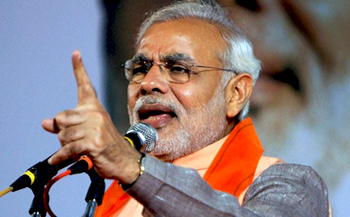
Dadri lynching and banning Pak singer regrettable; but don’t blame us: Modi

October 14, 2015

New Delhi, Oct 14: Prime Minister Narendra Modi, in an interview to Kolkata-based Bangla language newspaper Anand Bazaar Patrika, termed the Dadri incident ‘dukhad’ (unfortunate) and questioned the logic behind blaming the Central government for the incident.

modiHe said the Dadri incident and the banning of Pakistani singer Ghulam Ali's concerts were regrettable, but asked if it “is it fair to blame the Centre?”

Mohammad Akhlaq was beaten to death by a mob which suspected him of having stored and consumed beef. Several members of the BJP are among the suspects in the case.

‘Always practiced secularism’

The Prime Minister said that the "BJP had always practiced secularism in any situation where there have been differences; the party has never supported anyone involved in such incidents."

He took on the Opposition too, saying that by accusing the BJP of communalism and polarising communities, "isn’t the Opposition itself guilty of polarising the atmosphere?"

Comments

Steven
 - 
Tuesday, 12 Apr 2016

You specified, \Material products offer us a short-term happiness sugar high\"We must remember that if one continues to take pleasure in the brief sugar highs,
one will end up with DiaBETes.If you re-arrange the letters
a little you wind up in financial obligation (time
debt, monetary debt and relationship financial obligation).
LikeLike

My homepage law group: http://www.google.com"

Florene
 - 
Monday, 28 Mar 2016

Hi my friend! I wish to say that this post is amazing, great written and come with approximately all significant
infos. I would like to see extra posts like this .

Feel free to visit my web blog; century 21 real estate: http://www.google.com

Add new comment

  • Coastaldigest.com reserves the right to delete or block any comments.
  • Coastaldigset.com is not responsible for its readers’ comments.
  • Comments that are abusive, incendiary or irrelevant are strictly prohibited.
  • Please use a genuine email ID and provide your name to avoid reject.
Agencies
May 27,2020

Global health experts on Wednesday said novel coronavirus is here to stay for more than a year and called for aggressive testing to prevent its spread.

In an interaction with Congress leader Rahul Gandhi, health experts Professor Ashish Jha and Professor Johan Giesecke talked about the COVID-19 pandemic as part of the series being aired on Congress social media channels.

While Jha exuded confidence that a vaccine will be available in a year's time, Prof Giesecke said India should practice a lockdown that is as 'soft' as possible, as a severe lockdown will ruin its economy very quickly.

"When the economy is opened up after lockdown, you have to create confidence among people," Harvard health expert Ashish Jha told Gandhi.

Jha is a professor of Global Health at TH Chan School of Public Health and Director, Harvard Global Health institute.

He said coronavirus is a '12-18 months' problem and the world is not going to be free of this till 2021.

The expert also called for the need for aggressive testing strategy for high-risk areas.

Gandhi, while interacting with the experts, said life is going to change post COVID-19.

"If 9/11 was a new chapter, this will be a new book," he remarked.

Professor Johan Giesecke, former chief scientist, European Centre for Disease Prevention and Control said India should have a 'soft lockdown'.

"The situation that India is in, I think, you should have a soft lockdown, as soft as possible," he said.

"I think for India, you will ruin your economy very quickly if you have a severe lockdown. It is better, skip the lockdown, take care of the old and the frail...," he noted.

Comments

Add new comment

  • Coastaldigest.com reserves the right to delete or block any comments.
  • Coastaldigset.com is not responsible for its readers’ comments.
  • Comments that are abusive, incendiary or irrelevant are strictly prohibited.
  • Please use a genuine email ID and provide your name to avoid reject.
News Network
March 6,2020

New Delhi, Mar 6: As panicky depositors rushed to withdraw money from Yes Bank whose control was seized by the RBI in a dramatic late-night move, Finance Minister Nirmala Sitharaman on Friday assured depositors that their money is safe and said the central bank was working for an early resolution of the crisis.

The Reserve Bank of India (RBI) on Thursday evening capped withdrawals at Rs 50,000 for the next one month and imposed strict limits on operations at the country's fourth-largest private lender that faced "regular outflow of liquidity" after an effort to raise new capital failed.

"I am in continuous interaction with the RBI. The RBI is fully seized of the matter and has assured they will give a quick resolution," Sitharaman said here.

She said no depositor will lose his or her money and insisted that the immediate priority is to ensure Yes Bank customers are able to withdraw money within the stipulated cap.

"I want to assure every depositor that their money shall be safe. Their monies are safe," she said. "I am constantly in contact with the RBI and the steps that are taken are taken in the interest of depositors, banks and economy. We are fully seized of the development."

She was talking to reporters after meeting State Bank of India (SBI) Chairman Rajnish Kumar. On Thursday, the SBI board gave its "in-principle" approval to exploring investment opportunities in Yes Bank.

"So I repeat, the depositors can be assured that their money is safe," she said.

Soon after the RBI takeover, depositors thronged Yes Bank ATMs to withdraw money and police had to be deployed in some places to control the crowds.

Yes Bank has 1,000 branches across the country.

Refusing to elaborate on her meeting with the SBI chairman, the minister said that "was on a completely different matter".

"RBI governor has given me assurance that there will be an appropriate resolution soon. No depositor will lose (money)," she said. "Reserve Bank has taken cognizance of the problem."

The central bank, she said, has gone through the "process over and over again to find out an amicable solution".

"And that has been over the last couple of months. So it is not as if they have come in suddenly now. We have been monitoring the situation," she said adding the RBI has appointed an administrator who previously was with the SBI.

"Both the RBI and the government are looking at this with all the details before them, not just today. I have personally monitored the situation over the last couple of months with the RBI. Therefore we have taken a course which will be in everybody's interest," she added.

Yes Bank had been seeking new capital since last year to bolster its ratios and quell questions about its stability due to its exposure to the non-banking finance industry entangled in a prolonged crunch in the local credit market.

The SBI chairman said the resolution to the Yes Bank crisis will come "very shortly".

"This is not a sectoral problem. It is a bank-specific problem," he said. "The RBI will take all steps to ensure financial stability."

On SBI picking up a stake in Yes Bank, he said the lender already has an in-principle approval for doing so.

"If SBI has to pick up a stake in Yes Bank, we have an in-principle approval for that," he said.

Commenting on the crisis at Yes Bank, Alka Anbarasu, Vice President – Senior Credit Officer, Financial Institutions, Moody's Investors Service, said: "RBI's moratorium on Yes Bank is credit negative as it affects timely repayment of bank depositors and creditors."

"While Moody's expects Indian authorities will take steps to prevent the weakness in the bank's viability from significantly impacting its depositors and senior creditors, the lack of a coordinated and timely action highlights continued uncertainty around bank resolutions in India," she said.

Comments

Add new comment

  • Coastaldigest.com reserves the right to delete or block any comments.
  • Coastaldigset.com is not responsible for its readers’ comments.
  • Comments that are abusive, incendiary or irrelevant are strictly prohibited.
  • Please use a genuine email ID and provide your name to avoid reject.
Agencies
March 22,2020

New Delhi, Mar 22: The exercise to update the National Population Register (NPR) and the first phase of the Census 2021, scheduled to begin from April 1, are likely to be deferred for an indefinite period due to Coronavirus pandemic, officials said.

A formal order on this effect is expected within a day or two.

Discussions are going on at the highest level of the government and in all probability, the NPR and house listing phase of the Census work will be deferred till the threat of the Coronavirus is over, a home ministry official said.

The exercise to update NPR and the housing listing phase of the Census is scheduled to be carried out across the country from April 1 to September 30.

Last week, the home ministry had said the preparation for the Census 2021 and updation of the NPR were at its peak and they will begin from April 1.

The ministry said this after a conference of the Directors of the Census Operations on status of preparatory work around Census 2021 and NPR updation.

There has been opposition from several state governments to the NPR and some of the assemblies even adopted resolutions expressing reservations on the exercise.

The states which have been opposing the NPR include Kerala, West Bengal, Punjab, Rajasthan, Chhattisgarh and Bihar.

However, most of them also said they will cooperate with the house listing phase of the Census.

The objective of the NPR is to create a comprehensive identity database of every usual resident in the country.

The database would contain demographic as well as biometric particulars, they said.

The notification for the house listing census and NPR exercise came recently amid furore over the contentious Citizenship Amendment Act (CAA).

The home ministry officials said most of the states have notified provisions related to the NPR.

The NPR is a register of usual residents of the country. It is being prepared at the local (village/sub-town), subdistrict, district, state and national levels under provisions of the Citizenship Act, 1955 and the Citizenship (Registration of Citizens and Issue of National Identity Cards) Rules, 2003.

The data for NPR was last collected in 2010 along with the house listing phase of the Census 2011. Updating of this data was done during 2015 by conducting door to door survey.

While updating the register in 2015, the government has asked details like Aadhaar and their mobile number.

This time, the information related to their driving licence and voter ID card may also be gathered, the officials said, adding that PAN card details will not be collected as part of this exercise.

Though information regarding the place of birth of parents will be sought, it is up to the residents whether to respond the question as it is voluntary.

For the purposes of the NPR, a 'resident' is defined as a person who has lived in a local area for the past six months or more, or a person who intends to reside in that area for the next six months.

The law compulsorily seeks to register every citizen of India and issue a national identity card.

The demographic details of every individual are required for every usual resident: name, relationship to head of household, father's name, mother's name, spouse's name (if married), sex, date of birth, marital status, place of birth, nationality (as declared), present address of usual residence, duration of stay at present address, permanent residential address, occupation, educational qualification.

The Union Cabinet has approved Rs 3,941.35 crore for the NPR exercise.

Comments

Add new comment

  • Coastaldigest.com reserves the right to delete or block any comments.
  • Coastaldigset.com is not responsible for its readers’ comments.
  • Comments that are abusive, incendiary or irrelevant are strictly prohibited.
  • Please use a genuine email ID and provide your name to avoid reject.